Building a Self-Running Business: Myth or Reality?
The 'self-running business' that Tim Ferriss described and every founder aspires to is simultaneously a myth and a real achievable state depending entirely on what you mean by 'self-running.' Here is an honest account of what is actually possible, what it requires to get there, and what the founder's role becomes in a business that runs itself.
Aditya Sharma
Author

The idea of a self-running business one that generates revenue, manages operations, and grows without requiring the founder's daily involvement is the aspiration underlying most of the productivity literature aimed at entrepreneurs. Tim Ferriss described a version of it in The 4-Hour Workweek. Countless business coaches sell frameworks for achieving it. The founders who have actually built to meaningful scale have a more nuanced view: the self-running business, in the absolute sense that the founder can disappear for months and return to find the business healthier than when they left, is a myth for any organisation that is genuinely trying to grow. But the self-running operations layer where the monitoring, the coordination, the reporting, the exception management, and the routine decision-making all happen without the founder's direct involvement is absolutely real, achievable, and transformative when it is built correctly. The distinction matters because conflating the myth with the achievable state produces either unrealistic expectations that lead to disappointment, or the rejection of the entire concept that leaves founders trapped in operational management indefinitely.
What 'Self-Running' Can and Cannot Mean
The business processes that can genuinely self-run that can operate at high quality indefinitely without the founder's direct involvement are the processes that are definable, measurable, rule-applicable, and exception-bounded. The daily inventory monitoring that fires a reorder alert when any SKU crosses the threshold and generates a draft purchase order for one-click approval. The settlement reconciliation that runs nightly, flags discrepancies above the tolerance threshold, and queues the dispute package for human review. The post-purchase WhatsApp communication sequence that triggers automatically at each order status milestone without any human action. The performance marketing pause rules that deactivate campaigns above the CAC threshold and notify the growth lead for review. The NDR-to-campaign coordination loop that adjusts geo-targeting within 24 hours of a structural NDR threshold crossing. These are all genuinely self-running once built and calibrated, they operate continuously, correctly, and without founder involvement.The business processes that cannot genuinely self-run are the ones that require judgment, creativity, or relationship intelligence that is specific to the founder and cannot be encoded in a rule. Setting the three-year strategic direction. Deciding which new products to launch and when. Building the trust relationship with key investors, distribution partners, or institutional customers. Making the call on a major supplier negotiation where the right answer depends on reading the relationship dynamics in the room. Developing the next generation of team leads who will run the business at the next scale. Navigating the ethical or reputational decisions that arise when the business is challenged in ways that rules cannot anticipate. These are the processes that require the founder and these are the processes that the self-running operational layer frees the founder to focus on.
The Four Stages of Building a Self-Running Operations Layer
Stage 1: Data infrastructure (Months 12)
Build the data connections that make every key operational metric visible in real time without human assembly. The five data streams described in the data architecture article commercial, acquisition, inventory, financial, fulfilment connected and updating automatically. This is the foundation on which everything else rests. A self-running operations layer built on manual data is not self-running it is a layer that self-runs until someone forgets to update the spreadsheet.
Stage 2: Process automation (Months 24)
Automate the specific processes that currently require human action for routine execution. The post-purchase communication sequence. The inventory reorder alert generation. The settlement reconciliation. The performance marketing threshold monitoring. Each automation is built on the data infrastructure of stage 1 the process is automated because the data is current, structured, and accessible to the automation logic. The automation removes the human labour requirement for the routine execution of each process while preserving human review for exceptions that require judgment.
Stage 3: Exception management architecture (Months 35)
Design the exception handling framework that determines which exceptions the system manages autonomously, which are routed to specific team members, and which require founder involvement. Not every exception requires the founder. The customer service escalation above a specific order value threshold goes to the customer experience lead. The NDR spike in a specific geography goes to the operations lead, who also notifies the marketing lead. The settlement discrepancy above ₹50,000 goes to the finance lead with the dispute package. The founder receives only the exceptions that require their specific judgment the supplier relationship dispute, the major campaign strategy decision, the team leadership issue that no framework can resolve.
Stage 4: Team intelligence (Months 48)
The self-running business requires not just automated processes but capable people who can manage the exception layer without founder involvement. This stage is about building the team members who own each operational domain into people who can exercise sound judgment within the frameworks established in the prior stages and who have the visibility, the authority, and the accountability to make decisions in their domains without escalating everything to the founder. The team intelligence stage is where the self-running operations layer becomes durable rather than fragile because it no longer depends solely on automated systems but on a capable team operating within those systems.
What the Founder Does When Operations Run Themselves
The founder of a business with a self-running operations layer does not work a four-hour week. They work the same number of hours or more on a fundamentally different type of work. Instead of managing the daily operational exceptions that consume the majority of current founder time, they are investing in the decisions and relationships that will determine the business's trajectory over the next three to five years. The product development direction that will open a new category. The distribution partnership that will expand from five cities to fifty. The team hire that will build the capability the business needs for the next scale. The brand strategy that will determine how the business is positioned against the competitors who are catching up.The transformation from operational manager to strategic leader is not an entitlement that comes automatically when the operations layer is built. It is a choice that the founder has to make deliberately to stop filling the reclaimed time with more operational involvement and to start filling it with the strategic work that genuinely requires the founder's unique perspective, relationships, and judgment. The self-running business is not the goal. It is the infrastructure. The goal is what the founder does with the freedom that infrastructure creates.
The Self-Running Business Readiness Checklist
| Capability | Not Self-Running | Partially Self-Running | Fully Self-Running |
|---|---|---|---|
| Daily operations brief | Founder assembles manually each morning | Team member compiles and sends | Auto-generated from live data, delivered by 8am |
| Inventory reorder management | Founder checks and decides daily | Operations lead checks, founder approves | Alert fires automatically, purchase order queued for one-click approval |
| Settlement reconciliation | Monthly manual review, incomplete coverage | Weekly semi-automated review | Nightly automated reconciliation, discrepancy alerts, pre-assembled dispute packages |
| Campaign performance management | Founder reviews and adjusts campaigns daily | Marketing lead manages within guidelines | Threshold rules auto-pause; growth lead manages within CAC framework |
| Customer service escalations | All escalations reach founder | First-tier handled by CS lead, above threshold to founder | Framework handles 80%+ autonomously; genuine exceptions to CS lead |
| Supplier and procurement management | Founder manages all supplier relationships | Operations lead handles routine, founder handles strategic | Operations lead fully owns procurement; founder involved in contract-level decisions only |

Related articles
View all →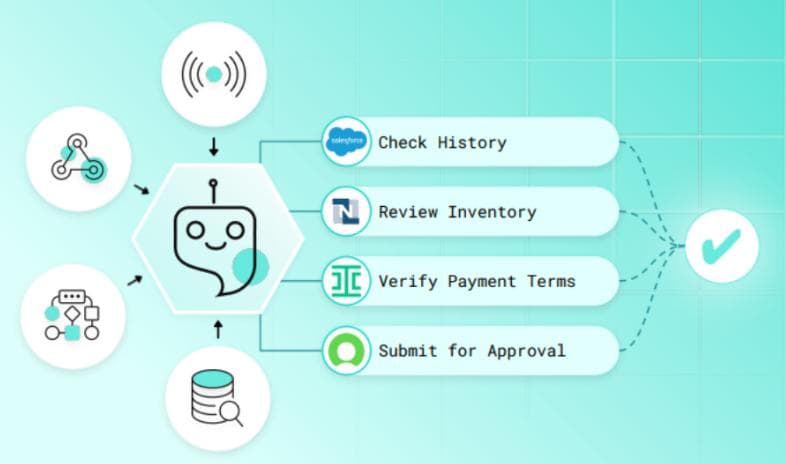 AI Execution
Why AI Execution Systems Will Define the Future of Enterprise Operations
The next frontier of enterprise competitive advantage is not strategy it is execution. AI execution systems that translate strategic intent into coordinated operational action, faster and more reliably than any human-managed process, are becoming the defining infrastructure of enterprise performance in every sector.
 Autonomous Coordination
The Rise of Autonomous Enterprise Coordination Platforms
Enterprise coordination the alignment of people, processes, information, and resources across organisational boundaries has always been expensive, slow, and error-prone when managed through human intermediaries alone. Autonomous coordination platforms powered by AI are replacing the coordination overhead of large organisations with intelligent systems that synchronise the enterprise continuously and without manual intervention.
 AI Agents
How AI Agents Are Transforming Enterprise Workflow Intelligence
AI agents autonomous systems that perceive their environment, reason about objectives, and take action across enterprise workflows are moving from research concept to operational reality. The enterprises deploying AI agents at scale are discovering that workflow intelligence is not just about automation it is about creating organisational capability that compounds with every cycle.