How Stockouts Damage More Than Just Sales
The ₹2 lakh in lost revenue during the stockout week is the smallest cost. The marketplace ranking that takes six weeks to recover, the customer who tried to buy and went to a competitor, and the CAC spent on traffic that could not convert these are the costs that compound long after the inventory is replenished.
Nirmal Nambiar
Author
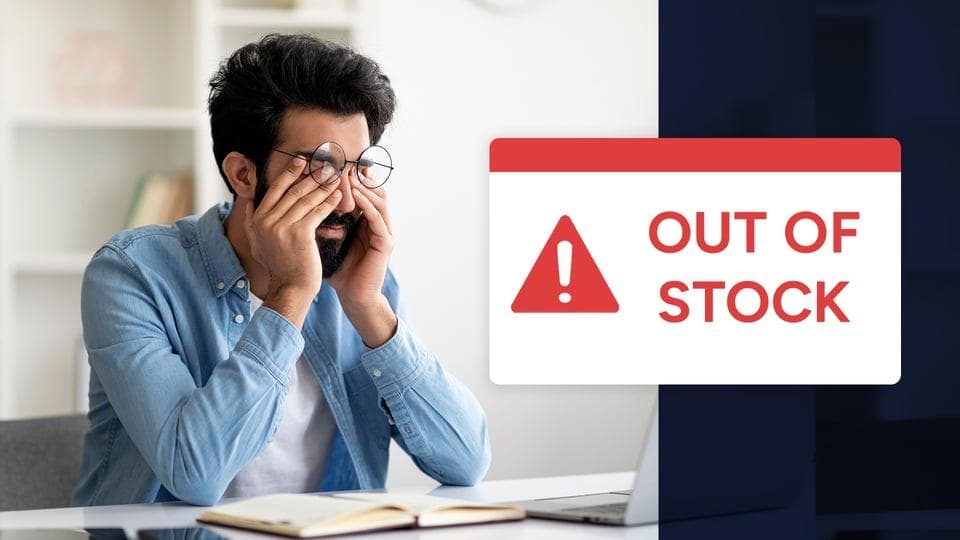
A stockout feels like a temporary operational problem the product runs out, the team scrambles to reorder, and within two to three weeks the inventory is replenished and the product is back on sale. The founder marks the incident as resolved and moves on. What does not resolve in two to three weeks is the downstream damage that the stockout created during its duration damage that accumulates silently in marketplace algorithm scores, customer acquisition efficiency, competitor awareness, and customer retention probability. Understanding the full cost of a stockout event, including all its second-order effects, is the analytical foundation for investing appropriately in the demand planning and inventory management systems that prevent it.
The Five Stockout Damage Channels Beyond Direct Revenue Loss
Channel 1: Marketplace algorithm ranking damage
Amazon, Flipkart, and Myntra algorithms factor inventory availability into organic search ranking. A product that goes out of stock marked as unavailable, or with a long delivery estimate driven by low inventory receives negative signals that reduce its position in search results. The algorithm's logic is customer-centric: a product that cannot be delivered promptly or at all is not a good recommendation, regardless of its review score or historical conversion. The ranking damage typically persists for 3 to 6 weeks after stock replenishment the algorithm needs to observe consistent availability signals before restoring the prior ranking. For a product generating ₹4 lakh monthly revenue primarily from organic search, a 25% ranking-driven visibility reduction for 5 weeks represents ₹1.25 lakh in post-recovery suppression revenue, in addition to the direct stockout loss.
Channel 2: CAC waste on unconvertible traffic
Marketing spend paid search, paid social, influencer campaigns continues to drive traffic to the product page during a stockout. That traffic arrives at an out-of-stock page and cannot convert. Every rupee of marketing spend that drove this traffic is wasted acquisition cost. At ₹8,000 daily paid marketing spend on a SKU that is out of stock for 10 days, the wasted acquisition spend is ₹80,000 in addition to the lost revenue from the customers those clicks could have acquired.
Channel 3: Competitor customer acquisition
A customer who arrives at an out-of-stock page does not simply leave and wait. They typically search for an alternative and find a competitor's product. If the competitor's product meets their need, they purchase, experience the competitor's brand, and may not return to the original brand even after the stock is replenished because they have already solved their problem with a brand that was available when they needed it. The customer acquisition cost the original brand spent to bring this customer to the page has been converted into a competitor acquisition the worst possible outcome.
Channel 4: Review and social proof gap
Products with consistent sales velocity accumulate reviews at a consistent rate. A 10-day stockout produces a 10-day gap in review accumulation not just the lost sales during the stockout, but the lost reviews that would have moved the product's total review count and rating toward the threshold at which organic visibility improves. For new products building toward the review thresholds that unlock better marketplace visibility (typically 50, 100, and 500 verified reviews for different marketplace visibility tiers), a stockout is not just a revenue setback it is a delayed milestone in the product's organic growth trajectory.
Channel 5: First-time customer retention loss
A first-time customer who arrives at the product page through a recommendation, a review, or organic search, finds the product out of stock, and makes a mental note to check back later has a significantly lower conversion probability than if the product had been available. Research on consumer return-visit behaviour for out-of-stock products finds that fewer than 20% of customers who encounter an out-of-stock message on a first visit actually return to purchase when stock is replenished. The 80% who do not return have been permanently lost as potential customers from an acquisition event the brand has already paid for.
The Full Stockout Cost Calculation
For a top-performing SKU generating ₹4 lakh monthly revenue (₹133,000 weekly) experiencing a 10-day stockout: direct revenue loss ₹1.9 lakh (at daily velocity). Marketing spend wasted on unconvertible traffic ₹56,000 (₹8,000 daily spend for 7 business days). Post-recovery ranking suppression ₹1.25 lakh (25% visibility reduction for 5 weeks). Lost customer lifetime value from customers acquired by competitors during the stockout period: assuming 40 customers redirected to competitors per day at ₹2,400 LTV each, and assuming 70% of them do not return: 40 × 10 × 0.70 × ₹2,400 = ₹6.72 lakh. Total stockout cost: approximately ₹9.9 lakh for a 10-day stockout on a ₹4 lakh monthly revenue SKU. This is the number that justifies investment in a real-time inventory monitoring system because the system cost is a fraction of a single stockout event's true cost.

Building SOPs That Actually Get Followed
Related articles
View all → Growth
The Future of Enterprise Growth Through AI Innovation
AI is not just improving the efficiency of existing growth strategies it is enabling entirely new growth models. The enterprises that understand how to use AI as a growth driver, not just a cost reducer, are accessing markets, customer segments, and revenue streams that were previously out of reach.
 AI
AIThe Future of AI-Powered Digital Marketplaces
Digital marketplaces are evolving from transactional platforms into intelligent commerce ecosystems. AI is reshaping how buyers discover products, how sellers manage operations, and how platforms create value for everyone in the ecosystem and the pace of this transformation is accelerating.
 Customer Support
How AI Can Transform Enterprise Customer Support Systems
Customer support is one of the highest-cost, highest-impact functions in a growing enterprise. AI is transforming it from a cost centre with linear scaling constraints into an intelligent service layer that delivers better customer outcomes at a fraction of the traditional cost per interaction.