Feature
AI Agent without APIs
Direct data access. Grounded intelligence. Consumer hardware.
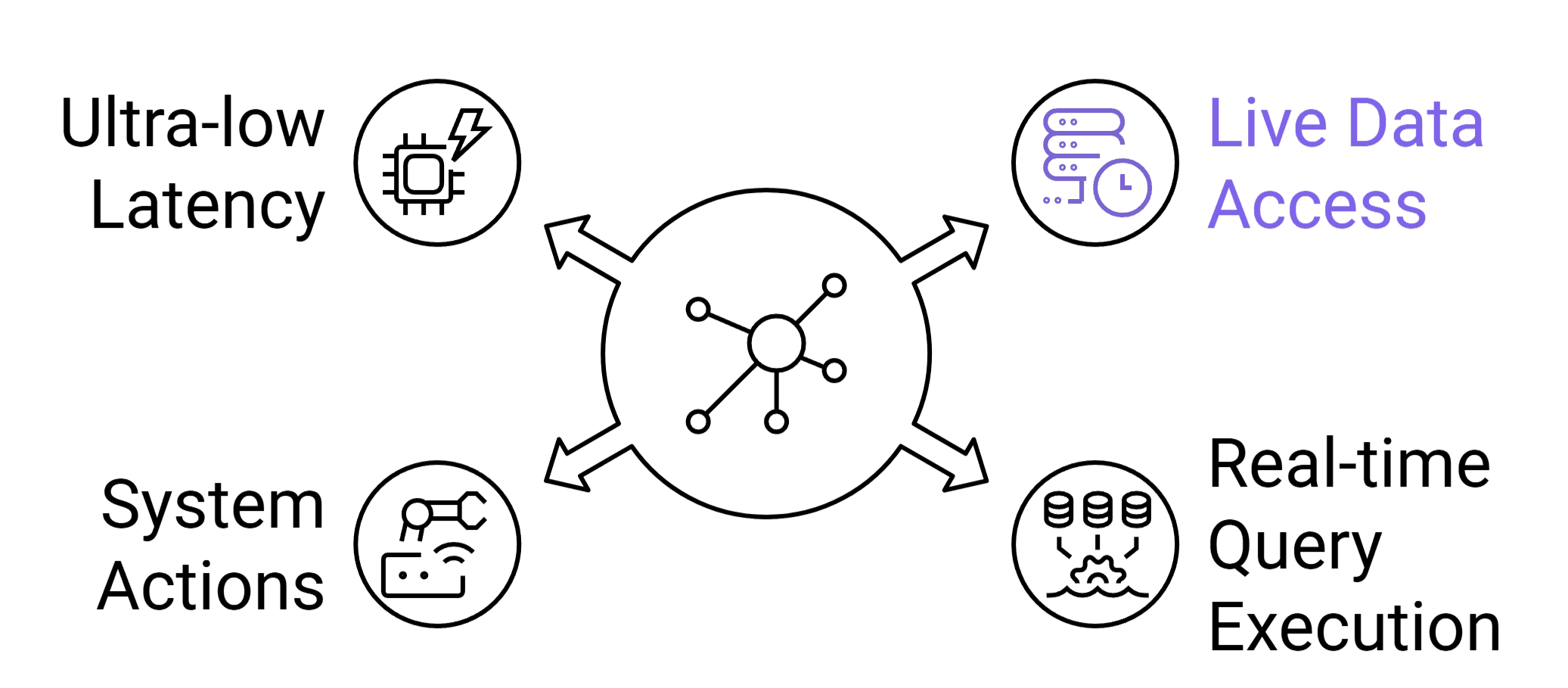
Powered by our proprietary Agentic Data Architecture (ADA), SuperManager AGI agents connect directly to company databases and systems instead of relying on APIs, middleware, or document-based retrieval. This allows agents to access live operational data, execute queries in real time, and perform actions across systems with ultra-low latency.
2–15 ms
Query latency (vs. 200–500 ms APIs)
4.2%
Hallucination rate (vs. 22.4% RAG)
0
GPU requirement for deployment
5×
Improvement in data accuracy
Overview
The ADA (Agentic Data Architecture) Integration Layer is the core technical infrastructure that makes SuperManager AGI's data capabilities fundamentally different from every other enterprise AI platform. While competitors build on top of existing API layers inheriting their latency, rate limits, and data staleness ADA establishes direct, permissioned connections to your actual databases and data systems.
This architectural choice has cascading benefits. Latency drops by an order of magnitude: 2–15ms vs 200–500ms for API-based retrieval. Rate limits disappear no more throttled queries or queued requests during peak hours. Data freshness goes from eventual consistency to real-time you're always querying the live state of your systems, not a cached export.
But the most important benefit is epistemic: because agents retrieve actual data rather than relying on semantic search over summaries, hallucination rates drop dramatically from 22.4% (measured in standard RAG systems on enterprise benchmarks) to 4.2% in ADA-powered agents. When your AI system tells you there are 847 units of SKU-4421 in warehouse B, that number came from a direct database query not an inference from a document chunk.
ADA is also designed for deployment accessibility: peer-reviewed architecture that runs on consumer-grade hardware without requiring GPUs. Enterprise AI capability without enterprise infrastructure cost.
Benefits
Direct Database Access
ADA bypasses API layers entirely connecting to databases directly with read-only, permissioned access. Query latency drops to 2–15ms, and you're always reading live data.
Evidence-Grounded Reasoning
Agent outputs are constructed from retrieved database records, not LLM inference. Every data point in an answer traces back to a specific row or document in your systems.
5x Hallucination Reduction
By grounding outputs in retrieved evidence rather than semantic approximation, ADA reduces hallucination rates from 22.4% to 4.2% measured on standardized enterprise benchmarks.
No API Rate Limits
Direct database connections don't have rate limits. Run complex multi-source queries continuously without throttling, queuing, or degraded performance during high-traffic periods.
GPU-Free Deployment
ADA's architecture is optimized to run on consumer hardware. No specialized GPU infrastructure is required dramatically reducing deployment cost and operational complexity.
Use Cases
Data Engineering Team
Replace slow API-based data pipelines with ADA direct connections for real-time analytics.
Query latency for operational analytics drops from 340ms (API average) to 9ms (ADA direct). Dashboard refresh rates increase from 5-minute intervals to real-time. Data pipeline maintenance overhead eliminated.
Enterprise Architect
Deploy SuperManager AGI on-premise without GPU infrastructure.
ADA runs on standard server hardware no NVIDIA cards, no cloud GPU instances. Full AI agent capability deployed within the organization's existing infrastructure budget.
Compliance Officer
Audit AI decision-making with full data provenance for every agent output.
Every agent response includes a provenance record: the exact database query executed, the records retrieved, and how the output was constructed. Regulators can verify exactly what data drove each AI decision.
How It Works
Step 1
Secure Connection Establishment
ADA establishes encrypted, read-only connections to your databases using minimal-privilege service accounts. Connection configuration is reviewed and approved by your DBA team before activation.
Step 2
Schema Intelligence
ADA indexes the connected database schemas tables, columns, types, relationships, and indexing building a semantic model that allows agents to construct accurate queries from natural language.
Step 3
Query Generation & Validation
When an agent needs data, ADA generates the appropriate query (SQL, NoSQL, or graph), validates it against the schema and permission scope, and executes it rejecting any query that exceeds defined access boundaries.
Step 4
Evidence Packaging
Query results are packaged as structured evidence objects with source table, column, row identifiers, and retrieval timestamp. Agents use this evidence directly rather than re-interpreting raw results.
Step 5
Grounded Output Construction
Agent responses are built strictly from evidence objects. The LLM layer formats and explains; it does not infer or supplement. Provenance is attached to every output for full traceability.
FAQ
What databases does ADA support for direct connection?
PostgreSQL, MySQL, MariaDB, MongoDB, Snowflake, BigQuery, Amazon Redshift, DynamoDB, Elasticsearch, and Microsoft SQL Server are natively supported. Oracle and SAP HANA support is in beta. Custom connectors are available for other systems.
How is the peer-review of ADA's architecture conducted?
ADA's core architecture paper has been submitted for external peer review by independent researchers in the database systems and AI reliability fields. The benchmark methodology, hallucination measurement framework, and latency test conditions are published and reproducible.
Does 'consumer hardware' mean I can run this on a laptop?
ADA is optimized to run on standard server hardware without GPU acceleration an 8-core CPU and 32GB RAM is sufficient for most deployments. For very large enterprises with high query volumes, we recommend a dedicated server. Laptop deployment is possible for development and testing.