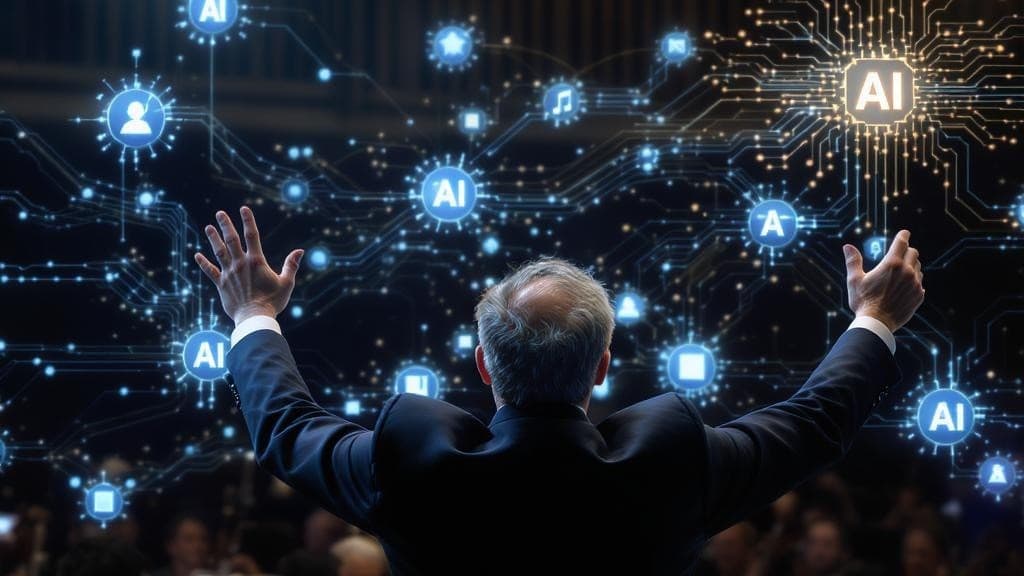
The idea of AI systems performing genuine management work not just supporting human managers with better data and tools, but actively coordinating teams, making operational decisions, and guiding the execution of complex projects seemed like science fiction as recently as five years ago. The management functions that organizations depend on for their day-to-day operation appeared to require the kind of contextual understanding, judgment, and adaptive reasoning that only human intelligence could provide. The rapid development of advanced AI and emerging AGI technologies has dramatically changed this picture. Today, intelligent systems are performing real management functions coordinating workflows across teams, allocating resources dynamically, detecting risks before they materialize, and generating decision support that helps human leaders make better choices faster. Rather than replacing humans entirely, the most successful organizational deployments are focusing on a new kind of collaboration between human leaders and AI-powered management platforms one that combines the distinctive strengths of each in ways that create management capability greater than either could achieve alone.
From Tools to Intelligent Managers
The evolution of AI in organizational contexts has followed a clear and accelerating trajectory from narrowly capable tools that assisted humans with specific, well-defined tasks, to broadly capable systems that can exercise genuine judgment across the full complexity of real management situations. Early AI tools in organizational contexts were primarily data analysis and reporting tools: they could process operational data faster than humans, identify statistical patterns in performance metrics, and generate visualizations that made complex information more accessible. Valuable, but fundamentally passive the human manager still needed to interpret the analysis, make the decisions, and execute the coordination. The AI system was a more sophisticated version of the spreadsheet, not a management partner.
Modern AI systems represent a qualitatively different level of capability they are increasingly able to coordinate workflows across connected tools without human instruction, track the health of complex multi-team projects with comprehensive real-time awareness that no human coordinator could match, and generate specific recommendations for operational decisions that are sophisticated enough to be acted on directly rather than just used as background information. The shift from passive analysis to active coordination is what makes current AI systems genuine management tools rather than management support tools and this shift has happened with remarkable speed as the underlying AI capabilities have advanced.
This capability evolution is transforming AI from a support tool into a genuine management partner one that handles a growing range of operational coordination and analytical functions that previously required dedicated human management capacity. The implication for organizational design is profound: the coordination rationale for certain management roles is weakening as AI systems become capable of performing those coordination functions more consistently, more comprehensively, and at greater scale than human coordinators. The management roles that remain most clearly valuable are those centered on the human leadership functions the coaching, the culture-building, the strategic direction, the complex judgment that AI systems cannot yet replicate.
How AGI Systems Support Management
AGI platforms support management by providing a continuously updated operational intelligence layer that gives human managers access to comprehensive, current, and contextually interpreted information about every aspect of the work they are responsible for. Rather than requiring managers to gather information manually from multiple tools and synthesize it into a coherent operational picture a process that consumes enormous amounts of management time and consistently produces an incomplete and partially outdated view AGI systems maintain this operational picture automatically, drawing on data from every connected tool in the organization's technology ecosystem and processing it into clear, actionable intelligence.
They help allocate tasks to the most appropriate team members by maintaining a continuously updated model of each individual's current workload, demonstrated expertise across different types of work, availability constraints, and developmental goals and applying this model to produce assignment recommendations that are better matched to individual capabilities and circumstances than manual assignment processes typically achieve. They monitor project progress and team productivity with a granularity and consistency that is not achievable through periodic human review, detecting deviations from plan at the earliest possible stage and surfacing them with enough lead time for meaningful intervention. They identify and track risks across multiple concurrent projects simultaneously, correlating signals from diverse data sources to recognize risk patterns that would be invisible in any individual data stream.
By automating these coordination and analytical functions, AGI systems allow the humans in management roles to focus their time and attention on the dimensions of management that require genuine human judgment, creativity, and relational intelligence the mentoring conversations that develop people's capabilities, the cultural leadership that defines how teams experience their work, the strategic judgment calls that determine organizational direction, and the complex interpersonal navigation that defines leadership in any human organization. The human manager supported by AGI is not doing less management they are doing more of the management that matters most.
Human–AI Collaboration
The management models that are producing the most compelling results in organizations that have deployed AGI systems are not those that have pushed most aggressively toward AI autonomy, but those that have developed the most thoughtful and effective frameworks for combining human leadership with AI operational capability. The key insight that has emerged from the most successful deployments is that human and AI management capabilities are genuinely complementary they are strong in different domains, and the combination produces results that neither could achieve alone. Designing the collaboration well means understanding clearly which decisions and functions belong to the AI system, which belong to the human leader, and how the interface between them should work to maximize the distinctive contribution of each.
AI systems provide the analytical intelligence and operational coordination that makes organizational management at scale possible the continuous monitoring, the comprehensive data synthesis, the pattern recognition across large datasets, and the tireless execution of coordination workflows that would otherwise consume the majority of human management time. These are the functions where AI's advantages in processing speed, analytical breadth, and operational consistency are most decisive, and where the substitution of AI for human effort produces the clearest improvements in efficiency and reliability.
Human leaders contribute the strategic thinking, empathy, ethical judgment, cultural intelligence, and relational depth that define leadership at its best the capabilities that inspire teams to exceptional performance, that navigate the complex interpersonal dynamics that affect organizational effectiveness, that build the cultures where talented people want to work and stay, and that exercise the kind of contextual wisdom in genuinely ambiguous situations that no algorithm can replicate. The most effective human-AI management partnerships are those where these complementary capabilities are deployed in the domains where each creates the most value, without either trying to do what the other does better.
Benefits for Organizations
AI-assisted management delivers measurable improvements in operational efficiency and decision speed that compound significantly over time as the AI systems accumulate organizational knowledge and as employees develop fluency in working with them. The most immediate and consistently reported benefit is the elimination of coordination overhead the status meetings, the manual reporting cycles, the information-gathering that precedes every management decision which frees both managers and individual contributors to invest more time in the substantive, value-creating work they were hired to do. Organizations report reductions in time spent on coordination overhead of thirty to fifty percent in well-implemented deployments, representing a significant reallocation of human attention toward higher-value activities.
Organizations gain significantly better visibility into project performance and team productivity not just at the moment when someone thinks to check, but continuously, with automatic alerting when anything significant changes. This persistent operational visibility eliminates the information gaps that allow problems to grow undetected in traditionally managed organizations, and it enables a fundamentally more proactive management style: leaders who always know what is happening can spend their time preventing problems rather than discovering and responding to them. The shift from reactive to proactive management is one of the most consistently cited qualitative improvements in organizations that have deployed AI management systems effectively.
Automated coordination reduces the administrative workload for managers and employees throughout the organization, with benefits that extend beyond time savings to improvements in focus quality and cognitive availability. The constant context-switching between coordination tasks and substantive work that characterizes traditionally managed organizations is cognitively costly in ways that are not immediately obvious it degrades the depth and quality of both the coordination work and the substantive work, and it creates a persistent sense of fragmentation and overload that drives burnout and disengagement. Eliminating this context-switching through AI automation of coordination produces improvements in work quality and employee experience that exceed the direct productivity gains from the time savings.
Challenges of AI-Led Management
The adoption of AI systems for genuine management functions raises substantial questions about accountability, trust, and the human dimensions of organizational leadership that cannot be addressed through technology alone and must be worked through carefully at the organizational and cultural level. The accountability question is foundational: when an AI system makes a management decision about task assignment, resource allocation, performance assessment, or risk prioritization and that decision turns out to be wrong or harmful, who is responsible? The answer cannot be the AI system, which has no legal or moral standing. It must be the humans who deployed, configured, and relied on the system. Establishing clear human accountability for AI management decisions is not just a legal and ethical requirement it is a practical necessity for maintaining the organizational trust that effective operation depends on.
Organizations must invest in ensuring that automated management decisions are as transparent and explainable as possible that the reasoning behind AI recommendations and decisions can be communicated clearly to the people they affect, and that meaningful processes exist for those people to raise concerns, request explanations, and seek review of decisions they believe are incorrect or unfair. The opacity of algorithmic decision-making is one of the most significant and consistently underestimated risks in AI management deployments. Employees who cannot understand why an AI system made a particular decision about their work, or who have no clear path to contesting that decision, experience a loss of agency that affects their engagement, their trust in the organization, and ultimately their performance.
Employees across organizations will need time, support, and honest communication to adapt to working under AI-assisted leadership structures that are genuinely different from the human management relationships they have been accustomed to. The transition challenges are not primarily about learning to use new tools they are about navigating a change in the fundamental nature of the manager-employee relationship that requires emotional as well as practical adjustment. Organizations that invest in this human dimension of the transition providing genuine support, maintaining honest communication, and preserving the human leadership relationships that matter most are significantly more successful in building the trust and engagement that make AI management deployments work.
The Future of AI Managers
As AGI systems continue to improve in capability, reliability, and organizational integration depth, they will progressively take on more complex and consequential management responsibilities moving from coordination and operational monitoring toward strategic analysis, organizational planning, and the kinds of judgment-intensive decisions that currently sit clearly in the domain of senior human leadership. This trajectory does not mean that human managers will become obsolete it means that the boundary between what AI systems can manage effectively and what requires human leadership will continue to shift, and that organizations and individuals who are actively developing their understanding of where that boundary lies, and how to work effectively on both sides of it, will be best positioned to thrive.
Future organizations could operate with AI systems coordinating work across global teams in real time managing the full complexity of multi-timezone, multi-cultural, multi-disciplinary project execution with a consistency and cultural sensitivity that is genuinely impressive. These systems will likely develop organizational models sophisticated enough to account for the nuanced dynamics of specific team cultures, individual working styles, and interpersonal relationships moving beyond the generic coordination logic of current systems toward the kind of contextually rich understanding that has previously been the exclusive domain of experienced human managers.
Human leaders in these future organizations will likely focus with increasing exclusivity on innovation, culture, long-term strategic direction, and the complex human development work that requires the empathy, moral judgment, and relational depth that remain the most distinctive and irreplaceable contributions of human leadership. The future of management is not a competition between human leaders and AI systems it is a collaboration in which each contributes what they do best, in a partnership that produces organizational performance and human flourishing that neither could achieve alone.