AI Can Now Create Entire Ads No Humans Needed
A $2,000 AI-made commercial ran at the NBA Finals. H&M replaced 30 real models with digital twins. Meta wants to run your entire ad campaign from a credit card number. Where does the human go?
Prince Kumar
Author
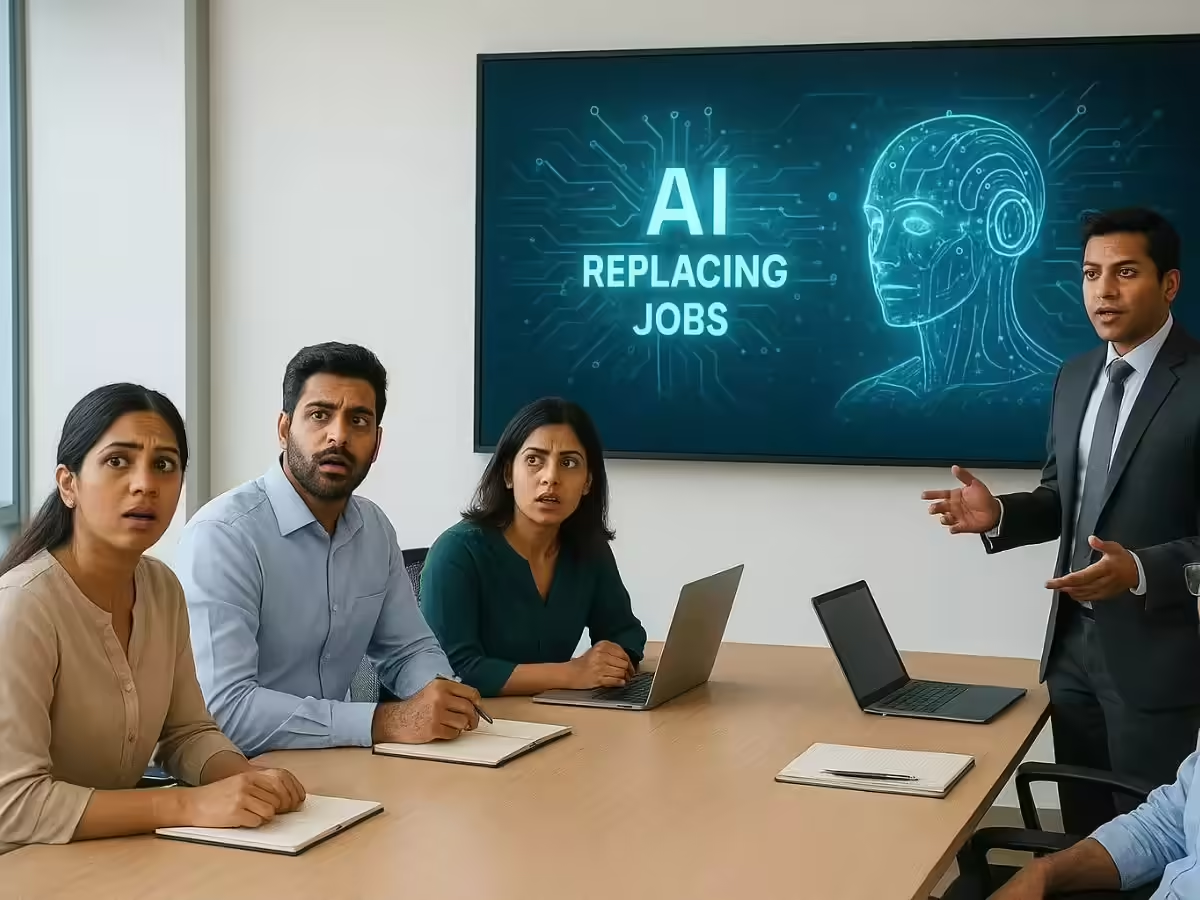
During the 2025 NBA Finals, a 30-second commercial aired that looked like it had a production budget in the hundreds of thousands. It was made entirely by AI, by one person, in under 48 hours, for $2,000. The company was Kalshi, a prediction markets platform. The filmmaker ran approximately 300 to 400 prompt iterations to assemble 15 usable clips. The ad earned over 20 million impressions. The creative industry's response ranged from 'this changes everything' to 'this is the end.' Both reactions are partially correct.
What Is Actually Possible Right Now
Kalshi Full AI commercial, $2,000, under 48 hours (2025)
Filmmaker PJ Accetturo used a full-stack AI workflow: ChatGPT and Gemini for ideation and scripting, Google's Veo 3 for prompt-to-video generation, CapCut for editing, and AI-generated voiceover. No camera crew, no director of photography, no studio rental. The ad ran at the NBA Finals and went viral. This is the most concrete proof-of-concept that exists for fully autonomous AI ad production.
H&M AI digital twins of 30 real models (2025)
H&M created AI-generated digital replicas of 30 of its human models for use across global campaigns. The stated goal: eliminate scheduling issues and speed up production across markets. The models themselves consented and retained image rights and ongoing compensation an important distinction from unauthorized replication. The campaign generated significant controversy about the future of modeling as a profession and the ethics of creating permanent, infinitely redeployable digital versions of real people.
British Council 1,000 localized ad variations, 70% cost reduction (2025)
Using AI-powered ad automation, the British Council produced over 1,000 localized ad variations across seven languages from a single master template. Time-to-market was cut by 50%, production costs by 70%. What previously took weeks of manual design and localization was completed in days. No additional agency headcount was hired. The human creative team remained for strategic and brand oversight but their output was multiplied, not their headcount.
Amaysim First fully AI-generated TV commercial in Australia (2025)
Australian telco Amaysim launched The Escape Story produced entirely using AI by two people from its in-house creative team. This is significant because it is a television commercial, not a social media asset. Television advertising has historically required the largest production budgets and the most complex crew structures. A two-person AI-native team producing a broadcast-quality spot is a structural shift in what the creative production industry is for.
Meta's Vision: Ads Without Humans at All
Mark Zuckerberg has stated publicly that Meta's long-term goal for advertising is simple: an advertiser enters a credit card number and a business objective. AI handles everything else creative generation, audience targeting, budget optimization, placement, and performance iteration. Meta has reportedly told advertisers this could be possible as early as the end of 2026.The infrastructure is being built toward that endpoint. Meta's Andromeda ad retrieval system has overhauled how ads are matched to users. Its Advantage+ suite now covers creative generation, targeting, and budget optimization. One marketing agency told Marketing Brew that Advantage+ campaigns now account for 60% to 70% of their Meta spending. The same agency noted that the system steers ads toward 'low-quality placements' and still requires human correction for brand-sensitive contexts.
What AI Cannot Do in Advertising (Yet)
The marketers using these tools most extensively are consistently clear about where AI falls short. Brand judgment understanding whether a piece of creative fits a brand's long-term positioning, cultural context, or tone is not something current AI can provide. An AI system optimizing for click-through rates will converge on what works statistically, which is not always what builds a brand.The British Council and Kalshi cases both illustrate the same underlying reality: AI multiplied the execution capacity of humans who had already done the strategic and conceptual work. The 1,000 British Council ad variations were produced from a brief, a brand identity, and a creative strategy built by humans. Kalshi's NBA Finals ad came from a filmmaker who knew what the brand needed to say. AI did not generate the brief. It executed it.
Who Is at Risk in the Creative Industry
| Role | Current Risk Level | Reason | What Survives |
|---|---|---|---|
| Production coordinator | High | Logistics and scheduling largely automatable | Complex multi-stakeholder productions |
| Junior copywriter | High | Basic ad copy, product descriptions, headlines | Brand voice, long-form strategy |
| Graphic designer (production) | High | Resizing, localization, variation generation | Original concept and direction |
| Photographer (product/studio) | Medium-High | AI image generation replacing standard product shots | Lifestyle, editorial, fashion with real humans |
| Model (commercial) | Medium | Digital twins for certain campaign types | Consent-based commercial work, talent relationships |
| Creative director | Low | Brand strategy and creative judgment still human | Grows in importance as AI output requires curation |
| Media planner | Medium | Targeting increasingly automated by platforms | Cross-channel strategy, brand safety oversight |
The Number That Frames Everything
GroupM, one of the world's largest media buying networks, projects that AI will inform 94.1% of global ad revenue by 2029. That figure doesn't mean AI will create 94.1% of ads. It means AI will be embedded in the targeting, optimization, measurement, and creative generation pipeline for almost every dollar of ad spend. The question is not whether AI enters advertising. It already has. The question is what role human judgment plays at each stage of that pipeline and whether the industry adjusts its workforce and pricing models before the decision is made for them.

Related articles
View all → AI
AIHow AI Is Transforming Enterprise Marketing Strategies
AI is not just changing how marketers work it is changing what marketing is capable of. From hyper-personalised customer journeys to predictive campaign optimisation, the gap between AI-enabled and AI-resistant marketing organisations is widening fast.
 Content Marketing
Why Modern Brands Are Becoming Media Companies
The most effective customer acquisition channel available to a D2C brand in 2026 is not a paid ad platform it is an owned media presence that creates consistent value for a defined audience, builds trust over time, and converts that trust into purchase consideration without a per-impression cost. The brands that have understood this are building media capabilities that make their marketing increasingly efficient with every piece of content they create.
 AI Discovery
AI Discovery vs Google Ads: Who Owns Customer Attention Now
For a decade, Google Ads owned the intent-capture moment the point at which a consumer with a specific need typed a query and brands competed to intercept that intent with a paid placement. In 2026, that moment is being fragmented across AI assistants, creator recommendations, and conversational search interfaces that do not serve ads in the traditional sense. The battle for customer attention has moved beyond search.