Building Resilient Businesses in an AI-Driven Economy
Resilience in an AI-driven economy is not about withstanding disruption it is about absorbing disruption faster than competitors, learning from it more effectively, and emerging from it with stronger capabilities. The businesses that build this adaptive resilience now are the ones that will define their industries in the decade ahead.
Manthan Sharma
Author
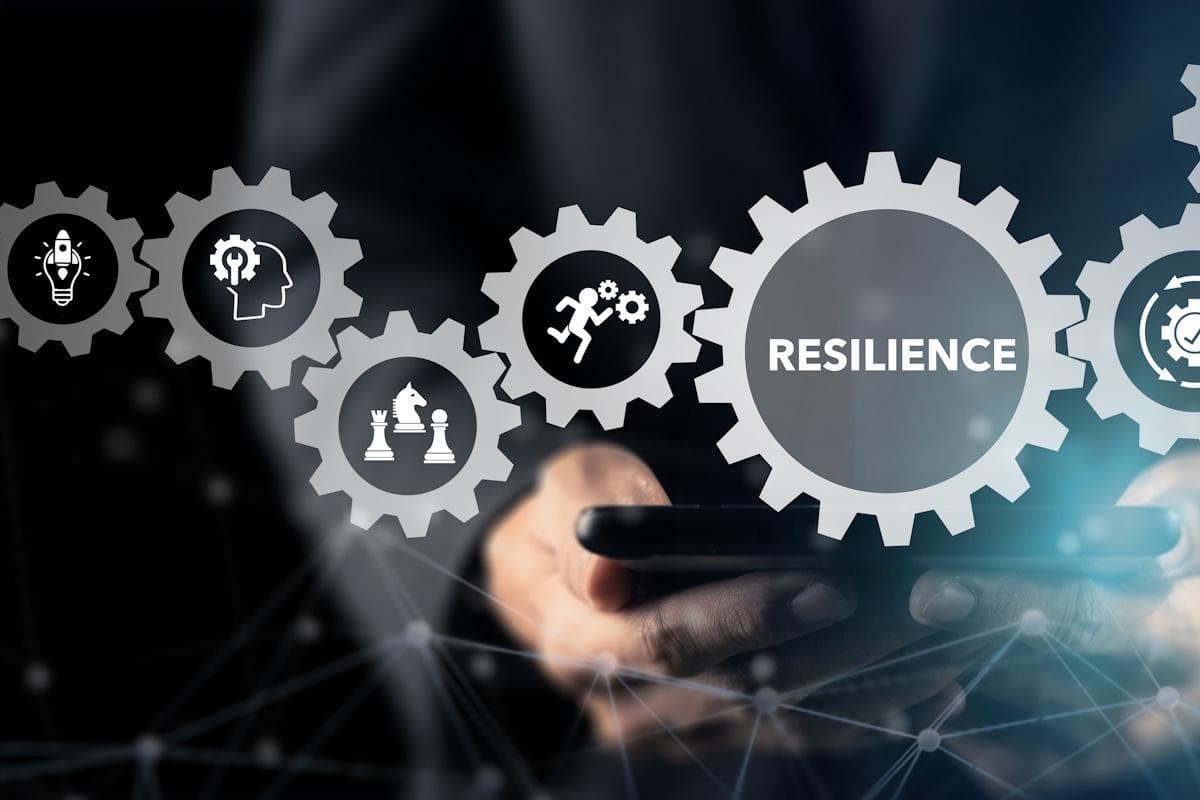
Three businesses in the same industry faced the same supply chain disruption in the same quarter. Business A had no early warning system: the disruption arrived as a supplier failure that halted production for eleven days before alternative sources were identified and qualified. Business B had a monitoring system that detected the disruption four days earlier than Business A, giving it a modest head start in finding alternatives enough to reduce the production halt to six days. Business C had an AI-powered supply chain intelligence system that had identified the supplier's financial stress signals eight weeks earlier, had begun qualifying alternative suppliers as a precaution, and had modestly increased safety stock in the affected components. When the disruption occurred, Business C experienced no production halt at all. The three businesses faced identical external shocks. Their outcomes differed entirely based on the resilience infrastructure they had built before the disruption arrived. Resilience is not the absence of disruption. It is the capability to anticipate, absorb, and recover from disruption faster and at lower cost than competitors and to use the resilience investment not just as insurance but as a source of competitive advantage in the disruption events that are inevitable in any industry operating in a volatile world.
Why AI Changes the Resilience Calculus
Traditional business resilience was built on redundancy: duplicate suppliers, buffer inventory, backup facilities, and cash reserves. Redundancy is expensive it ties up capital in assets that sit idle until a disruption occurs and it is static it protects against disruptions that were anticipated when the redundancy was designed, but not against novel disruption types. AI changes the resilience calculus in two ways. First, it enables early warning at a scale and accuracy that human monitoring cannot match: AI systems that continuously process thousands of signals supplier financial data, geopolitical developments, weather patterns, commodity markets, social media sentiment can identify disruption precursors weeks or months before they become operational events, giving businesses the lead time to act proactively rather than reactively. Second, AI enables dynamic response: instead of triggering a predefined contingency plan when a disruption occurs, AI-powered response systems can optimise the response to the specific characteristics of the actual disruption, finding the lowest-cost recovery path in real time rather than executing a plan designed for a scenario that the actual disruption may not match.The shift from redundancy-based to intelligence-based resilience is not just cheaper though AI-powered early warning and dynamic response do reduce the capital required for traditional redundancy buffers. It is also more effective: the business that can identify and respond to a disruption weeks earlier than a competitor has a structural advantage in every disruption event, regardless of the disruption type. In industries where supply chain disruptions, regulatory changes, and competitive shocks arrive with increasing frequency, this intelligence-based resilience advantage compounds over time into a durable competitive position.
The Four Pillars of AI-Powered Business Resilience
Pillar 1: AI-powered risk sensing and early warning
The foundation of AI-powered resilience is the ability to detect disruption signals before they become operational events. This requires an enterprise risk sensing system that continuously processes external signals supplier financial health indicators, geopolitical risk indices, commodity price volatility, weather and climate data, regulatory development tracking, and competitive intelligence and correlates these signals with the enterprise's specific exposure profile. A global manufacturer whose critical component supply is concentrated in a single geography should be monitoring the political stability, labour market conditions, and infrastructure reliability of that geography continuously not reviewing a quarterly risk report. AI systems that do this monitoring continuously, flagging signals that exceed risk thresholds and providing the lead time for proactive response, are the early warning infrastructure that resilient businesses are building as a standard operational capability.
Pillar 2: Dynamic supply chain and operational flexibility
Resilience requires not just the awareness that a disruption is coming but the operational flexibility to respond to it effectively. This means supply chain architectures designed for flexibility: qualified alternative suppliers for critical components, multi-sourcing strategies that distribute supply risk, and supplier relationship investments that make the enterprise a preferred customer when allocation decisions are required. It also means manufacturing and operational flexibility: production systems that can switch between product configurations, facilities that can be repurposed across product lines, and workforce skills that can be redeployed across operational roles. AI-powered supply chain flexibility management systems that continuously model alternative supply configurations and their cost-service trade-offs, ready to be executed when a disruption requires a rapid sourcing shift converts static contingency plans into dynamic response capability.
Pillar 3: Financial resilience through AI-optimised capital structure
The business that enters a disruption with insufficient liquidity is forced into suboptimal responses: accepting unfavourable terms from alternative suppliers because it cannot wait for better options, deferring capital investments that would accelerate recovery, or drawing down credit facilities at unfavourable rates. Financial resilience the liquidity and credit capacity to fund an effective disruption response is the enabling condition for all other resilience capabilities. AI-powered financial planning systems that model cash flow under multiple disruption scenarios, optimise the trade-off between liquidity reserves and return on invested capital, and identify the credit facilities and capital structure that provide the best resilience-to-cost ratio are enabling enterprises to build financial resilience more efficiently than traditional CFO-team treasury management can achieve.
Pillar 4: Organisational learning systems that improve with each disruption
The most resilient organisations are not those that experience the fewest disruptions they are the ones that learn most effectively from each disruption and emerge with improved capability. This requires deliberate organisational learning infrastructure: post-disruption review processes that identify what the early warning system missed and why, what the response optimised well and what it missed, and what the resilience investment portfolio should adjust based on the disruption experience. AI systems that track disruption outcomes against predictions, identify the signals that predicted the disruption most accurately, and update risk models based on observed outcomes create a learning loop that makes the resilience system more accurate with each event. The business that has survived and learned from ten disruptions has a resilience advantage over a competitor that has survived the same disruptions through luck and redundancy but has not built the organisational learning systems to improve its resilience capability.
The AI-Powered Resilience Readiness Diagnostic
- Do you have a continuous risk sensing system that monitors the external signals most relevant to your enterprise's specific risk exposure supply chain, regulatory, competitive, and macro-economic or do you rely on periodic risk reviews that may not detect disruptions until they have already arrived?
- Have you quantified your enterprise's current resilience gaps the disruption types and magnitudes that your current capabilities cannot absorb without significant operational or financial impact and designed a resilience investment roadmap to close them?
- Is your supply chain architecture designed for flexibility qualified alternative suppliers, multi-sourcing strategies, and dynamic re-sourcing capability or does it optimise for cost efficiency at the expense of resilience?
- Do you have the financial resilience liquidity reserves, available credit capacity, and capital structure to fund an effective response to the highest-probability disruption scenarios your business faces?
- Have you built organisational learning processes that capture lessons from each disruption event and feed them back into your risk sensing models, response playbooks, and resilience investment priorities?
Related articles
View all → Enterprise Future
The Future of Large Enterprises in an Autonomous AI Economy
The large enterprise's traditional advantages scale, capital, brand, distribution are being partially eroded by AI democratisation. The large enterprise's new advantages the data scale to train AI systems, the institutional relationships to deploy them, and the capital to build the infrastructure are equally real. The enterprises that recognise which advantages they retain and which they are losing will navigate the autonomous AI economy; the ones that do not will not.
 Execution Speed
Why Enterprise Execution Speed Will Define Market Leadership in the AI Era
In the AI era, the fastest-executing enterprise wins. Not the best-strategised, not the most well-resourced the fastest. Execution speed is becoming the primary competitive variable, and the organisations that have built AI-powered execution infrastructure are setting a pace their competitors cannot match.
 Coordination
AI-Powered Enterprise Coordination for Cross-Functional Business Teams
Cross-functional coordination is one of the highest-cost, highest-friction activities in enterprise management. AI-powered coordination systems are reducing this friction dramatically and the teams that adopt them are moving faster, with fewer misalignments and less coordination overhead.