Contribution Margin vs Gross Margin: What Founders Miss
Gross margin tells you how much money is left after the cost of making the product. Contribution margin tells you how much money is left after the cost of making, selling, delivering, and acquiring the customer for the product. Most founders manage their business on gross margin. The ones who survive manage it on contribution margin.
Manthan Sharma
Author
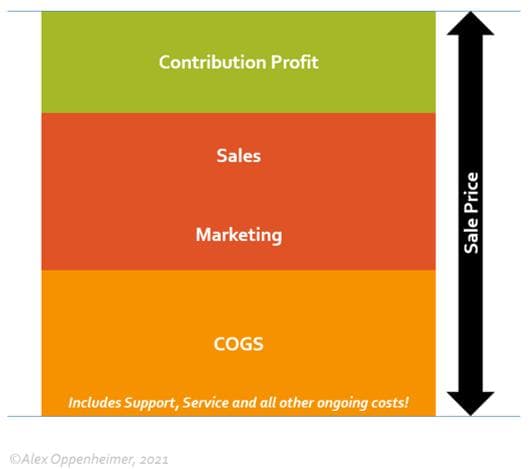
The brand's gross margin was 62%. The founder presented this number with justified confidence 62% gross margin in an FMCG category is genuinely strong, well above the category average, and sufficient to suggest that the business has the financial structure to invest in growth. What the founder did not present because the number had not been calculated was the contribution margin: 62% gross margin, minus 24% customer acquisition cost (blended CAC as a percentage of revenue), minus 8% fulfilment and logistics cost, minus 3% payment gateway and platform fees, minus 2% returns handling cost. Contribution margin: 25%. Not bad, but a very different picture from the 62% that was leading the business's financial narrative. And at the brand's current fixed cost structure team, warehouse lease, software subscriptions, agency retainers 25% contribution margin on ₹60 lakh monthly revenue generates ₹15 lakh of contribution, against ₹18.4 lakh of monthly fixed costs. The business was not profitable. The gross margin suggested it should be. The contribution margin revealed why it was not. This is the most consequential calculation error in the D2C financial management playbook.
The Definition Gap: What Each Metric Actually Measures
Gross margin measures the profitability of the product itself the revenue remaining after the direct cost of producing and sourcing the product (cost of goods sold, or COGS). In a manufacturing business, COGS includes raw materials, direct labour, and manufacturing overhead. In a D2C business sourcing from contract manufacturers, COGS is typically the purchase price of finished goods plus inbound freight. Gross margin answers the question: is the product itself economically viable at this price point?Contribution margin measures the profitability of the business model the revenue remaining after all variable costs, including not only COGS but the variable costs of selling, marketing, delivering, and servicing the product. The variable costs that gross margin excludes but contribution margin includes are: customer acquisition cost (the marketing spend, including all platform fees and agency costs, attributable to acquiring the customers who generated the revenue in the period), fulfilment and last-mile logistics cost, payment gateway and marketplace commission fees, and variable customer support and returns handling costs. Contribution margin answers the question: does selling one more unit of this product through this channel to this customer segment make the business more or less financially healthy?
Why CAC Is the Variable Cost That Changes Everything
The variable cost that most dramatically separates contribution margin from gross margin and the one that is most frequently excluded from founder unit economics calculations is customer acquisition cost. CAC is a variable cost in the most direct sense: the business only incurs it when it acquires a customer, and the total CAC in a period scales (imperfectly but directionally) with the number of new customers acquired. Including CAC in the contribution margin calculation is not optional. Excluding it produces a metric that flatters the business model while hiding the most consequential driver of whether the business is actually generating value.The subtlety that makes CAC calculation difficult for founders is the blending problem. Marketing spend in any period acquires some customers who will generate high LTV (high repeat purchase frequency, high average order value) and some who will not repurchase. The blended CAC total marketing spend divided by total new customers acquired is an average that may obscure the economics of specific channels, campaigns, or customer segments. A brand with a blended CAC of ₹820 may have a Google Shopping CAC of ₹380 and a Meta Reels CAC of ₹1,640 and the contribution margin per customer acquired through each channel is dramatically different. The founder who manages on blended CAC is optimising the average while potentially scaling the channels with the worst unit economics fastest.
Building a Contribution Margin Model That Drives Decisions
A contribution margin model that is genuinely useful for decision-making has three levels of granularity. The first level is per-order contribution margin: revenue per order minus COGS per order minus fulfilment cost per order minus payment and platform fees per order minus returns cost per order (calculated as a per-order allocation of the period's returns cost). This number tells the founder whether the fulfilment operation is financially viable before marketing is considered.The second level is per-customer contribution margin: the per-order contribution margin multiplied by the average number of orders per customer in the cohort period, minus the CAC for that cohort. This number tells the founder whether the customer acquisition strategy is financially viable whether the customers being acquired are worth more over their relevant lifetime than they cost to acquire. The third level is per-channel contribution margin: the per-customer contribution margin calculated separately for each acquisition channel and fulfilment channel combination. This is the number that tells the founder where to allocate the next rupee of growth investment and where to stop. The brands that build and manage this three-level model make fundamentally better capital allocation decisions than the brands managing on gross margin alone and the compounding of better capital allocation over twelve to twenty-four months is the difference between a business that grows profitably and a business that grows its way into a financial crisis.

Why Cash Flow Timing Matters More Than Profit
Related articles
View all → AI
AIThe Future of AI-Powered Digital Marketplaces
Digital marketplaces are evolving from transactional platforms into intelligent commerce ecosystems. AI is reshaping how buyers discover products, how sellers manage operations, and how platforms create value for everyone in the ecosystem and the pace of this transformation is accelerating.
 Customer Support
How AI Can Transform Enterprise Customer Support Systems
Customer support is one of the highest-cost, highest-impact functions in a growing enterprise. AI is transforming it from a cost centre with linear scaling constraints into an intelligent service layer that delivers better customer outcomes at a fraction of the traditional cost per interaction.
 Logistics
The Future of Smart Logistics and Autonomous Delivery Systems
Autonomous vehicles, drone delivery, AI-powered routing, and real-time supply chain visibility are moving from pilot projects to operational infrastructure. The logistics industry is undergoing its most significant transformation since containerisation and the businesses that adapt earliest will define the next era of commerce.