The Evolution of Digital Transformation in the Agentic Era
Digital transformation is entering its third wave: the first wave automated individual tasks, the second wave connected systems, and the third waveagentic transformationdeploys autonomous execution across workflows. First-wave transformation focused on digitizing manual processes: moving paper forms to digital systems, implementing ERP and CRM platforms, and establishing data infrastructure. Second-wave transformation focused on integration: connecting siloed systems through APIs, implementing workflow automation, and enabling cross-system data visibility. Third-wave agentic transformation focuses on autonomous execution: deploying AI agents that coordinate workflows across systems, make operational decisions within governance boundaries, and optimize operations continuously without human coordination.
Manroze
Author

A First-wave transformation (2005-2015): company digitizes manual processes, implements ERP system, establishes data warehouse. Value: improved data visibility, reduced manual data entry, faster reporting. Second-wave transformation (2015-2024): company connects systems through APIs, implements RPA for routine processes, deploys analytics dashboards. Value: reduced system context switching, automated routine transactions, improved decision visibility. Third-wave agentic transformation (2025+): company deploys AI agents that orchestrate workflows autonomously, make operational decisions within parameters, and optimize continuously based on performance data. The fundamental shift from recommendation to execution, from insights to autonomous operations, represents the transformation defining enterprise AI in 2026. The enterprises capturing value are those deploying execution capabilitynot those with the most sophisticated analysis.
The Strategic Imperative: Why This Transformation Matters Now
The transition described represents a fundamental shift in how enterprises operate and compete. Organizations that understand this shift and act decisively will gain structural advantages that competitors cannot easily replicate. The economic case is compelling: First wave: 15-25% efficiency, Second wave: 25-40% efficiency, Third wave: 50-70% efficiency improvements demonstrate that this is not incremental improvement but transformative change in operational capability.The enterprises succeeding with this transformation share consistent patterns: they treat AI execution as strategic infrastructure rather than departmental technology, they establish governance frameworks enabling autonomous operation within risk boundaries, and they measure success through operational outcomes rather than technology deployment metrics. The competitive dynamics are clear: organizations deploying execution-capable AI systems operate with structural cost and speed advantages over those maintaining human-coordinated operations.
Implementation Realities: Building Capability While Managing Risk
Successful implementation requires balancing autonomous execution capability with governance controls that satisfy risk, compliance, and operational requirements. The technical architecture must support both execution authority and audit transparency. Organizations report that governance frameworksnot technical capabilityare the primary constraint on deployment velocity. Only 21% of enterprises have mature governance for autonomous agents according to Deloitte research.The implementation path follows consistent patterns: start with clearly bounded workflows where autonomous execution delivers measurable value, establish explicit authority boundaries and escalation criteria, deploy monitoring infrastructure that provides visibility into autonomous decisions, measure impact through operational metrics and business outcomes, and expand systematically as performance demonstrates reliable execution. Organizations attempting to deploy broadly without proven governance encounter failures that set back transformation timelines.
The Competitive Landscape: Windows of Advantage Are Narrowing
The opportunity described in the evolution of digital transformation in the agentic era represents a time-limited competitive advantage. As AI execution capabilities mature and become more accessible, the differentiation shifts from having the capability to executing at scale with operational excellence. Early movers gain advantages that compound: operational efficiency improvements fund additional AI investments, organizational learning about autonomous operations creates execution expertise that competitors must develop, and market positioning as execution leaders rather than automation followers attracts talent and partnerships.The strategic question facing enterprises is not whether to pursue this transformation but how quickly to execute and at what scale. Organizations waiting for technology to mature further or for clearer best practices risk falling behind competitors who are building execution capability now. The market data indicates rapid adoption: 40% of enterprise applications will feature AI agents by 2026, and organizations achieving significant ROI share characteristics of execution-first rather than recommendation-first deployment. The window for first-mover advantage is measured in quarters, not years.

Related articles
View all →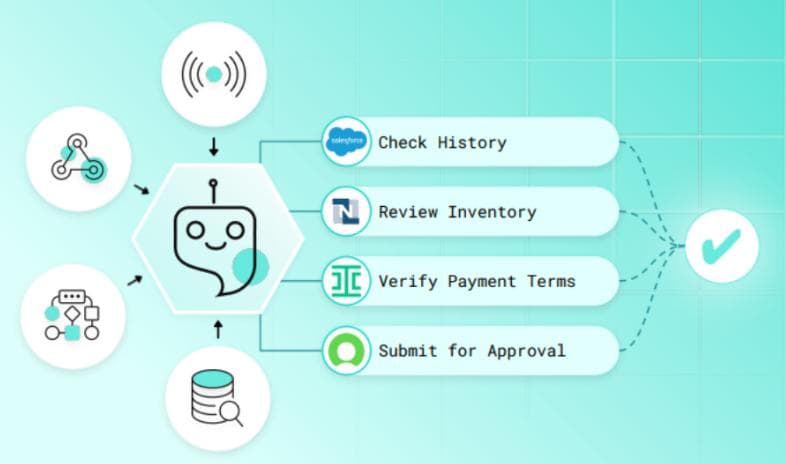 AI Execution
Why AI Execution Systems Will Define the Future of Enterprise Operations
The next frontier of enterprise competitive advantage is not strategy it is execution. AI execution systems that translate strategic intent into coordinated operational action, faster and more reliably than any human-managed process, are becoming the defining infrastructure of enterprise performance in every sector.
 AI-Native Infrastructure
Why Global Enterprises Need AI-Native Operational Infrastructure
The operational infrastructure that global enterprises built in the pre-AI era was designed for a different competitive environment. Enterprises that try to layer AI on top of legacy operational infrastructure will capture a fraction of AI's potential. The ones that rebuild their operational foundations as AI-native will gain structural advantages their competitors cannot close.
 Agentic AI
The Evolution of Enterprise Operations in the Age of Agentic AI
Agentic AI AI systems that pursue goals, take actions, and adapt to feedback without requiring step-by-step human instruction is not an incremental evolution of enterprise automation. It is a structural shift in what operational systems can do and what human operators are for.