How AI-Native Management Systems Will Reshape Fortune 500 Operations
The management systems that Fortune 500 companies have built over decades the planning cycles, the performance reviews, the approval processes, the reporting structures were designed for human management speed. AI-native management systems are designed for market speed, and their adoption is beginning to reshape the operational tempo, the cost structure, and the competitive capability of the world's largest organisations.
Prince Kumar
Author

The management system of a Fortune 500 company is a complex institutional artefact the accumulated result of decades of organisational design decisions, regulatory adaptations, competitive responses, and cultural evolutions. It includes the formal structures (reporting hierarchies, committee structures, governance frameworks) and the informal mechanisms (management rhythms, communication norms, decision-making cultures) that together determine how the enterprise perceives its environment, makes decisions, and executes those decisions across its global operations. The management system is, in effect, the enterprise's operating system and like an operating system, it determines both what the enterprise can do and how fast and efficiently it can do it. The management systems of most Fortune 500 companies were designed for a world where information moved slowly, markets changed quarterly rather than daily, and the human management bandwidth available to process information and coordinate action was the primary constraint on organisational performance. That world has changed, and the management systems built for it are increasingly misaligned with the operational environment the organisations they govern now face. AI-native management systems built from the ground up around AI-powered information processing, decision support, and execution coordination are the upgrade that Fortune 500 operations require.
The Limitations of Legacy Management Systems
Legacy management systems have four structural limitations that AI-native systems are designed to address. The first is information latency: management decisions in traditional systems are made on the basis of reports that are produced periodically monthly financial reports, quarterly business reviews, annual strategic plans that describe the state of the business as it was at the time the report was prepared, not as it is now. The decision made in the monthly executive review is made on data that is two to four weeks old, in an operational environment that may have changed significantly since the data was collected. The second limitation is coordination bottlenecks: traditional management systems route operational decisions through approval hierarchies that are designed for financial control and accountability rather than for speed. The purchase order approval that requires three levels of management sign-off takes five days in a system designed for financial governance; the same approval in an AI-native system that has been programmed with the approval criteria and authority thresholds takes seconds.The third limitation is scale constraints: traditional management systems scale linearly with headcount managing more concurrent operational decisions requires more management bandwidth, which requires more management staff. AI-native management systems scale with computation, not headcount the system's capacity to manage concurrent operational decisions is not constrained by the number of managers available to review and approve them. The fourth limitation is learning rate: traditional management systems learn slowly, through the formal mechanisms of after-action reviews, annual strategy updates, and periodic process redesign exercises that occur on multi-month cycles. AI-native management systems learn continuously, updating their decision models and performance standards in response to operational outcomes at the speed of data generation rather than the speed of organisational review cycles.
What AI-Native Management Systems Look Like in Practice
AI-native management systems replace the periodic, human-operated management cycle with continuous, AI-assisted management capability that maintains operational alignment without the coordination overhead of traditional management processes. The planning process in an AI-native management system is not an annual event it is a continuous capability that maintains a rolling operational plan, updating it in response to performance data, market signals, and strategic direction changes in real time. The review process is not a monthly meeting it is a continuous monitoring system that surfaces exceptions and anomalies to the relevant human decision-makers when they occur, not when the next review cycle is scheduled.The approval process in an AI-native management system is not a sequential routing of requests through management hierarchy it is an AI-evaluated request processing system that applies the enterprise's approval criteria autonomously for routine approvals and routes genuinely exception cases to the appropriate human authority with the context required for efficient decision-making. Super Manager AGI is designed to function as the AI-native management system layer: receiving operational signals from the enterprise's information systems, maintaining the operational plan and performance model, autonomously managing the routine operational decisions and coordination workflows, and surfacing the genuinely strategic decisions to the human management team with the context and analysis required to make them well.
The Fortune 500 Adoption Path
The Fortune 500 adoption path for AI-native management systems follows a consistent pattern across the organisations that have made the transition most successfully. The entry point is not the comprehensive replacement of existing management systems the organisational and change management complexity of that approach makes it high-risk and slow-moving. The entry point is the deployment of AI-native management capability for a specific management domain typically supply chain operations, financial operations, or customer operations where the limitations of the existing management system are creating the most measurable operational cost.The deployment of AI-native management capability for a specific domain generates the operational performance data, the organisational learning, and the leadership confidence that enables expansion to additional domains. Each expansion builds on the previous deployment's experience, and the accumulated operational learning from multiple domain deployments progressively creates the enterprise-wide AI-native management capability that represents the full competitive advantage of the transition. The Fortune 500 companies that are furthest along this path having deployed AI-native management capability across multiple functional domains over two to three years are now seeing the emergent competitive benefits of cross-domain AI coordination that no single-domain deployment generates: the supply chain AI system coordinating with the financial AI system, which coordinates with the customer operations AI system, to produce enterprise-wide operational coherence at a speed and scale that their human management systems could not sustain.
Why Consulting Firms Are Investing in AI Execution and Workflow Intelligence
Related articles
View all →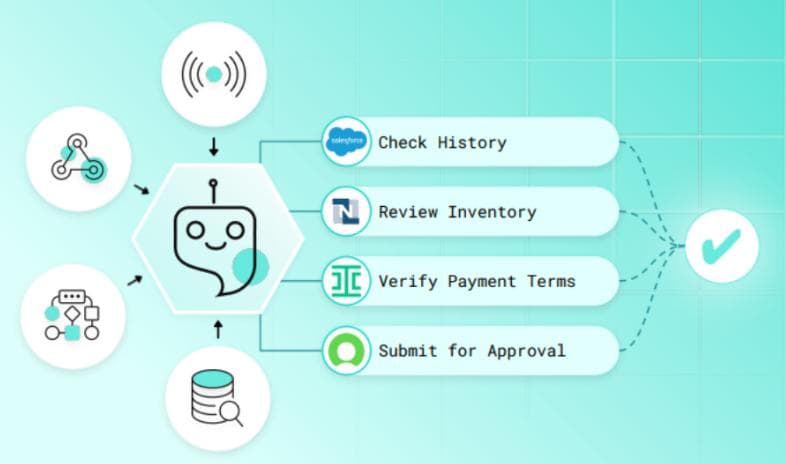 AI Execution
Why AI Execution Systems Will Define the Future of Enterprise Operations
The next frontier of enterprise competitive advantage is not strategy it is execution. AI execution systems that translate strategic intent into coordinated operational action, faster and more reliably than any human-managed process, are becoming the defining infrastructure of enterprise performance in every sector.
 AI-Native Infrastructure
Why Global Enterprises Need AI-Native Operational Infrastructure
The operational infrastructure that global enterprises built in the pre-AI era was designed for a different competitive environment. Enterprises that try to layer AI on top of legacy operational infrastructure will capture a fraction of AI's potential. The ones that rebuild their operational foundations as AI-native will gain structural advantages their competitors cannot close.
 Agentic AI
The Evolution of Enterprise Operations in the Age of Agentic AI
Agentic AI AI systems that pursue goals, take actions, and adapt to feedback without requiring step-by-step human instruction is not an incremental evolution of enterprise automation. It is a structural shift in what operational systems can do and what human operators are for.