Inventory Dead Stock: The ₹10L Mistake Most Founders Ignore
The ₹10 lakh sitting in your warehouse as slow or dead stock is not an asset. It is a liability that is costing you ₹23 lakh per year to hold, blocking the working capital that would fund your next growth phase, and slowly writing itself off while you focus on acquiring new customers.
Manroze
Author
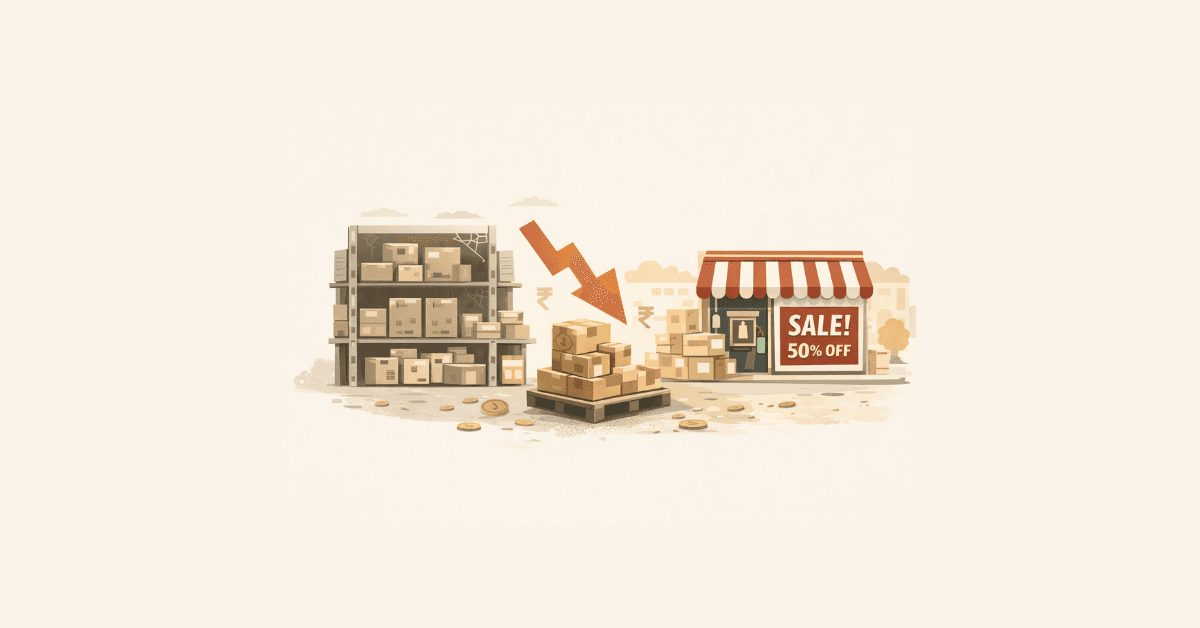
There is a number most D2C and FMCG founders have not calculated: the total value of inventory that has not moved in 90 days. Not the headline inventory number on the balance sheet the specific subset of that inventory that is sitting in the warehouse generating no revenue while consuming warehouse space, blocking working capital, and accumulating the carrying cost of approximately ₹2 to ₹3 lakh per ₹10 lakh of dead stock per year. For most brands at ₹30 to ₹80 lakh monthly revenue, this figure runs between ₹8 lakh and ₹25 lakh a meaningful fraction of available working capital parked in goods that have stopped moving. The reason this mistake is so common is not that founders are unaware that slow inventory is a problem. It is that the problem is never presented as a single, concrete number. It lives in the inventory spreadsheet as a collection of individual SKUs with low movement, each of which feels like it might turn around next season, next campaign, next festive period. The aggregation the total rupee value of dead and slow stock and its carrying cost is almost never calculated. When it is calculated, it changes decisions.
How Dead Stock Accumulates: The Three Root Causes
Optimistic demand forecasting at the production stage
The most common root cause of dead stock is a production decision made on a forecast that assumed demand would be higher than it turned out to be. The forecast was built on last season's bestseller, or the growth rate of the prior quarter, or the founder's confidence that the new variant would perform as well as the original. The production run was placed at MOQ levels that assumed that forecast would be correct. When actual sell-through came in at 60% of forecast, the excess 40% became slow stock that the business now carries indefinitely. This cause requires a process fix: shifting from forecast-based production decisions to sell-through velocity-based decisions where every production run is sized to actual current demand with a conservative buffer, not to a demand target.
New SKU launches that underperformed without early detection
New product launches are inherently high-risk inventory events. The initial production run for a new SKU is typically placed before there is any sell-through data based entirely on the product team's belief in the product and the marketing team's confidence in the launch plan. When a new SKU underperforms its launch forecast which happens to approximately 40 to 60% of new product launches across consumer categories the brand is left with excess inventory of a product whose demand signal has not yet been validated. The brands that minimise new SKU dead stock risk do two things: they place smaller initial production runs (accepting higher per-unit cost to reduce inventory risk), and they set a hard review trigger at 45 days post-launch if sell-through has not reached the threshold that justifies the current inventory position at that point, they begin clearance pricing immediately rather than waiting for the situation to naturally resolve.
Channel mix shifts that leave channel-specific inventory stranded
A brand that has inventory ring-fenced for a specific channel a dedicated marketplace inventory allocation, a dedicated retail channel stock position can accumulate dead stock when that channel's performance shifts without a corresponding inventory reallocation. Marketplace algorithm changes that reduce organic visibility, a retail chain that renegotiates shelf placement terms, a distributor that reduces order frequency each of these can strand channel-specific inventory that the brand cannot easily reallocate because it was physically positioned for that channel's fulfilment requirements. The fix is inventory flexibility: wherever possible, maintaining a unified inventory pool that can be allocated to any channel based on real-time demand rather than pre-committed channel-specific allocations.
Calculating Your Real Dead Stock Number
The calculation every founder should run monthly: export your full SKU inventory list with unit count and standard cost per unit. Filter to SKUs with zero or near-zero sales movement in the trailing 90 days. Sum the total value at standard cost. That number is your dead stock position. Now apply the carrying cost rate for your business typically 20 to 25% annually for Indian D2C and FMCG brands including warehouse rent, capital cost, insurance, and obsolescence risk. The annual carrying cost of your dead stock position is that percentage of the dead stock value money you are spending every year to hold goods that are generating no revenue.For a brand with ₹12 lakh of dead stock at a 22% carrying cost rate: ₹2.64 lakh per year in carrying costs on goods that are not moving. If that ₹12 lakh of dead stock could instead be converted to cash through clearance pricing even at a 30% discount to standard cost, recovering ₹8.4 lakh the brand has freed ₹8.4 lakh of working capital that could fund the next production run at standard margin, while eliminating ₹2.64 lakh of annual carrying costs. The clearance discount is expensive in isolation. In the context of the carrying cost and the opportunity cost of the blocked working capital, it is almost always the right decision.
The Dead Stock Prevention System
Prevention is significantly cheaper than cure. The dead stock prevention system has four components. First, a weekly sell-through velocity report by SKU that makes slow movers visible before they become dead stock a SKU moving below 30% of its expected weekly velocity at week 4 post-production is a slow stock alert, not a dead stock event, and has many more remediation options at that stage. Second, a hard clearance trigger at 60 days of below-threshold movement automatic price reduction or channel reallocation initiation when a SKU crosses this threshold, rather than a manual review that may not happen for another three weeks. Third, a SKU rationalisation review quarterly that assesses which SKUs in the portfolio are generating disproportionate slow and dead stock risk relative to their contribution margin, and makes explicit decisions about discontinuation or production reduction. Fourth, a new SKU launch protocol that caps initial production runs at the quantity justified by conservative sell-through projections with explicit milestones for scaling production only after the initial batch demonstrates the forecast velocity.

Related articles
View all → Autonomous Coordination
The Rise of Autonomous Enterprise Coordination Platforms
Enterprise coordination the alignment of people, processes, information, and resources across organisational boundaries has always been expensive, slow, and error-prone when managed through human intermediaries alone. Autonomous coordination platforms powered by AI are replacing the coordination overhead of large organisations with intelligent systems that synchronise the enterprise continuously and without manual intervention.
 AI Agents
How AI Agents Are Transforming Enterprise Workflow Intelligence
AI agents autonomous systems that perceive their environment, reason about objectives, and take action across enterprise workflows are moving from research concept to operational reality. The enterprises deploying AI agents at scale are discovering that workflow intelligence is not just about automation it is about creating organisational capability that compounds with every cycle.
 Enterprise Management
The Future of Enterprise Management Through AI Execution Layers
Enterprise management is being restructured by AI execution layers intelligent systems that sit between strategic direction and operational action, translating intent into coordinated execution at a speed and consistency that human management hierarchies cannot match. The enterprises that deploy these layers effectively are redefining what management means and what managers do.