The 'Out of Stock' Problem: Lost Revenue You Don't Track
The stockout is not the problem. The stockout is the consequence of a demand planning failure that happened three weeks earlier. And the revenue you lost during the stockout never appears in your P&Lbecause you cannot record revenue that was never received. Here is how to measure what you are actually losing.
Nirmal Nambiar
Author
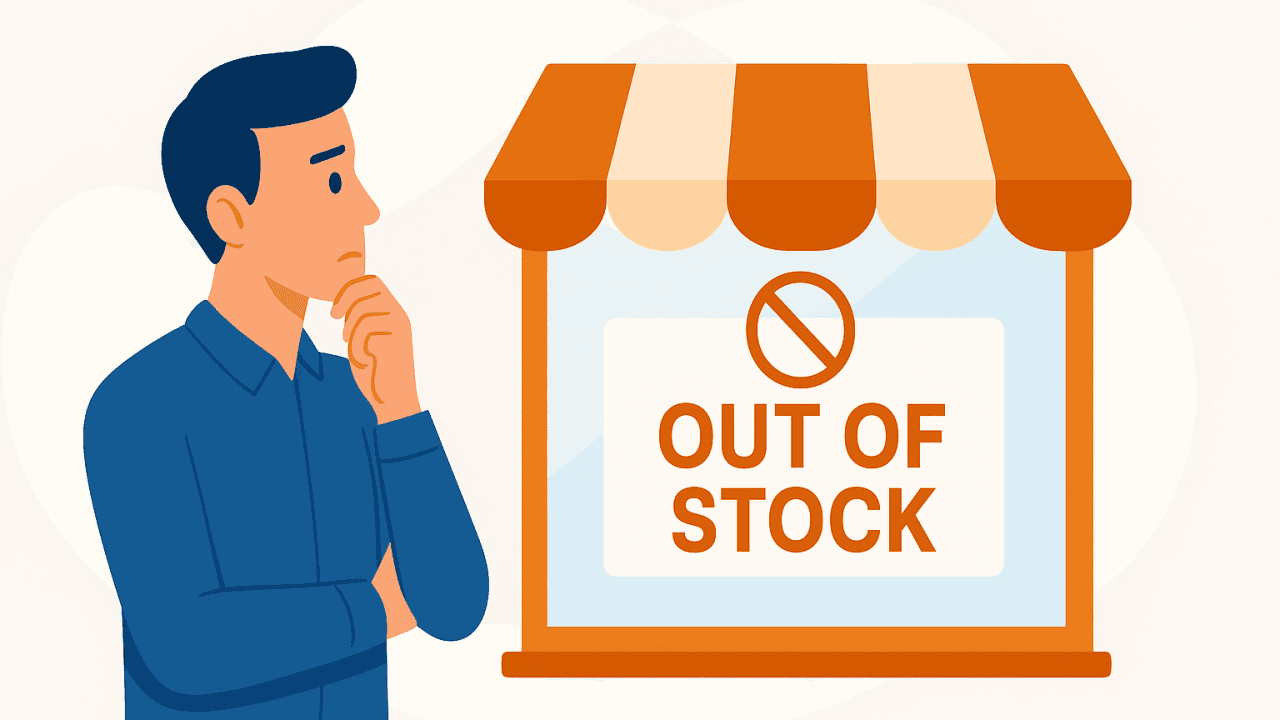
The ₹8 lakh that a brand loses to stockouts in a quarter is the most invisible loss in the P&L. It is not recorded as a cost. It does not appear as a reduction in revenue. The orders were never placed, so they are not reflected in any system as lost. The only evidence that the loss occurred is the sell-through velocity data during the stockout period, which most brands are not monitoring at the granularity required to calculate what did not sell. This invisibility is the reason most founders dramatically underestimate the cost of their stockout problemthey experience it as an operations inconvenience (we ran out of stock, we had to wait for the reorder) rather than as the revenue event it actually is. A brand with a top-selling SKU generating ₹4 lakh per month in revenue that experiences a 10-day stockout has lost approximately ₹1.3 lakh in direct revenuebefore accounting for the marketplace algorithm penalty that typically reduces organic visibility for 3 to 6 weeks after an in-stock recovery.
How to Calculate Your Actual Stockout Revenue Loss
Most brands know they had a stockout. Almost none have calculated what the stockout cost them. The calculation is straightforward once the methodology is clear. For each stockout event on a specific SKU in a specific channel: identify the daily sales velocity of that SKU in that channel in the 14 days before the stockout (the pre-stockout velocity). Multiply the pre-stockout velocity by the number of days the SKU was out of stock. That number is the direct revenue loss from the stockout event. If a SKU was selling 45 units per day at ₹599 per unit and was out of stock for 10 days, the direct revenue loss is 450 units × ₹599 = ₹2.7 lakh.The direct revenue loss is not the full cost. Add the marketplace algorithm penalty: most D2C brands operating on Amazon and Flipkart experience a 15 to 35% reduction in organic search visibility in the 2 to 4 weeks following a stockout recovery, as the algorithm updates the SKU's availability score. At 25% velocity reduction for three weeks on a SKU previously generating ₹4 lakh per month, the algorithm penalty adds approximately ₹75,000 in additional revenue suppression. Total cost of the 10-day stockout on this SKU: ₹2.7 lakh direct + ₹75,000 algorithm penalty = ₹3.45 lakh. This is the number that justifies the investment in demand planning and inventory intelligence.
Why Stockouts Keep Happening: The Root Causes
Stockouts in Indian D2C and FMCG businesses originate from four recurring root causes that are different from the operational story most founders tell themselves (we just ran out faster than expected). The first root cause is demand forecasting built on the wrong datausing last month's or last season's sales as the primary forecast input without accounting for the current velocity trend, current promotional activity, or upcoming demand events that will pull forward consumption. A SKU whose velocity increased 30% in the trailing two weeks because of an influencer post is being restocked based on its three-month averagewhich was 30% lower. The reorder quantity is wrong before it is placed.The second root cause is reorder trigger points that do not account for supplier lead time variabilitythe difference between the stated lead time (10 days) and the actual lead time at the 75th percentile (14 days). A brand that places reorders when stock reaches 12 days of cover, expecting a 10-day replenishment, will regularly experience stockouts when the supplier delivers at 13 to 15 days. The third root cause is channel-specific inventory that cannot be reallocated quicklyAmazon FBA inventory that is positioned and locked while the D2C website is out of stock on the same SKU. The fourth is manual monitoring that only catches stockout risk when someone looks at the inventory spreadsheetwhich may be Tuesday when the problem became critical on Saturday.
The Demand Planning System That Prevents Stockouts
Preventing stockouts requires a demand planning system that operates on real sell-through data at the SKU and channel level, updated daily or better, with automated alerts that surface risk early enough for action. The specific components: a sell-through velocity calculation by SKU and channel using a 14-day rolling average weighted toward recent data (so velocity trend changes are reflected quickly), a days-of-cover projection that uses the weighted velocity against current inventory to project the stock-out date, and an alert trigger at a configurable thresholdtypically 14 to 18 days of coverthat fires the reorder signal with enough lead time to accommodate actual (not stated) supplier delivery timelines.The alert should include not just the projected stock-out date but the recommended reorder quantity calculated from the current velocity trend rather than from a fixed reorder quantity set at the beginning of the season. A SKU whose velocity has trended up 25% in the last two weeks should trigger a reorder 25% larger than the standard reorder quantitynot the same standard quantity that was set when velocity was lower. Building this adjustment into the reorder recommendation logic prevents the chronic under-reordering that causes repeat stockout cycles on the same SKUs.
The Opportunity Cost Calculation Every Founder Should Run Quarterly
- Pull every SKU that experienced a zero-stock period of more than 48 hours in the last quartermost brands have 5 to 12 such events per quarter
- For each stockout event, calculate the daily pre-stockout velocity and multiply by stockout days to get direct revenue loss
- Apply a 20% post-stockout velocity reduction for 3 weeks to each event to estimate the algorithm/visibility penalty
- Sum the total across all stockout eventsthe resulting number is the quarterly revenue opportunity cost of the demand planning gap
- Compare this number to the cost of implementing a real-time inventory monitoring and alert systemthe payback period is typically 4 to 8 weeks at any meaningful scale
Related articles
View all → Autonomous Coordination
The Rise of Autonomous Enterprise Coordination Platforms
Enterprise coordination the alignment of people, processes, information, and resources across organisational boundaries has always been expensive, slow, and error-prone when managed through human intermediaries alone. Autonomous coordination platforms powered by AI are replacing the coordination overhead of large organisations with intelligent systems that synchronise the enterprise continuously and without manual intervention.
 AI Agents
How AI Agents Are Transforming Enterprise Workflow Intelligence
AI agents autonomous systems that perceive their environment, reason about objectives, and take action across enterprise workflows are moving from research concept to operational reality. The enterprises deploying AI agents at scale are discovering that workflow intelligence is not just about automation it is about creating organisational capability that compounds with every cycle.
 Enterprise Management
The Future of Enterprise Management Through AI Execution Layers
Enterprise management is being restructured by AI execution layers intelligent systems that sit between strategic direction and operational action, translating intent into coordinated execution at a speed and consistency that human management hierarchies cannot match. The enterprises that deploy these layers effectively are redefining what management means and what managers do.