The AI Productivity Paradox (2026): More AI, Slower Decisions
Every new AI dashboard added to an enterprise increases cognitive load, not productivity. The paradox of 2026: AI tools reduce tactical work while multiplying the strategic coordination overhead required to act on what they surface. The fix is not more assistants it is autonomous executors.
Manthan Sharma
Author

A mid-size enterprise with 800 employees now runs fourteen AI-powered tools across its operations demand forecasting, contract analysis, spend analytics, customer churn prediction, inventory optimisation, and eight others. Collectively, these tools surface approximately 340 flagged items per week across the leadership and operations teams. The number of weekly coordination meetings has increased by 60% over the previous year. Decision cycle times for operational issues have increased, not decreased. This is the AI productivity paradox of 2026: the accumulation of AI tools that were each individually justified as productivity enhancers is, in aggregate, producing slower decisions and higher coordination overhead. More AI is creating less productivity.
Why Every New Dashboard Adds Cognitive Load
The assumption behind most enterprise AI deployments is that more information, better organised, produces better and faster decisions. This assumption is partially correct and fundamentally incomplete. Better information does improve decision quality when the decision-maker has the bandwidth to process it. When the volume of AI-surfaced information exceeds the bandwidth of the humans responsible for acting on it, additional information does not improve decisions. It creates paralysis, prioritisation overhead, and coordination meetings.Each AI dashboard added to an enterprise workflow creates three categories of cognitive load: the load of reviewing the dashboard's outputs, the load of determining which outputs require action and which are noise, and the load of coordinating with other teams to execute on the outputs that do require action. The first two loads were anticipated. The third load which scales with the number of tools and the number of cross-team dependencies was not.
The Paradox: AI Reduces Tactical Work, Multiplies Coordination Overhead
AI tools are genuinely effective at eliminating tactical, repetitive cognitive work. Analysts no longer manually reconcile transaction sets; the AI does it. Procurement teams no longer manually review every contract clause; the AI flags the relevant ones. Operations managers no longer manually track every shipment; the AI monitors them. The tactical work is reduced.But the elimination of tactical work does not eliminate the coordination work that follows from acting on the insights that tactical work used to produce. When a human analyst reconciled transactions and found a discrepancy, they owned the problem. They emailed the vendor, updated the ledger, and closed the loop. When an AI system reconciles transactions and flags a discrepancy, it has produced an insight that now requires a human to own the response and that ownership decision, escalation path, and coordination overhead is entirely new work that did not exist in the manual process.
From Assistants to Autonomous Executors
The resolution to the AI productivity paradox is not to add better dashboards or smarter assistants. It is to move from systems that surface insights for human action to systems that autonomously execute routine responses without requiring human review. The distinction is not semantic. An assistant that tells a procurement manager that a PO approval is overdue by three days adds to the coordination overhead. An autonomous executor that escalates the PO through the approval chain, notifies the relevant approver, and logs the resolution requires zero human coordination for the routine case.Enterprises that resolve the AI productivity paradox will be the ones that identify which categories of AI-surfaced actions are sufficiently routine and low-risk that autonomous execution is both safe and efficient and deploy execution systems for those categories rather than adding more dashboards.

Where Enterprises Actually Lose Money: Hidden Bottlenecks & Approval Traps
Related articles
View all →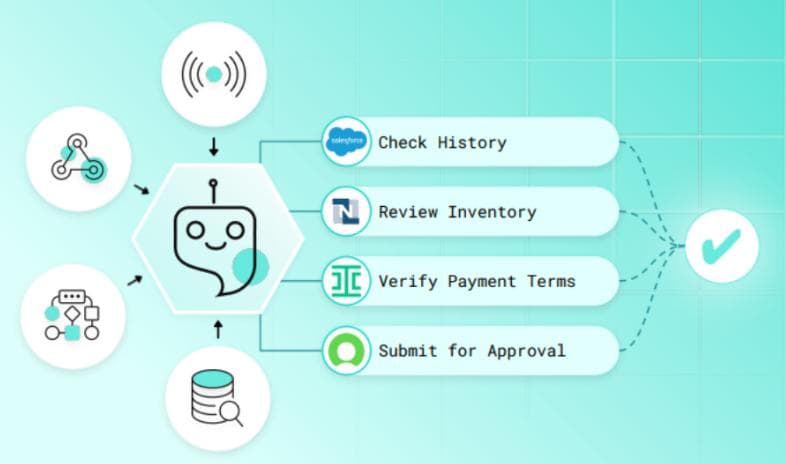 AI Execution
Why AI Execution Systems Will Define the Future of Enterprise Operations
The next frontier of enterprise competitive advantage is not strategy it is execution. AI execution systems that translate strategic intent into coordinated operational action, faster and more reliably than any human-managed process, are becoming the defining infrastructure of enterprise performance in every sector.
 Autonomous Coordination
The Rise of Autonomous Enterprise Coordination Platforms
Enterprise coordination the alignment of people, processes, information, and resources across organisational boundaries has always been expensive, slow, and error-prone when managed through human intermediaries alone. Autonomous coordination platforms powered by AI are replacing the coordination overhead of large organisations with intelligent systems that synchronise the enterprise continuously and without manual intervention.
 AI Agents
How AI Agents Are Transforming Enterprise Workflow Intelligence
AI agents autonomous systems that perceive their environment, reason about objectives, and take action across enterprise workflows are moving from research concept to operational reality. The enterprises deploying AI agents at scale are discovering that workflow intelligence is not just about automation it is about creating organisational capability that compounds with every cycle.