Where Enterprises Actually Lose Money: Hidden Bottlenecks & Approval Traps
The financial losses that matter most in enterprise operations are not fraud or waste they are the compounding cost of cross-department delays, approval bottlenecks, and missed automated actions. Each delayed decision and every overlooked contract renewal quietly drains value at scale.
Prince Kumar
Author

The procurement team submitted a purchase order on a Tuesday. The operations lead approved it Thursday. The finance controller was travelling and approved it the following Monday. The vendor received the order Monday afternoon and confirmed a delivery date that was now twelve days later than the operations team had planned for, creating a production line delay that cost the company ₹14 lakh in idle capacity. The PO was for ₹6.8 lakh of raw materials. The approval process for a ₹6.8 lakh purchase order generated a ₹14 lakh production loss. This is not an exceptional case. It is the routine financial reality of approval traps in mid-size and large enterprises and it is where a significant and largely unmeasured portion of enterprise value is destroyed every quarter.
Cross-Department Delays: The Compounding Cost
The average mid-size enterprise has fourteen recurring workflow types that require cross-department handoffs procurement, finance, legal, operations, HR, and IT all intersect in ways that create sequential dependencies. Each dependency introduces a delay. Each delay has a cost that is almost never measured at the workflow level because it manifests as a downstream operational inefficiency rather than a line item on the P&L.Estimates from operational efficiency studies suggest that the cost of a delayed procurement decision including idle capacity, supplier relationship strain, and rescheduling costs averages $8,200 per incident in a mid-size enterprise. For a company processing 200 procurement decisions per month with an average delay of two days per decision, this represents over $1.6 million in annual workflow-delay costs that appear nowhere in the AI investment conversation.
Approval Bottlenecks: The Five-Day $10k Problem
The five-day average approval time for a $10,000 purchase order is not a technology problem every enterprise already has an approval workflow system. It is a prioritisation and accountability problem. Approvers have competing demands on their attention. Low-value approvals queue behind higher-priority work. Reminders are manual. Escalation paths are informal. The approval workflow system records the approval when it happens; it does not enforce when it must happen.The financial cost of approval bottlenecks compounds across categories: delayed vendor payments that forfeit early payment discounts, missed SLA commitments that trigger penalty clauses, inventory stockouts caused by delayed reorder approvals, and contract renewals that lapse because the renewal approval was not processed in time. Each of these is individually small. Collectively, they represent a significant and addressable source of value destruction.
Missed Actions: The Invisible Loss
The most financially significant category of enterprise workflow loss is not delayed approvals it is the actions that are never taken at all. Contract renewal dates that pass unnoticed. SLA breach thresholds that are crossed without automatic escalation. Inventory reorder points that are hit during a weekend when no one is monitoring the dashboard. Vendor payment terms that expire without a renegotiation trigger.These are not failures of intelligence most enterprises have AI or analytics systems that could flag every one of these events. They are failures of execution. The system that flags a contract renewal sixty days before expiry and does nothing further has not delivered value. The system that flags the renewal, creates the internal review task, assigns it to the right owner, and escalates if unresolved within ten days has closed the loop. The difference between these two systems is the presence or absence of an autonomous execution layer.

Related articles
View all →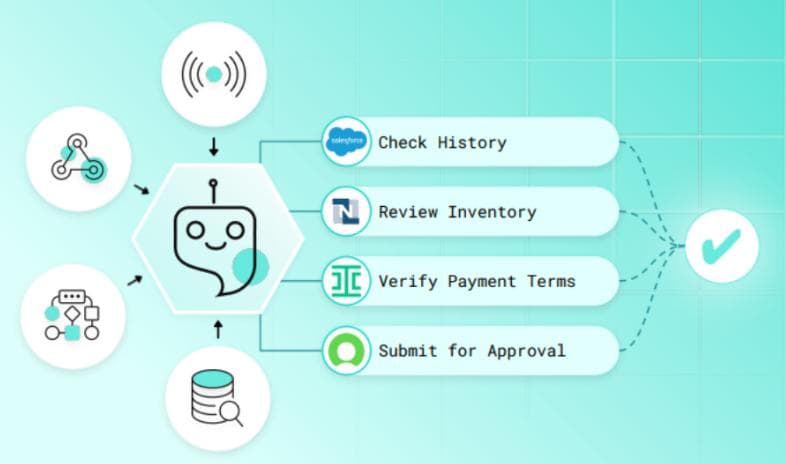 AI Execution
Why AI Execution Systems Will Define the Future of Enterprise Operations
The next frontier of enterprise competitive advantage is not strategy it is execution. AI execution systems that translate strategic intent into coordinated operational action, faster and more reliably than any human-managed process, are becoming the defining infrastructure of enterprise performance in every sector.
 Autonomous Coordination
The Rise of Autonomous Enterprise Coordination Platforms
Enterprise coordination the alignment of people, processes, information, and resources across organisational boundaries has always been expensive, slow, and error-prone when managed through human intermediaries alone. Autonomous coordination platforms powered by AI are replacing the coordination overhead of large organisations with intelligent systems that synchronise the enterprise continuously and without manual intervention.
 AI Agents
How AI Agents Are Transforming Enterprise Workflow Intelligence
AI agents autonomous systems that perceive their environment, reason about objectives, and take action across enterprise workflows are moving from research concept to operational reality. The enterprises deploying AI agents at scale are discovering that workflow intelligence is not just about automation it is about creating organisational capability that compounds with every cycle.