Enterprise AI Is Broken: Why It's Not Delivering ROI
Billions have been spent on AI across enterprises worldwide, yet manual follow-ups still dominate daily operations. Dashboards multiply, pilots launch, and most quietly die. The missing layer is not intelligence it is execution.
Nirmal Nambiar
Author

A Fortune 500 company spends $4 million on an AI transformation initiative. Eighteen months later, the primary output is a set of dashboards that the operations team reviews every Monday morning and then acts on manually. This is not an edge case. It is the dominant outcome of enterprise AI investment in 2026. Gartner estimates that close to 70% of AI pilots never reach production scale. Of those that do, the majority deliver insight anomaly detection, forecasting, summarisation without delivering the one thing enterprises actually need: action. The billion-dollar gap in enterprise AI is not a gap in intelligence. It is a gap in execution. What if AI did not just show you a problem, but fixed it?
Billions Spent, Manual Follow-Ups Still Rule
The enterprise AI market crossed $50 billion in annual spend in 2025. The primary deliverable of that spend, for most large organisations, is a richer set of dashboards and a longer list of flagged anomalies that humans are expected to act on. The AI has done its job it found the signal. The human is still responsible for the response.This is the structural failure of the current generation of enterprise AI deployment. Intelligence was treated as the hard problem. Execution was assumed to follow automatically. It does not. The gap between a flagged insight and a closed workflow loop is precisely where enterprise value disappears into email threads, Slack messages, approval queues, and weekly status meetings.
Why AI Pilots Die Before They Scale
The 70% failure-to-scale rate for AI pilots is not primarily a technology problem. It is an integration and ownership problem. A pilot that detects invoice mismatches in a controlled dataset is straightforward to build. A production system that detects an invoice mismatch and automatically routes it to the right vendor contact, updates the ERP, and logs the resolution for audit without a human in the middle requires an execution architecture that most enterprises have not built.The pilot succeeds because its output is a report. The production system fails to scale because its output needs to be an action, and no one has defined who or what owns that action.
The Missing Layer: Execution
Enterprises have invested heavily in the intelligence layer of AI. They have models that forecast demand, detect fraud, summarise contracts, and flag SLA breaches. What they have not built is the execution layer the system that takes the output of those models and closes the loop across the SaaS tools, ERP systems, approval chains, and human stakeholders that make up an enterprise workflow.The execution layer is not a dashboard. It is not an alert. It is an autonomous system that owns the workflow from signal to resolution, acts across integrated systems, and surfaces only genuine exceptions for human review. The enterprise AI stack is not broken at the intelligence layer. It is broken because the execution layer does not exist.

The Core Problem: AI Gives Insights, But Enterprises Need Execution
Related articles
View all →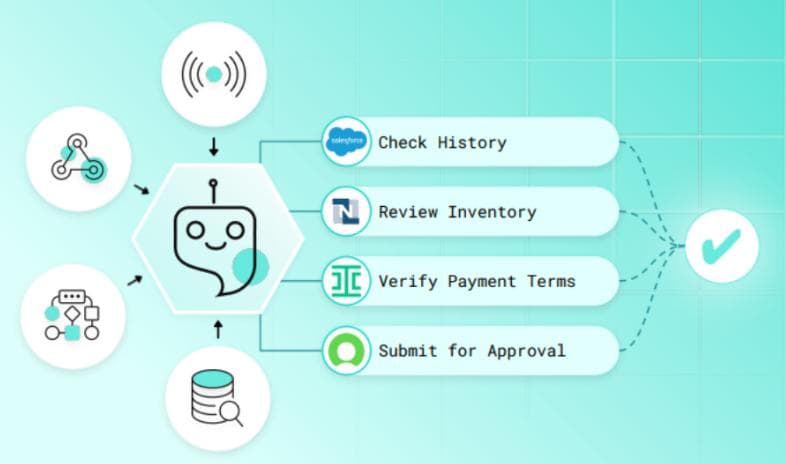 AI Execution
Why AI Execution Systems Will Define the Future of Enterprise Operations
The next frontier of enterprise competitive advantage is not strategy it is execution. AI execution systems that translate strategic intent into coordinated operational action, faster and more reliably than any human-managed process, are becoming the defining infrastructure of enterprise performance in every sector.
 Autonomous Coordination
The Rise of Autonomous Enterprise Coordination Platforms
Enterprise coordination the alignment of people, processes, information, and resources across organisational boundaries has always been expensive, slow, and error-prone when managed through human intermediaries alone. Autonomous coordination platforms powered by AI are replacing the coordination overhead of large organisations with intelligent systems that synchronise the enterprise continuously and without manual intervention.
 AI Agents
How AI Agents Are Transforming Enterprise Workflow Intelligence
AI agents autonomous systems that perceive their environment, reason about objectives, and take action across enterprise workflows are moving from research concept to operational reality. The enterprises deploying AI agents at scale are discovering that workflow intelligence is not just about automation it is about creating organisational capability that compounds with every cycle.