The Core Problem: AI Gives Insights, But Enterprises Need Execution
LLMs can summarise, forecast, and flag anomalies with impressive accuracy. What they cannot do is close the loop. The gap between an AI-generated insight and a resolved enterprise workflow is where most AI value is lost and it is a structural gap, not a technology gap.
Aditya Sharma
Author

The AI detected the problem at 2:14 AM. An invoice from a Tier-1 vendor had a line-item discrepancy of ₹3.8 lakh against the approved purchase order. The system flagged it, logged it, and sent an alert to the finance manager's inbox. The finance manager saw the alert at 9:30 AM, forwarded it to the accounts payable team, who emailed the vendor at 11:15 AM, received a response the following morning, and resolved the discrepancy four days after the AI first detected it. The AI worked perfectly. The execution layer did not exist. This is the core problem with enterprise AI in 2026 not a failure of intelligence, but a structural absence of the system that converts intelligence into action.
The Gap: Intelligence Without a Closure Mechanism
Large language models and modern AI systems are genuinely capable of summarising complex documents, forecasting demand with high accuracy, detecting anomalies in financial data, and generating structured recommendations. What they are not, by design, is execution systems. An LLM produces text. A forecasting model produces a probability distribution. A fraud detection system produces a flag. None of these outputs close a workflow loop without a downstream system that translates the output into an action a payment, an escalation, a ticket, a contract amendment.The gap between insight and action is not a minor inefficiency. It is the structural reason that AI investment delivers reports rather than outcomes. Every flagged anomaly that requires a human to email a vendor, every forecast that requires a human to adjust a purchase order, every detected SLA breach that requires a human to escalate a ticket each one represents a point where the execution layer is missing and the value of the AI insight is partially or fully lost.
Three Symptoms of the Missing Execution Layer
The first symptom is tool proliferation without coordination. Enterprises accumulate AI tools one for finance, one for operations, one for customer success each generating its own insights, none of which are connected to the others or to a shared execution mechanism. The result is a set of siloed intelligence systems that require humans to manually coordinate the responses they generate.The second symptom is persistent human-as-router behaviour. The most common use of a senior operations or finance professional in a modern enterprise is forwarding an AI-generated alert to the right person and following up to confirm it was acted on. This is not a high-value use of human attention. It is the direct consequence of having intelligence without an execution layer.The third symptom is the status update meeting. When AI systems flag issues but do not own resolution, the coordination overhead of tracking which issues are in which stage of resolution across teams, tools, and time zones gets absorbed into meetings. More AI without an execution layer produces more meetings, not fewer.
The Solution: An Execution Layer That Bridges Insight to Action
The execution layer that enterprises need is a system that takes structured AI outputs flags, forecasts, anomaly detections, recommendations and autonomously executes the corresponding workflow actions across the integrated SaaS and ERP tools the enterprise uses. It creates the vendor email. It routes the approval. It updates the ERP record. It reassigns the Jira ticket. It does not wait for a human to interpret the insight and decide what to do.This is not an AI assistant. It is an autonomous execution platform a system with defined workflow ownership, integration with enterprise tools, an audit trail for every action, and human-in-the-loop escalation only for genuine exceptions. The intelligence layer of enterprise AI is mature. The execution layer is the gap that determines whether that intelligence generates value.

The AI Productivity Paradox (2026): More AI, Slower Decisions
Related articles
View all →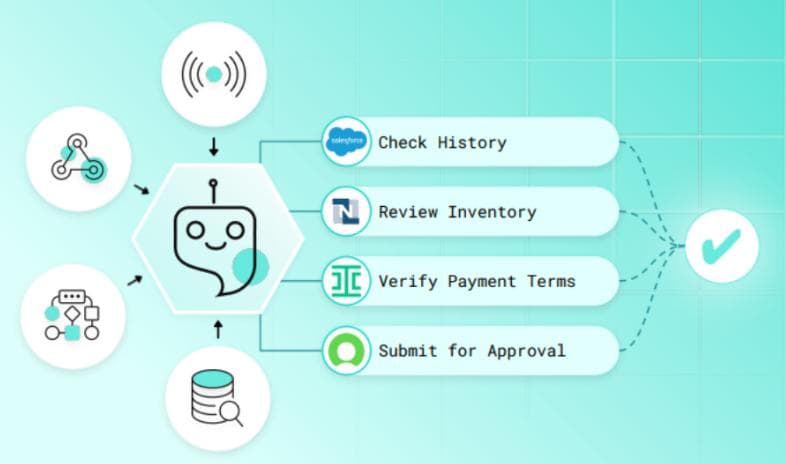 AI Execution
Why AI Execution Systems Will Define the Future of Enterprise Operations
The next frontier of enterprise competitive advantage is not strategy it is execution. AI execution systems that translate strategic intent into coordinated operational action, faster and more reliably than any human-managed process, are becoming the defining infrastructure of enterprise performance in every sector.
 Autonomous Coordination
The Rise of Autonomous Enterprise Coordination Platforms
Enterprise coordination the alignment of people, processes, information, and resources across organisational boundaries has always been expensive, slow, and error-prone when managed through human intermediaries alone. Autonomous coordination platforms powered by AI are replacing the coordination overhead of large organisations with intelligent systems that synchronise the enterprise continuously and without manual intervention.
 AI Agents
How AI Agents Are Transforming Enterprise Workflow Intelligence
AI agents autonomous systems that perceive their environment, reason about objectives, and take action across enterprise workflows are moving from research concept to operational reality. The enterprises deploying AI agents at scale are discovering that workflow intelligence is not just about automation it is about creating organisational capability that compounds with every cycle.