Why Your Current AI Architecture Is Broken (LLMs Are Not Executors)
LLMs are probabilistic text generators with no memory of workflow state, no ownership of outcomes, and no accountability for resolution. Building enterprise execution systems on top of them without an accountability layer is an architectural error one that most enterprises have already made.
Manroze
Author

The AI system your enterprise deployed six months ago can summarise a hundred-page contract in forty seconds. It can forecast next quarter's demand with 87% accuracy. It can detect anomalies in a transaction set of ten million records in under three minutes. It cannot remember that it flagged an invoice discrepancy last Tuesday and the vendor has not responded. It cannot own the escalation that should have happened on Thursday. It cannot verify that the resolution logged by the accounts payable team on Friday actually matches the original discrepancy it detected. This is not a limitation of the specific model your enterprise chose. It is the architectural reality of what large language models are and understanding that reality is the prerequisite for building AI systems that actually deliver enterprise value.
What LLMs Actually Are And Are Not
A large language model is a probabilistic text generator trained to produce contextually appropriate outputs given a structured input. It is extraordinarily capable within that definition. It is not, by design or architecture, a workflow execution system. It has no persistent memory of previous interactions unless explicitly provided. It has no mechanism for tracking the state of a multi-step workflow across time. It has no ownership of outcomes it produces an output and its involvement ends. It has no accountability structure there is no audit trail of what actions were taken as a result of its outputs.Building an enterprise execution system on top of an LLM without addressing these architectural gaps is equivalent to building a logistics operation around a system that is excellent at generating shipping labels but has no mechanism for tracking whether the shipment was picked up, is in transit, or has been delivered. The intelligence layer works. The execution architecture is absent.
Three Broken Assumptions in Current Enterprise AI Architecture
The first broken assumption is that insights drive action. The implicit model behind most enterprise AI deployments is that if the AI surfaces a clear, well-formatted insight to the right person, action will follow. In practice, insight-to-action conversion rates in enterprise workflows are low because the insight is clear but the ownership, priority, and execution path are not. Insight is necessary but not sufficient for action.The second broken assumption is that humans will follow up. Workflow systems built on the assumption that humans will consistently act on AI-generated alerts within appropriate timeframes are systems that have not been calibrated to actual human behaviour in an attention-competitive environment. Humans follow up on the alerts they remember, have bandwidth for, and are accountable to. Without a system that enforces follow-up, a significant proportion of alerts are never acted on.The third broken assumption is that more tools help. The proliferation of AI tools in an enterprise increases the total volume of insights generated but without a unified execution layer, it also increases the coordination overhead of acting on those insights. More tools without an execution layer produces more noise, not more action.
The Missing Component: An Accountability Layer with Audit Trails
The architectural component that enterprise AI deployments are missing is not a better model or a smarter dashboard. It is an accountability layer a system that tracks the state of every workflow action from trigger to resolution, enforces follow-up through automated escalation, maintains an audit trail of every action taken and by whom, and surfaces only genuine exceptions for human review.This accountability layer requires idempotent action design every action the system takes must be safe to retry if confirmation is not received, and must not produce duplicate effects if executed more than once. It requires integration with the enterprise's actual workflow tools not a separate dashboard, but actions taken directly in the ERP, CRM, project management, and communication systems the teams already use. And it requires a clear ownership model every workflow the system manages must have a defined human owner who receives escalations and whose name is attached to the audit trail. This is the architecture of an agentic execution system, and it is the layer that current enterprise AI deployments are missing.
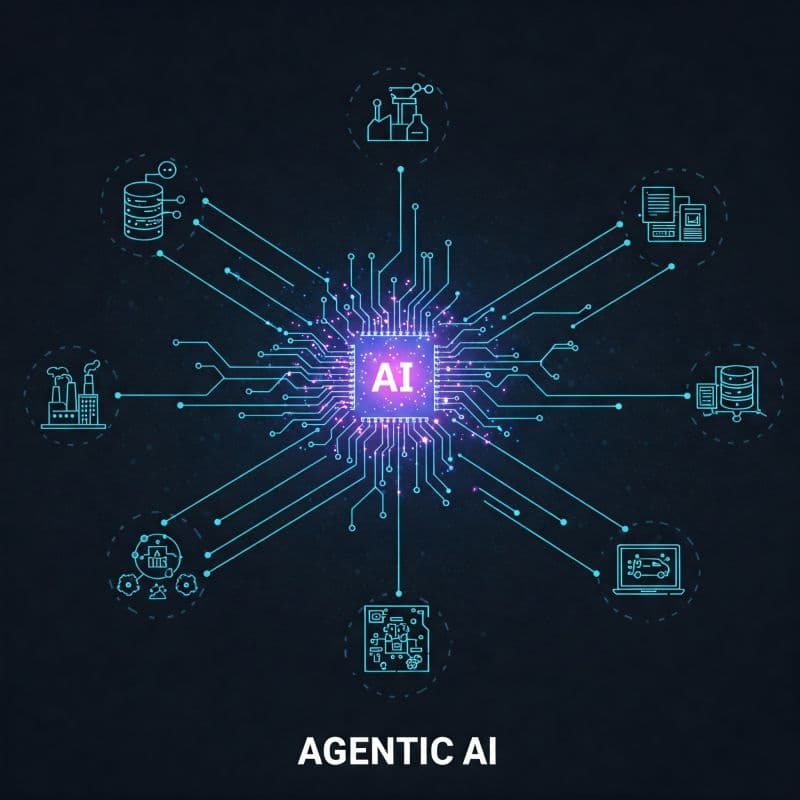
The Shift: Autonomous Execution Layer Where AI Takes Action, Not Just Notes
Related articles
View all →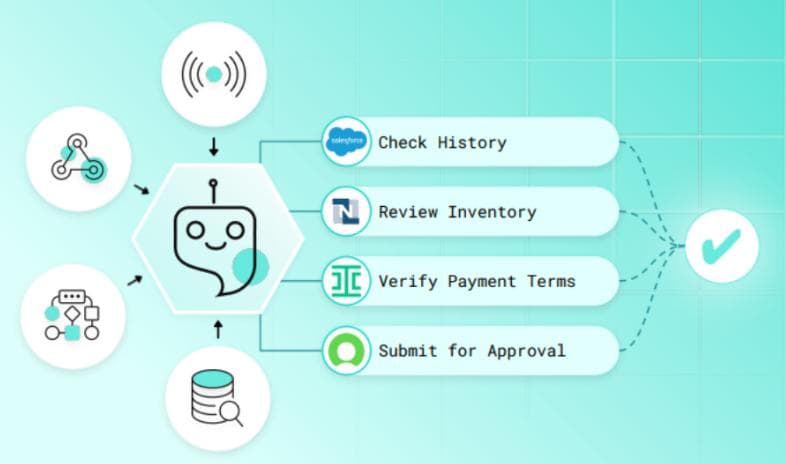 AI Execution
Why AI Execution Systems Will Define the Future of Enterprise Operations
The next frontier of enterprise competitive advantage is not strategy it is execution. AI execution systems that translate strategic intent into coordinated operational action, faster and more reliably than any human-managed process, are becoming the defining infrastructure of enterprise performance in every sector.
 Autonomous Coordination
The Rise of Autonomous Enterprise Coordination Platforms
Enterprise coordination the alignment of people, processes, information, and resources across organisational boundaries has always been expensive, slow, and error-prone when managed through human intermediaries alone. Autonomous coordination platforms powered by AI are replacing the coordination overhead of large organisations with intelligent systems that synchronise the enterprise continuously and without manual intervention.
 AI Agents
How AI Agents Are Transforming Enterprise Workflow Intelligence
AI agents autonomous systems that perceive their environment, reason about objectives, and take action across enterprise workflows are moving from research concept to operational reality. The enterprises deploying AI agents at scale are discovering that workflow intelligence is not just about automation it is about creating organisational capability that compounds with every cycle.