Why CAC Is No Longer a Marketing Problem It's a Business Model Problem
Rising customer acquisition costs are not a failure of marketing execution that better creative or smarter targeting can fix. They are a structural consequence of market maturation, competitive density, and platform economics that no amount of marketing optimisation can reverse. CAC is now a business model variable and the brands that treat it as a marketing variable are solving the wrong problem.
Nirmal Nambiar
Author
The marketing team had tried everything. New creative formats. Influencer seeding. Regional language campaigns. Lookalike audience expansion. A/B tests on every landing page element. New platform experiments on ShareChat and Moj. Each initiative produced a temporary improvement in CAC followed by a return to the trend rising, quarter after quarter, regardless of what the marketing team did. The founder eventually asked the question that reframed the problem: 'Is this a marketing execution problem, or is it a problem with the business model we are trying to make work with marketing?' The answer, when examined honestly, was the latter. The brand was competing in a category with twelve well-funded, well-branded competitors for an audience of approximately 4 million high-intent potential customers in India's metros. The total addressable paid media inventory for that audience was finite. Twelve brands competing for the same finite inventory with increasingly similar creative approaches had driven the auction price up to a level where the unit economics required a fundamental business model change not a better headline.
Why CAC Rise Is Structural, Not Tactical
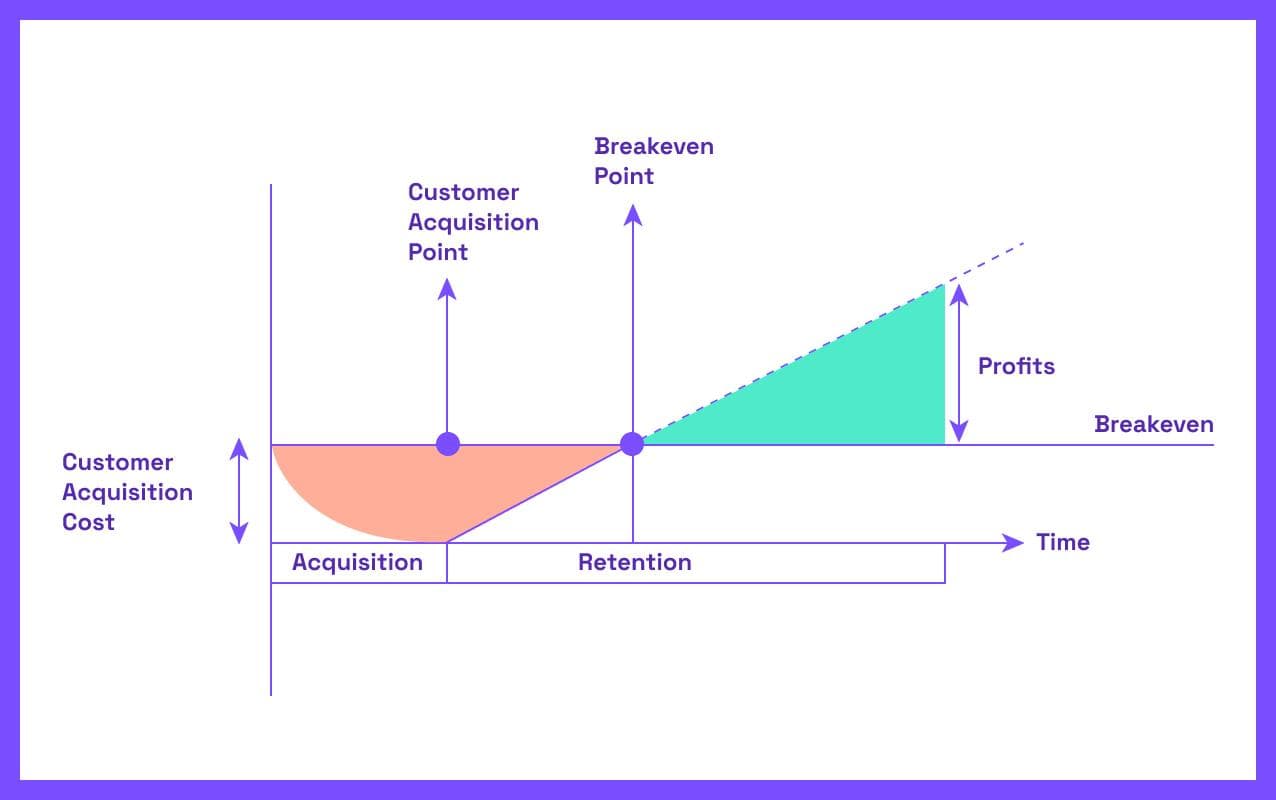
Customer acquisition cost in digital advertising markets follows a predictable structural trajectory. In the early stage of a category's digital advertising development, CPMs and CPCs are low because demand for the relevant audience inventory is sparse and the platforms are incentivised to offer competitive pricing to attract advertiser spend. As the category matures and more brands compete for the same audience, auction dynamics drive prices up. As targeting precision improves, the most valuable audience segments the high-intent, high-LTV consumers become the most competed-for and the most expensive to reach. The result is a long-term structural increase in CAC that is largely independent of any individual brand's marketing execution quality.The D2C brands that launched between 2018 and 2021 acquired their first cohorts at CAC levels that reflected the early-stage pricing of Indian digital advertising markets. The cohort economics that justified their initial business models were based on acquisition costs that were structurally temporary available only because the market had not yet attracted the competitive density that drives auction prices to their equilibrium levels. The CAC those brands are paying in 2026 is not a marketing failure. It is the market arriving at the price level that the competitive density of the category supports. Treating it as a marketing problem to be solved with better creative is a category error.
CAC as a Business Model Variable: What That Means
Treating CAC as a business model variable rather than a marketing variable changes the set of solutions the brand considers. If CAC is a marketing problem, the solutions are marketing solutions: better creative, smarter targeting, new channels, lower funnel optimisation. If CAC is a business model problem, the solutions are business model solutions: changing the revenue model so that a higher CAC is economically sustainable, changing the customer acquisition mechanism so that the marginal CAC decreases with scale, or changing the product and channel strategy so that the brand competes in a less crowded auction environment.The revenue model solutions include subscription and auto-replenishment models that increase LTV sufficiently to justify higher acquisition costs a brand that acquires a subscription customer at ₹1,200 CAC with a ₹4,800 annual LTV has a fundamentally different unit economics equation than a brand acquiring a transactional customer at the same ₹1,200 CAC with a ₹1,800 twelve-month LTV. The acquisition mechanism solutions include community building, content marketing, and referral programmes that generate acquisition at zero or near-zero marginal cost per customer once the mechanism is established. The product and channel strategy solutions include geographic expansion into Tier-2 and Tier-3 markets where auction density is lower, and channel mix shifts toward retail and quick commerce where the discovery mechanism is not a paid auction.
The Business Model Redesign Required
The business model redesign required to sustainably manage structurally rising CAC has three components. The first is LTV architecture: every element of the post-purchase experience product quality, packaging, customer service, loyalty programme, subscription incentives, and community must be designed to maximise the revenue generated from each acquired customer over their full relationship with the brand. A brand with a 90-day cohort retention rate of 45% and an average of 3.8 purchases per retained customer per year can sustain a significantly higher CAC than a brand with equivalent first-purchase metrics and a 90-day retention rate of 20%.The second component is acquisition diversification: building the non-paid acquisition mechanisms organic content, creator partnerships, community, retail discovery, referral that provide acquisition volume at CAC levels that do not depend on auction pricing. These mechanisms take twelve to twenty-four months to build to meaningful scale, which means the brand that starts building them when CAC pressure is already acute is building them too late. The third component is margin management: ensuring that the gross and contribution margin generated per order is sufficient to absorb the structurally higher CAC at the brand's current scale. If the contribution margin cannot support the CAC required to grow at the desired rate, the growth rate must be reduced or the contribution margin must be improved through pricing, COGS reduction, or channel mix optimisation before additional acquisition investment is justified.
Why Inventory Accuracy Is Harder in Omnichannel Than You Think
Related articles
View all → AI-Native Infrastructure
Why Global Enterprises Need AI-Native Operational Infrastructure
The operational infrastructure that global enterprises built in the pre-AI era was designed for a different competitive environment. Enterprises that try to layer AI on top of legacy operational infrastructure will capture a fraction of AI's potential. The ones that rebuild their operational foundations as AI-native will gain structural advantages their competitors cannot close.
 Strategic Execution
AI-Powered Enterprise Execution for Faster Strategic Outcomes
Strategic advantage in the current era is not determined by the quality of strategy alone it is determined by the speed at which strategy is executed. AI-powered enterprise execution systems are compressing the time from strategic decision to operational outcome in ways that are redefining competitive dynamics across every sector.
 Execution Speed
Why Enterprise Execution Speed Will Define Market Leadership in the AI Era
In the AI era, the fastest-executing enterprise wins. Not the best-strategised, not the most well-resourced the fastest. Execution speed is becoming the primary competitive variable, and the organisations that have built AI-powered execution infrastructure are setting a pace their competitors cannot match.