AI Agents vs Traditional Automation: What Changes?
The shift from traditional automation to AI agents represents a fundamental change in what enterprises can automate and how automated systems handle variability. Traditional automation excels at repetitive, rule-based tasks where the process is fully defined and exception conditions are rare. AI agents handle ambiguity, adapt to changing conditions, and operate effectively in scenarios where traditional automation fails because the rules cannot anticipate every variation. A traditional automation that processes invoice data extracts predefined fields and matches them to purchase ordersbut breaks when suppliers use different formats or when exceptions require judgment calls. An AI agent processes invoices by understanding document structure regardless of format, reasoning about appropriate matching logic when exact matches do not exist, and escalating only scenarios that genuinely require human judgment beyond the agent's authority. The difference is not speed of executionit is breadth of scenarios that can be automated.
Manthan Sharma
Author
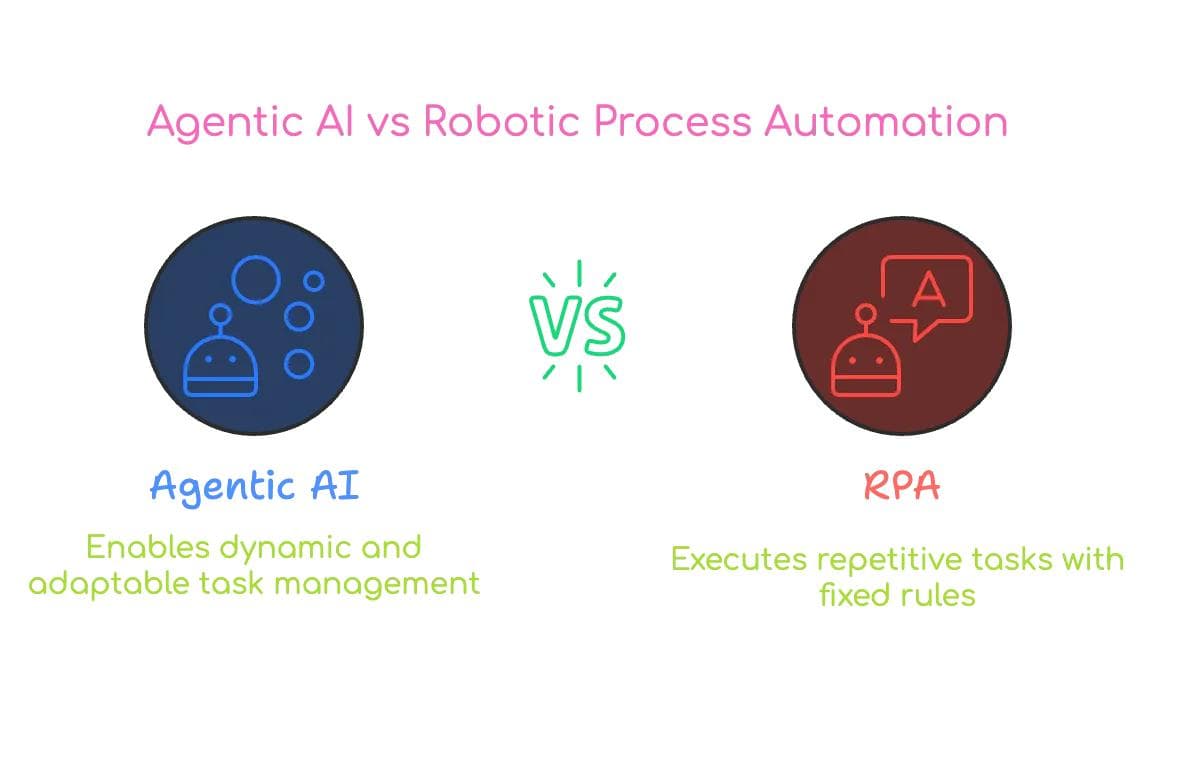
A healthcare insurance provider processes 45,000 claims daily with complex adjudication rules spanning coverage verification, procedure code validation, provider network status, and coordination of benefits. The traditional automation approach used robotic process automation (RPA) to handle straightforward claims: if all required fields are present, coverage is active, procedure codes match approved lists, and no exceptions exist, the RPA bot approves the claim automatically. In practice, this automation handled 31% of claimsthe remaining 69% required human review because they encountered variations that broke the predefined rules: missing secondary insurance information, procedure codes that did not exactly match approved lists but were clinically equivalent, provider network status that changed between service date and claim submission. The human claims processors spent their time reviewing these exceptions, many of which were routine variations rather than genuine judgment calls. The same provider deployed AI agents for claims processing: the agents understand clinical terminology and can match procedure codes to approved treatments based on clinical equivalence rather than requiring exact code matches, they reason about coordination of benefits when secondary insurance information is incomplete by querying external databases, they handle provider network changes by checking current status rather than requiring submission-date accuracy, and they escalate only scenarios that require genuine judgmentexperimental procedures, high-cost treatments requiring medical necessity review, or fraud indicators. The result: AI agents process 78% of claims automatically versus 31% with traditional RPA, claims processors now focus exclusively on complex medical reviews rather than processing routine variations, and claim processing cycle time dropped by 56% because routine variations no longer queue for human review. The fundamental difference is not the automation technologyit is what can be automated: traditional RPA handles rigid processes, AI agents handle processes with inherent variability.
Brittle Rules vs Adaptive Reasoning: The Core Technical Difference
Traditional automation operates through explicit rules: if condition A is true, take action B; if condition C occurs, escalate to human review. This works excellently for processes that are fully specifiablepayroll calculations, standard report generation, database backupsbut fails when processes involve judgment calls that humans handle intuitively but that are difficult to encode as explicit rules. An accounts payable process might have a rule that invoices matching purchase orders within 2% of amount are approved automatically, but what about invoices that are 2.3% over because of shipping surcharges, or invoices that match all fields except the vendor changed their company name? Traditional automation escalates these as exceptions requiring human review because the rules cannot anticipate every variation. Human processors resolve these routinely because they understand business context and can reason about whether variations are significant or routine.AI agents operate through reasoning rather than rigid rules: they understand the objective (validate that invoices represent legitimate purchases and match contracted terms), they have context about business operations (this vendor frequently incurs shipping charges, company name changes are documented in vendor master), and they can reason about whether variations are consistent with the objective even when they do not match predefined rules exactly. This adaptive capability is what allows AI agents to automate processes that traditional automation cannot handle: research shows that enterprises deploying AI agents report 40-60% increases in automation coverage because agents can handle process variations that RPA systems escalate as exceptions. The economic advantage is not marginalit is the difference between automating 30-40% of a process (the rigid rules) and automating 70-80% (the entire process including routine variations), with humans handling only scenarios that genuinely require judgment beyond the agent's authority. Organizations report that traditional automation reduces processing time by 15-25% while AI agents reduce processing time by 45-65% because they automate the routine variations that traditional systems cannot address.
Exception Handling: Where Traditional Automation Breaks and AI Agents Thrive
The operational reality that distinguishes AI agents from traditional automation is how systems handle exceptions. Traditional automation is designed for the happy path: when inputs match expected formats, when conditions align with predefined rules, and when no unusual circumstances exist, traditional automation executes flawlessly. But enterprise operations are full of exceptionsvariations in data format, timing issues, system unavailability, regulatory changes, supplier behavior changesand traditional automation handles exceptions through escalation: when anything falls outside predefined rules, the system stops and queues the case for human review. This creates two problems: first, many escalated exceptions are routine variations that do not actually require human judgment but that the automation cannot handle; second, genuine complex exceptions queue alongside routine variations, making it difficult for human reviewers to prioritize appropriately.AI agents are specifically designed for exception handling: they operate in the gray zone between routine automation and genuine judgment calls. An AI agent processing insurance claims can handle missing information by querying additional data sources, evaluate clinical equivalence when procedure codes do not match exactly, and adjust for timing variations when coverage status changed between service and claim dates. Research shows that AI agents reduce exception rates by 60-75% compared to traditional automation because they handle routine variations autonomously rather than escalating them. For the scenarios that do require escalation, AI agents provide better context: instead of simply flagging that a claim does not match predefined rules, the agent explains what specific aspect requires judgment, provides relevant context from customer history, and often suggests potential resolutions for the human reviewer to consider. Organizations deploying AI agents report that human exception processors become 2-3x more productive because they handle fewer but more meaningful exceptions with better context for decision-making. The strategic implication is that AI agents extend automation into the exception zone that traditional automation cannot address, fundamentally expanding what percentage of enterprise processes can operate autonomously.
Implementation Strategy: When to Use Traditional Automation vs AI Agents
The choice between traditional automation and AI agents is not either-orit is matching the right technology to process characteristics. Traditional automation remains the optimal choice for processes that are fully specifiable, have minimal variations, require high speed and low latency, and operate in environments where rule compliance is paramount. Payroll processing, financial close procedures, report generation, and backup operations are examples where traditional automation provides deterministic execution with minimal overhead. AI agents are optimal for processes that involve unstructured data, require adaptation to variations, need context awareness across systems, and operate in domains where exceptions are common but not arbitrary. Claims processing, customer service, invoice processing, and supply chain coordination are examples where AI agents provide superior automation coverage because they can handle the routine variations that traditional systems cannot address.The implementation pattern for enterprises with existing traditional automation is additive rather than replacement: identify processes where traditional automation handles the core happy path but generates high exception volumes, deploy AI agents to handle the exception zonethe variations that do not match rigid rules but do not require genuine human judgment, measure the reduction in exception escalations and improvement in end-to-end processing time, and expand AI agent coverage systematically while maintaining traditional automation for the deterministic core processes. Organizations deploying this hybrid approach report optimal results: traditional automation handles 40-50% of process volume with minimal latency and overhead, AI agents handle 30-40% of volume representing the routine variation zone, and human specialists handle 10-20% representing genuine complex scenarios. The strategic advantage is substantial: enterprises operating with traditional automation alone can automate 40-50% of processes; enterprises adding AI agents can automate 70-80% of processes; and the remaining 10-20% that requires human judgment gets better outcomes because specialists focus exclusively on complex scenarios rather than processing routine variations alongside genuine judgment calls.

How AI Execution Systems Reduce Operational Bottlenecks
Related articles
View all → AI Execution
Why AI Execution Systems Will Define the Future of Enterprise Operations
The next frontier of enterprise competitive advantage is not strategy it is execution. AI execution systems that translate strategic intent into coordinated operational action, faster and more reliably than any human-managed process, are becoming the defining infrastructure of enterprise performance in every sector.
 AI Agents
How AI Agents Are Transforming Enterprise Workflow Intelligence
AI agents autonomous systems that perceive their environment, reason about objectives, and take action across enterprise workflows are moving from research concept to operational reality. The enterprises deploying AI agents at scale are discovering that workflow intelligence is not just about automation it is about creating organisational capability that compounds with every cycle.
 AI-Native Infrastructure
Why Global Enterprises Need AI-Native Operational Infrastructure
The operational infrastructure that global enterprises built in the pre-AI era was designed for a different competitive environment. Enterprises that try to layer AI on top of legacy operational infrastructure will capture a fraction of AI's potential. The ones that rebuild their operational foundations as AI-native will gain structural advantages their competitors cannot close.