AI Execution Agents: The Missing Infrastructure Layer for Digital Transformation
Digital transformation programmes have invested trillions in data, cloud, and analytics infrastructure. Most have not invested in the execution layer the AI agents that translate digital insight into operational action. Without this layer, digital transformation creates better visibility into problems without creating the capability to solve them faster.
Manroze
Author

The standard digital transformation investment portfolio looks remarkably similar across industries and geographies: cloud migration to create scalable infrastructure, data platform modernisation to create a single source of truth, analytics and BI tools to create management visibility, and digital channels to create customer-facing capability. This portfolio, executed well, produces an enterprise that has better data, better visibility, and better customer interfaces than it had before the transformation. What it does not produce what the standard portfolio does not address is an enterprise that acts faster. The insight layer is transformed. The execution layer is not. A sales operations team with a real-time dashboard showing which deals are at risk still has to manually review that dashboard, identify the at-risk deals, decide on interventions, communicate those interventions to the relevant account managers, and follow up to ensure the interventions were executed. The dashboard made the problem visible in real time. The response time is still measured in hours or days. AI execution agents are the missing infrastructure layer in most digital transformation portfolios: the software capability that closes the gap between the insight the data layer produces and the operational response the business requires. Without this layer, digital transformation investments produce diminishing returns each marginal improvement in data quality and analytics sophistication yields less value because the execution constraint, not the insight constraint, is the binding limitation on business performance.
The Missing Layer: Why Insight Without Execution Infrastructure Underperforms
The insight-execution gap is the most underanalysed source of digital transformation underperformance. Organisations that have invested heavily in data and analytics infrastructure frequently find that the ROI of their investments is lower than projected not because the insights generated are inaccurate or irrelevant, but because the organisational capacity to act on insights at the speed and scale the data enables is the binding constraint. A logistics company that knows, in real time, that 3% of tomorrow's deliveries are at risk of missing their time windows has better information than its competitors. But if acting on that information requires a human dispatcher to review the dashboard, identify the at-risk deliveries, manually assess the rerouting options, and update the routing system one delivery at a time, the real-time data advantage is only partially realised. AI execution agents that automatically detect the at-risk deliveries, assess rerouting options against current road conditions and driver availability, execute the optimal rerouting decisions, notify affected customers, and alert the human dispatcher only to the cases that require manual judgment realise the full value of the real-time data infrastructure.The missing layer is not just a technology gap. It is an architecture gap: most digital transformation programmes were designed with a mental model that separates insight production from action execution, and assigns the action execution function to human operators who review insight outputs and decide what to do with them. This mental model made sense when the volume and velocity of insights was limited by the data processing capacity of legacy systems. In a cloud-native, real-time data architecture, the volume and velocity of actionable insights can far exceed the capacity of human operators to act on them. The AI execution agent layer is the architectural response to this imbalance: it brings the execution capacity into alignment with the insight production capacity, ensuring that every actionable insight the data layer produces can actually be acted upon.
The Four Types of AI Execution Agents Enterprises Are Deploying
Type 1: Monitoring and alert execution agents
Monitoring and alert execution agents continuously observe operational metrics across enterprise systems, detect when metrics deviate from acceptable ranges or trend toward threshold violations, and execute predefined response actions alerting the right people, initiating diagnostic procedures, adjusting system parameters without waiting for a human to notice the deviation and decide what to do. In IT operations, supply chain management, financial monitoring, and customer experience management, monitoring execution agents are compressing the response time to operational anomalies from hours to minutes, reducing the operational impact of issues that would otherwise compound while awaiting human attention.
Type 2: Decision execution agents
Decision execution agents automate the execution of operational decisions that follow defined logic pricing updates, inventory reordering, resource allocation, scheduling adjustments that currently require human operators to review data, make a decision, and execute it in one or more enterprise systems. By embedding the decision logic in the agent and giving it write access to the relevant systems, decision execution agents can execute hundreds or thousands of operational decisions per hour that human operators could only execute in days. The value is not just speed it is consistency: decision execution agents apply the same logic to every decision, without the fatigue, distraction, and inconsistency that characterise human decision-making at high volume.
Type 3: Coordination execution agents
Coordination execution agents manage the execution of multi-party processes customer onboarding, supplier qualification, project delivery, regulatory compliance workflows that require coordinating the actions of multiple people and systems over extended timeframes. These agents maintain awareness of the full coordination state, track the completion of each party's responsibilities, identify when coordination is breaking down or dependencies are creating bottlenecks, and intervene to keep the process moving sending reminders, escalating delays, rerouting tasks to available alternatives, and updating all parties on current status. Coordination execution agents are particularly valuable in processes where coordination failure is the primary cause of delay and where the overhead of human coordination management is a significant operational cost.
Type 4: Learning and optimisation agents
Learning and optimisation agents continuously improve the operational performance of the processes they manage by tracking outcomes, identifying patterns in what produces good and bad results, and adjusting their execution approach to increase the frequency of good outcomes. A customer retention agent that tracks which intervention types produce the highest retention rates for which customer segments and continuously updates its intervention selection to favour the highest-performing approaches is not just executing a retention process. It is continuously improving the retention process through operational experience. Learning agents convert operational execution into an ongoing improvement programme, producing compounding performance gains that justify their deployment cost many times over.
The Execution Agent Infrastructure Diagnostic
- Have you mapped the insight-to-action lag in your highest-value operational processes the time between a data insight being available and the corresponding operational action being executed and quantified the business value of closing this gap?
- Does your current digital infrastructure provide the system integration layer APIs, event streams, and real-time data access that AI execution agents require to read enterprise state and execute actions across multiple systems?
- Have you identified the specific execution agent types monitoring, decision, coordination, or learning that address the most significant operational constraints in your current digital transformation investment portfolio?
- Do you have the governance and audit infrastructure required to operate AI execution agents in a regulated environment maintaining records of agent decisions, providing explainability for agent actions, and enabling human review and override of agent behaviour?
- Have you assessed the change management implications of execution agent deployment specifically, how the roles of the human operators whose work agents will augment or replace will change, and how you will manage the workforce transition?

Related articles
View all →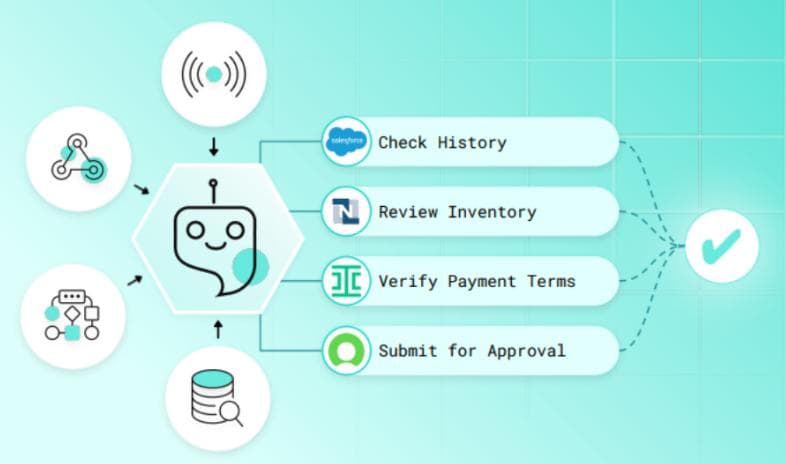 AI Execution
Why AI Execution Systems Will Define the Future of Enterprise Operations
The next frontier of enterprise competitive advantage is not strategy it is execution. AI execution systems that translate strategic intent into coordinated operational action, faster and more reliably than any human-managed process, are becoming the defining infrastructure of enterprise performance in every sector.
 AI Agents
How AI Agents Are Transforming Enterprise Workflow Intelligence
AI agents autonomous systems that perceive their environment, reason about objectives, and take action across enterprise workflows are moving from research concept to operational reality. The enterprises deploying AI agents at scale are discovering that workflow intelligence is not just about automation it is about creating organisational capability that compounds with every cycle.
 AI-Native Infrastructure
Why Global Enterprises Need AI-Native Operational Infrastructure
The operational infrastructure that global enterprises built in the pre-AI era was designed for a different competitive environment. Enterprises that try to layer AI on top of legacy operational infrastructure will capture a fraction of AI's potential. The ones that rebuild their operational foundations as AI-native will gain structural advantages their competitors cannot close.