AI Isn't Taking Jobs Companies Are Using It as an Excuse
The real story behind AI-related layoffs isn't automation it's corporate cover.
Aditya Sharma
Author
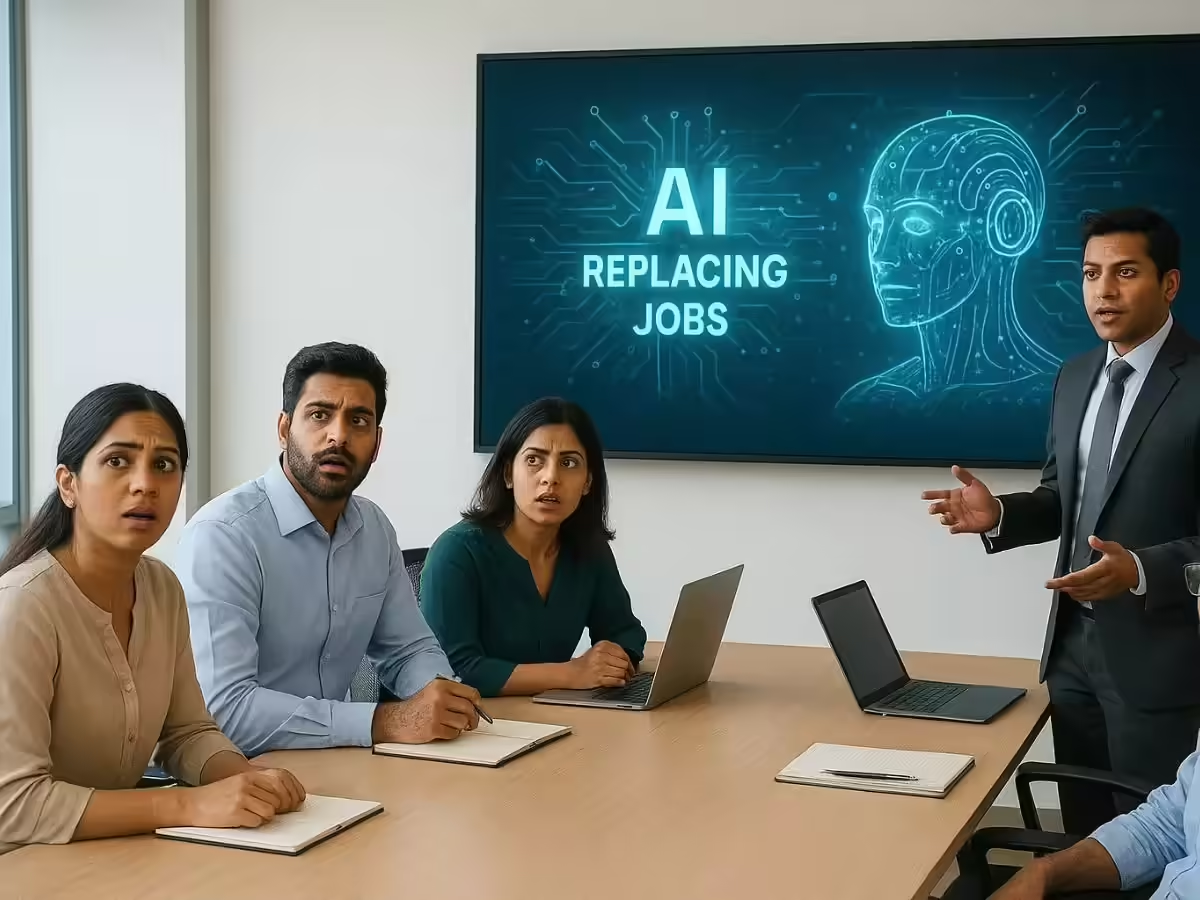
Every week, another headline: 'Company X lays off Y thousand workers, cites AI.' It sounds inevitable like gravity. But look closer at the numbers, the timing, and the decisions being made in boardrooms, and a different picture emerges. AI is being used as a convenient narrative to justify choices that have nothing to do with automation.
The Pattern Is Too Convenient
In 2023 and 2024, some of the most profitable companies in the world announced layoffs in the same breath as AI investment announcements. The optics were deliberate: AI is replacing workers, so job cuts are inevitable. But profitable companies don't cut jobs because they have to. They cut them because Wall Street rewards it.When a company posts record revenue, buys back billions in stock, and simultaneously lays off 10,000 employees AI didn't do that. A board decision did.
What the Data Actually Shows
| Company | Layoffs (202324) | Profit Same Year | Stated Reason |
|---|---|---|---|
| 12,000 | $73.8B | AI restructuring | |
| Microsoft | 10,000 | $72.4B | AI prioritization |
| Amazon | 27,000 | $30.4B | Efficiency & AI |
| Meta | 21,000 | $39.1B | Year of Efficiency |
AI Can't Do What Companies Claim
The jobs being cut customer support leads, mid-level engineers, HR roles, content teams are not yet replaceable by current AI. LLMs hallucinate. They can't maintain long-term project context. They require constant human oversight to be reliable.The productivity gains AI delivers are real but marginal in most enterprise settings. A 20% efficiency boost in one team does not justify eliminating that team.
Who Actually Benefits from the Narrative
- Executives who use 'AI disruption' to push through politically difficult headcount reductions
- Investors who see AI as a margin improvement story and reward cost-cutting accordingly
- Companies that want to reduce compensation burdens while maintaining output expectations through surviving employees
- PR teams who frame greed as inevitability
The Workers Paying the Price
The workers being let go aren't being replaced by robots. In most cases, their work is being redistributed to remaining employees who are expected to absorb it without additional pay. AI is the justification, overwork is the outcome.This matters because it shapes public policy. If lawmakers believe AI is the primary driver of unemployment, they focus on retraining programs instead of the real issue: unchecked corporate power to use technology as political cover.
What Genuine AI Displacement Looks Like
Real automation displacement
True AI-driven job loss is happening but it's narrow and specific. Data labelers, basic transcription, some tier-1 support. These are low-wage roles, and the displacement is real. But this is a fraction of the layoffs being blamed on AI.
Corporate restructuring disguised as automation
The larger wave of layoffs hitting mid-to-senior knowledge workers at profitable firms has almost nothing to do with AI capability. It's a correction from over-hiring during the 20202021 boom, dressed up in AI language because it's less defensible to say 'we hired too many people when money was cheap.'
What Should Actually Change
- Companies should be required to disclose if AI actually replaced a role, versus a headcount reduction decision
- Severance and worker protections should not be negotiable based on the stated reason for layoffs
- Investors should stop rewarding layoffs at profitable companies as a reflexive signal of 'discipline'
- The media should push harder on the gap between stated AI rationale and actual role elimination data
The Bottom Line
AI is a powerful tool. It will change work over the next decade in real and significant ways. But right now, in 2024 and 2025, it is being used primarily as a narrative device a way to make corporate decisions sound like natural forces rather than deliberate choices.Calling it what it is isn't anti-technology. It's just accurate.

Related articles
View all → Autonomous Coordination
The Rise of Autonomous Enterprise Coordination Platforms
Enterprise coordination the alignment of people, processes, information, and resources across organisational boundaries has always been expensive, slow, and error-prone when managed through human intermediaries alone. Autonomous coordination platforms powered by AI are replacing the coordination overhead of large organisations with intelligent systems that synchronise the enterprise continuously and without manual intervention.
 AI Agents
How AI Agents Are Transforming Enterprise Workflow Intelligence
AI agents autonomous systems that perceive their environment, reason about objectives, and take action across enterprise workflows are moving from research concept to operational reality. The enterprises deploying AI agents at scale are discovering that workflow intelligence is not just about automation it is about creating organisational capability that compounds with every cycle.
 AI-Native Infrastructure
Why Global Enterprises Need AI-Native Operational Infrastructure
The operational infrastructure that global enterprises built in the pre-AI era was designed for a different competitive environment. Enterprises that try to layer AI on top of legacy operational infrastructure will capture a fraction of AI's potential. The ones that rebuild their operational foundations as AI-native will gain structural advantages their competitors cannot close.