How AI Agents Can Streamline Complex Enterprise Operations at Scale
The complexity of large-scale enterprise operations has always created a ceiling on how much any organisation can manage effectively. AI agents are raising that ceiling handling the coordination, monitoring, and execution tasks that previously limited operational scale.
Manroze
Author

Operational complexity is the natural enemy of scale. As enterprises grow more products, more markets, more customers, more suppliers, more regulatory requirements the operational complexity of managing all of these dimensions simultaneously grows faster than the management capacity available to handle it. AI agents are the first technology that addresses operational complexity at its source rather than through its symptoms. Not by simplifying the underlying complexity, but by handling the coordination, monitoring, and execution tasks that complexity generates, at a scale and speed that makes the complexity manageable without the proportional management overhead that complexity has historically required.
How AI Agents Handle Operational Complexity
AI agents handle operational complexity through a combination of capabilities that no previous automation technology has provided simultaneously. Parallel processing: AI agents can monitor hundreds of operational metrics, manage thousands of concurrent tasks, and coordinate dozens of interdependent workflows simultaneously. Contextual awareness: AI agents can maintain and apply context across complex, multi-step operational processes understanding that a supplier delay in week one has implications for production scheduling in week three and customer delivery commitments in week four, and proactively managing those downstream implications from the moment the upstream event occurs.Adaptive response: when the operational environment changes a demand spike, a quality issue, a logistics disruption AI agents can identify the change, assess its implications across all affected operational dimensions, and initiate appropriate responses without the latency that human-operated processes introduce. This combination of scale, context, and adaptability makes AI agents qualitatively different from previous automation tools and it is this combination that makes them effective at managing the complex, interconnected operational environments that large enterprises operate.
AI Agent Applications in Complex Operations
Supply Chain Operations
Supply chain operations represent one of the highest-complexity, highest-impact applications for AI agents in large enterprises. An AI agent managing supply chain operations monitors demand signals, inventory positions, supplier performance, logistics status, and production schedules simultaneously identifying the cross-dimensional implications of each signal and coordinating responses that optimise across all constraints. When a key supplier reports a delivery delay, the AI agent simultaneously assesses the inventory buffer available, identifies the production schedule adjustments required, evaluates alternative sourcing options, and generates the customer communication required if delivery commitments are at risk all before a human supply chain manager has been briefed on the original delay.
Financial Operations
In financial operations, AI agents are transforming the management of accounts payable, accounts receivable, financial close processes, and compliance monitoring. AI agents that manage accounts payable autonomously matching invoices to purchase orders, identifying discrepancies, routing exceptions for human review, and executing approved payments are achieving processing speeds and accuracy rates that manual processes cannot match. For large enterprises processing thousands of invoices per day across multiple currencies and entities, the operational efficiency of AI agent-managed financial operations represents a significant cost reduction and compliance quality improvement.
AI Agent Deployment Questions for Complex Operations
- Which operational domains in your enterprise have the highest complexity measured by the number of concurrent processes, interdependencies, and exception types and are these the domains where AI agent deployment would deliver the most value?
- What is the current error rate and processing cost for your highest-volume operational processes and how do these compare to benchmarks from enterprises that have deployed AI agents in equivalent processes?
- What data infrastructure is required to support AI agent operation in your highest-priority domain and what is your current gap relative to that requirement?
- How would you design the human oversight model for AI agent-managed operations in your enterprise defining the escalation protocols and performance monitoring frameworks?
- What pilot scope would allow you to evaluate AI agent performance in a meaningful but contained operational context before committing to full-scale deployment?

Why Intelligent Execution Systems Are the Future of Enterprise Management
Related articles
View all →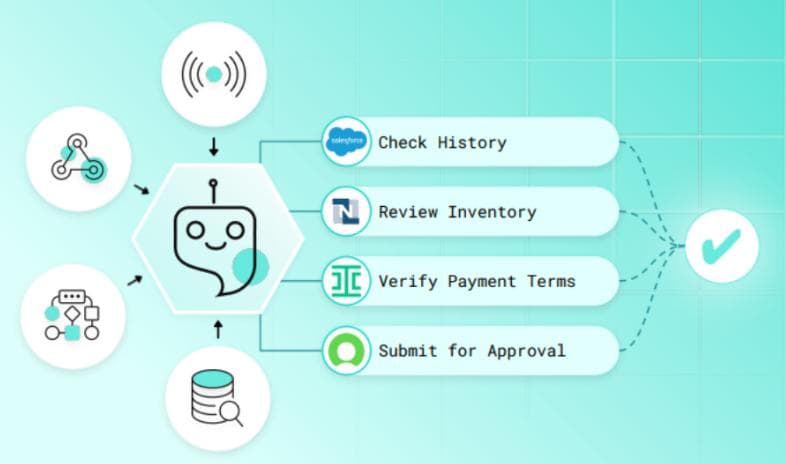 AI Execution
Why AI Execution Systems Will Define the Future of Enterprise Operations
The next frontier of enterprise competitive advantage is not strategy it is execution. AI execution systems that translate strategic intent into coordinated operational action, faster and more reliably than any human-managed process, are becoming the defining infrastructure of enterprise performance in every sector.
 AI Agents
How AI Agents Are Transforming Enterprise Workflow Intelligence
AI agents autonomous systems that perceive their environment, reason about objectives, and take action across enterprise workflows are moving from research concept to operational reality. The enterprises deploying AI agents at scale are discovering that workflow intelligence is not just about automation it is about creating organisational capability that compounds with every cycle.
 AI-Native Infrastructure
Why Global Enterprises Need AI-Native Operational Infrastructure
The operational infrastructure that global enterprises built in the pre-AI era was designed for a different competitive environment. Enterprises that try to layer AI on top of legacy operational infrastructure will capture a fraction of AI's potential. The ones that rebuild their operational foundations as AI-native will gain structural advantages their competitors cannot close.