The Future of Predictive Maintenance in Smart Industries
Unplanned equipment downtime costs industrial enterprises billions annually. Predictive maintenance powered by IoT sensors and AI is replacing scheduled maintenance cycles with real-time failure prediction and the operational and financial impact is transformative.
Manthan Sharma
Author
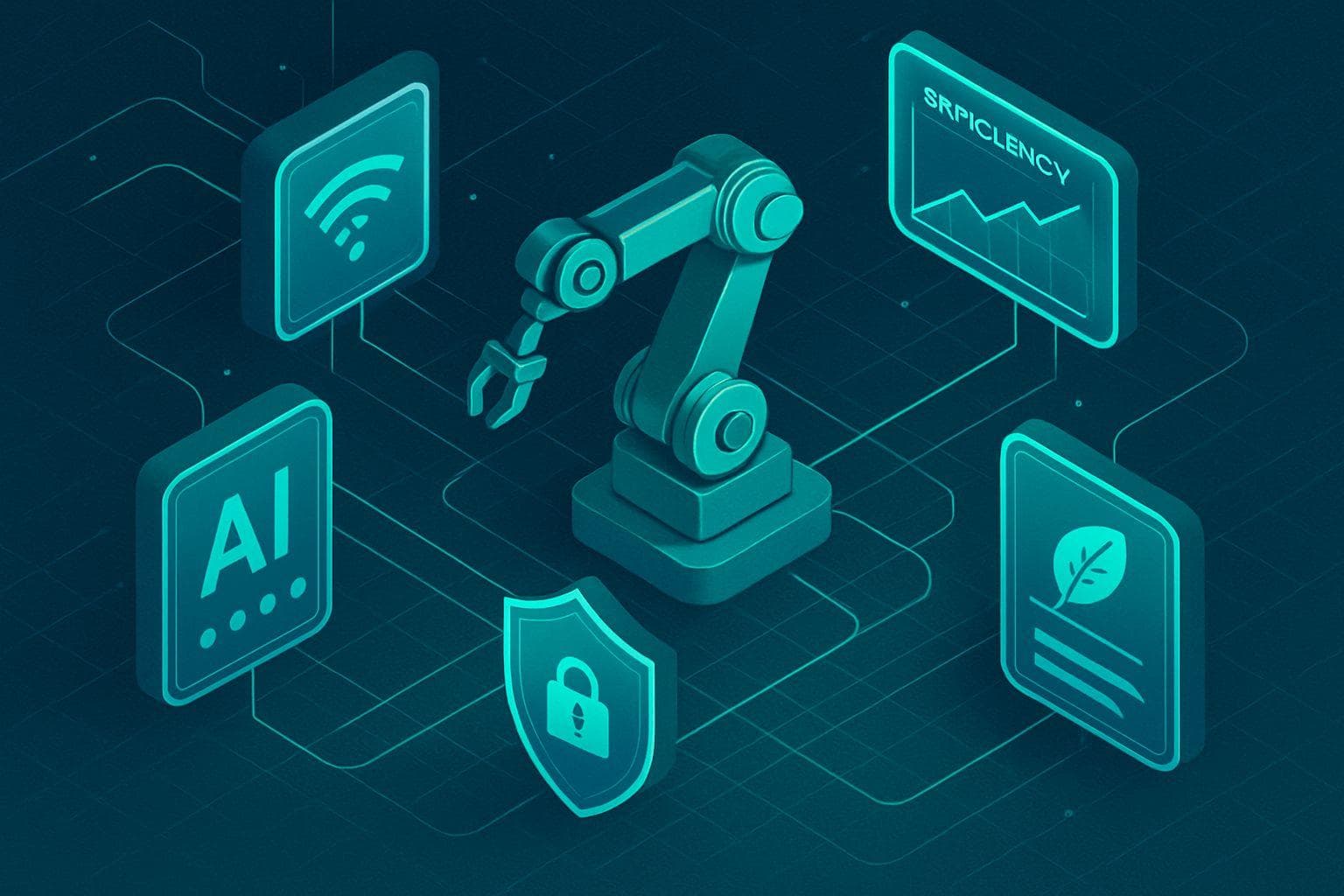
The traditional approach to industrial equipment maintenance fixed schedules, reactive repairs, and periodic inspections is being replaced by a data-driven model that predicts failure before it occurs. Predictive maintenance systems combine IoT sensor data, machine learning models, and real-time monitoring to identify equipment degradation patterns and trigger maintenance interventions at the optimal moment after the warning signs appear but before the failure occurs. For industrial enterprises, this shift represents one of the highest-ROI technology investments available: reducing unplanned downtime, extending asset life, and optimising maintenance labour allocation.
Why Predictive Maintenance Is Now Viable at Scale
Predictive maintenance as a concept has existed for decades, but its practical implementation at scale was constrained by the cost of sensors, the availability of connectivity infrastructure, and the computational resources required to process and analyse sensor data in real time. All three constraints have been resolved in the past five years IoT sensors are now commodity components, industrial connectivity is broadly available, and cloud and edge computing have made real-time analytics economically feasible for operations of any scale.The result is a predictive maintenance market that is growing rapidly across manufacturing, energy, logistics, and infrastructure and an increasingly wide gap between industrial enterprises that have deployed predictive maintenance capabilities and those still operating on fixed maintenance schedules.
Four Dimensions of Predictive Maintenance Value
Dimension 1: Unplanned downtime elimination
Unplanned equipment failures are the most expensive maintenance event combining the direct cost of repair with the indirect cost of lost production, supply chain disruption, and customer impact. Predictive maintenance systems reduce unplanned downtime by 30 to 50% in mature deployments by catching failure precursors early enough to schedule interventions without production impact.
Dimension 2: Maintenance cost optimisation
Scheduled maintenance replaces components on a time basis regardless of actual wear leading to both over-maintenance (replacing components that have useful life remaining) and under-maintenance (missing components that are degrading faster than the schedule assumes). Predictive maintenance replaces components based on actual condition, reducing maintenance material costs by 20 to 30% in typical industrial deployments.
Dimension 3: Asset life extension
Equipment that is maintained at the optimal point in its degradation cycle not too early, not too late experiences less secondary damage from operating in a degraded state and less unnecessary wear from over-maintenance interventions. Industrial enterprises with mature predictive maintenance programmes report asset life extension of 15 to 25% compared to scheduled maintenance regimes.
Dimension 4: Safety and compliance improvement
Equipment failures in industrial environments carry significant safety risk. Predictive maintenance reduces the probability of catastrophic failure events by identifying degradation patterns before they reach critical thresholds. In regulated industries, this capability also supports compliance with equipment safety standards that require documented maintenance based on equipment condition.
Predictive Maintenance Readiness Questions
- What percentage of your critical production equipment is instrumented with real-time condition monitoring sensors? Below 50% means the majority of your highest-risk assets are operating without predictive visibility.
- What is your current ratio of unplanned to planned maintenance events? Above 30% unplanned indicates a maintenance programme that is primarily reactive.
- Do you have a baseline measurement of the cost of unplanned downtime per hour for your critical production lines? Without this baseline, the ROI of predictive maintenance investment cannot be quantified.
- What is your current mean time between failures for your highest-criticality equipment? This baseline is required to measure the impact of predictive maintenance deployment.
- Do you have the data infrastructure to store, process, and analyse continuous sensor data streams from your equipment fleet? Without this infrastructure, sensor investment alone will not deliver predictive capability.
Why Enterprise Data Governance Will Become a Competitive Advantage
Related articles
View all → Autonomous Coordination
The Rise of Autonomous Enterprise Coordination Platforms
Enterprise coordination the alignment of people, processes, information, and resources across organisational boundaries has always been expensive, slow, and error-prone when managed through human intermediaries alone. Autonomous coordination platforms powered by AI are replacing the coordination overhead of large organisations with intelligent systems that synchronise the enterprise continuously and without manual intervention.
 AI Agents
How AI Agents Are Transforming Enterprise Workflow Intelligence
AI agents autonomous systems that perceive their environment, reason about objectives, and take action across enterprise workflows are moving from research concept to operational reality. The enterprises deploying AI agents at scale are discovering that workflow intelligence is not just about automation it is about creating organisational capability that compounds with every cycle.
 AI-Native Infrastructure
Why Global Enterprises Need AI-Native Operational Infrastructure
The operational infrastructure that global enterprises built in the pre-AI era was designed for a different competitive environment. Enterprises that try to layer AI on top of legacy operational infrastructure will capture a fraction of AI's potential. The ones that rebuild their operational foundations as AI-native will gain structural advantages their competitors cannot close.