The Rise of Autonomous Enterprise Coordination Platforms
Enterprise coordination the alignment of people, processes, information, and resources across organisational boundaries has always been expensive, slow, and error-prone when managed through human intermediaries alone. Autonomous coordination platforms powered by AI are replacing the coordination overhead of large organisations with intelligent systems that synchronise the enterprise continuously and without manual intervention.
Prince Kumar
Author

The coordination cost of large enterprises is one of the most significant and least visible drains on organisational productivity. Meetings convened to synchronise information that should flow automatically. Emails written to align stakeholders who should be kept informed by systems. Delays caused by approval processes that require human intermediaries to move decisions from the person with the question to the person with the authority. Reports produced to give leaders visibility into operational reality that real-time systems should provide continuously. Every large enterprise has built a significant coordination overhead the management and administrative work required to keep a complex organisation aligned that consumes the time, attention, and energy of talented people who should be applying their capabilities to work that creates value rather than work that maintains synchronisation. Autonomous enterprise coordination platforms are eliminating this overhead by replacing human coordination intermediaries with AI systems that maintain organisational alignment automatically, continuously, and without the latency and error rate that human coordination introduces.
The Coordination Problem at Enterprise Scale
Coordination in large enterprises operates across three dimensions that each generate their own overhead. Informational coordination ensuring that the people who need to know something know it, at the time they need to know it, in a format they can act on is currently managed through a combination of meetings, reports, emails, and informal networks that are slow, incomplete, and heavily dependent on individual communication behaviours. Decision coordination routing decisions to the people with the authority and information to make them, and communicating the outcomes to the people who need to act on them is managed through approval workflows and escalation chains that introduce days of latency into decisions that should take minutes. Resource coordination ensuring that the right resources are available to the right work at the right time is managed through planning processes that are always operating on information that is at least partially outdated by the time the plan is implemented.Autonomous coordination platforms address all three dimensions simultaneously. AI systems that monitor information flows, decision queues, and resource allocation across the enterprise continuously and that proactively route information, accelerate decisions, and rebalance resources without requiring human intermediaries to initiate each coordination action reduce coordination latency from days and hours to minutes and seconds. The human effort that was previously consumed by coordination moves to the strategic and creative work that AI systems cannot perform and the organisation becomes measurably faster, more aligned, and more responsive as a result.
Four Dimensions of Autonomous Enterprise Coordination
Dimension 1: Autonomous information routing and synthesis
Autonomous coordination platforms monitor the enterprise's information environment continuously tracking what information exists, who needs it, and when and route relevant information to the right people proactively rather than requiring them to seek it out. AI synthesis capabilities aggregate information from multiple sources into coherent, contextually relevant briefings that give decision-makers the complete picture they need without requiring them to manually assemble it from disparate sources. The result is an organisation where information asymmetry the condition where critical information exists in the enterprise but has not reached the people who need to act on it is systematically eliminated rather than managed through communication protocols and reporting requirements.
Dimension 2: Intelligent decision routing and acceleration
A significant proportion of enterprise decision latency is not caused by the time required to make the decision it is caused by the time required to route the decision to the right person, provide them with the information they need, and communicate the outcome to the people who need to act on it. Autonomous coordination platforms automate this routing and communication process identifying who has the authority and information to make each decision, assembling the relevant context, routing the decision request with the minimum required information, and communicating outcomes to all affected parties immediately upon resolution. Decisions that currently take days to navigate approval chains can be completed in hours or minutes when the coordination overhead is automated.
Dimension 3: Cross-functional workflow synchronisation
Enterprise workflows that span multiple functions product launches, customer onboarding, procurement cycles, compliance reviews are among the most coordination-intensive activities in large organisations. Each handoff between functions is a potential coordination failure point where information is lost, timelines slip, and accountability gaps develop. Autonomous coordination platforms maintain a real-time model of cross-functional workflow status, proactively manage handoffs between functions, identify bottlenecks before they cause timeline failures, and maintain complete accountability records across the entire workflow. The reduction in cross-functional coordination overhead is typically 30 to 50% of the management time currently consumed by these workflows.
Dimension 4: Real-time resource rebalancing
Enterprise resource allocation matching available human, financial, and technological resources to the work that needs to be done is currently managed through planning cycles that operate on a monthly or quarterly cadence and produce allocations that are outdated before they are implemented. Autonomous coordination platforms monitor resource utilisation and work demand in real time, identify mismatches between available resources and operational requirements, and surface rebalancing recommendations to the relevant decision-makers immediately rather than waiting for the next planning cycle to surface the mismatch. For enterprises with highly variable workloads, this real-time rebalancing capability is a direct productivity and cost efficiency advantage.
Autonomous Coordination Platform Readiness Diagnostic
- What percentage of your management team's time is currently consumed by coordination activities meetings, status updates, approval processes, and information routing versus strategic and value-creating work? The coordination percentage is the primary overhead opportunity for autonomous platform investment.
- How long does a typical cross-functional decision take from initial identification to resolution and how much of that time is elapsed waiting for routing, review, and communication rather than active decision-making? The waiting time is the autonomous coordination opportunity.
- Do you have real-time visibility into the status of all active cross-functional workflows with clear accountability for each stage and automated alerting when handoffs are delayed? Without this visibility, cross-functional coordination failures are discovered late and managed reactively.
- How does information currently reach the people who need it in your organisation through proactive routing, periodic reporting, or individual information-seeking? The degree to which information-seeking is required rather than provided automatically is a measure of informational coordination overhead.
- What is your current resource utilisation rate across your key operational functions and how quickly can you identify and correct resource allocation mismatches when demand patterns shift? Above two weeks to correction indicates a resource coordination process operating on planning cadences that are too slow for operational reality.
- How much management overhead is generated by your current coordination model in meeting hours, report production time, and approval process management per unit of strategic output? This ratio is the productivity baseline against which autonomous coordination platform investment should be evaluated.
Related articles
View all →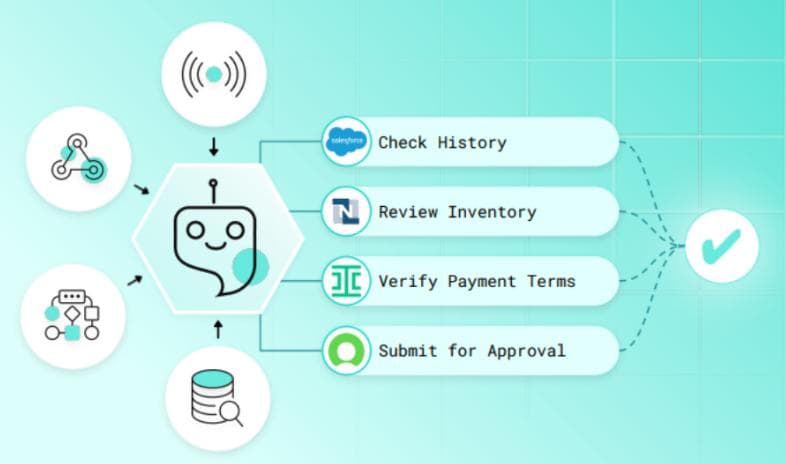 AI Execution
Why AI Execution Systems Will Define the Future of Enterprise Operations
The next frontier of enterprise competitive advantage is not strategy it is execution. AI execution systems that translate strategic intent into coordinated operational action, faster and more reliably than any human-managed process, are becoming the defining infrastructure of enterprise performance in every sector.
 AI Agents
How AI Agents Are Transforming Enterprise Workflow Intelligence
AI agents autonomous systems that perceive their environment, reason about objectives, and take action across enterprise workflows are moving from research concept to operational reality. The enterprises deploying AI agents at scale are discovering that workflow intelligence is not just about automation it is about creating organisational capability that compounds with every cycle.
 AI-Native Infrastructure
Why Global Enterprises Need AI-Native Operational Infrastructure
The operational infrastructure that global enterprises built in the pre-AI era was designed for a different competitive environment. Enterprises that try to layer AI on top of legacy operational infrastructure will capture a fraction of AI's potential. The ones that rebuild their operational foundations as AI-native will gain structural advantages their competitors cannot close.