Thinking in Constraints: The Real Way to Scale
Every business has exactly one binding constraint at any point in time the single factor that most limits the system's output. Improving anything other than the binding constraint does not improve the system's overall performance. Identifying and managing constraints sequentially is not a management theory. It is the most direct path to scalable growth available to any business.
Prince Kumar
Author
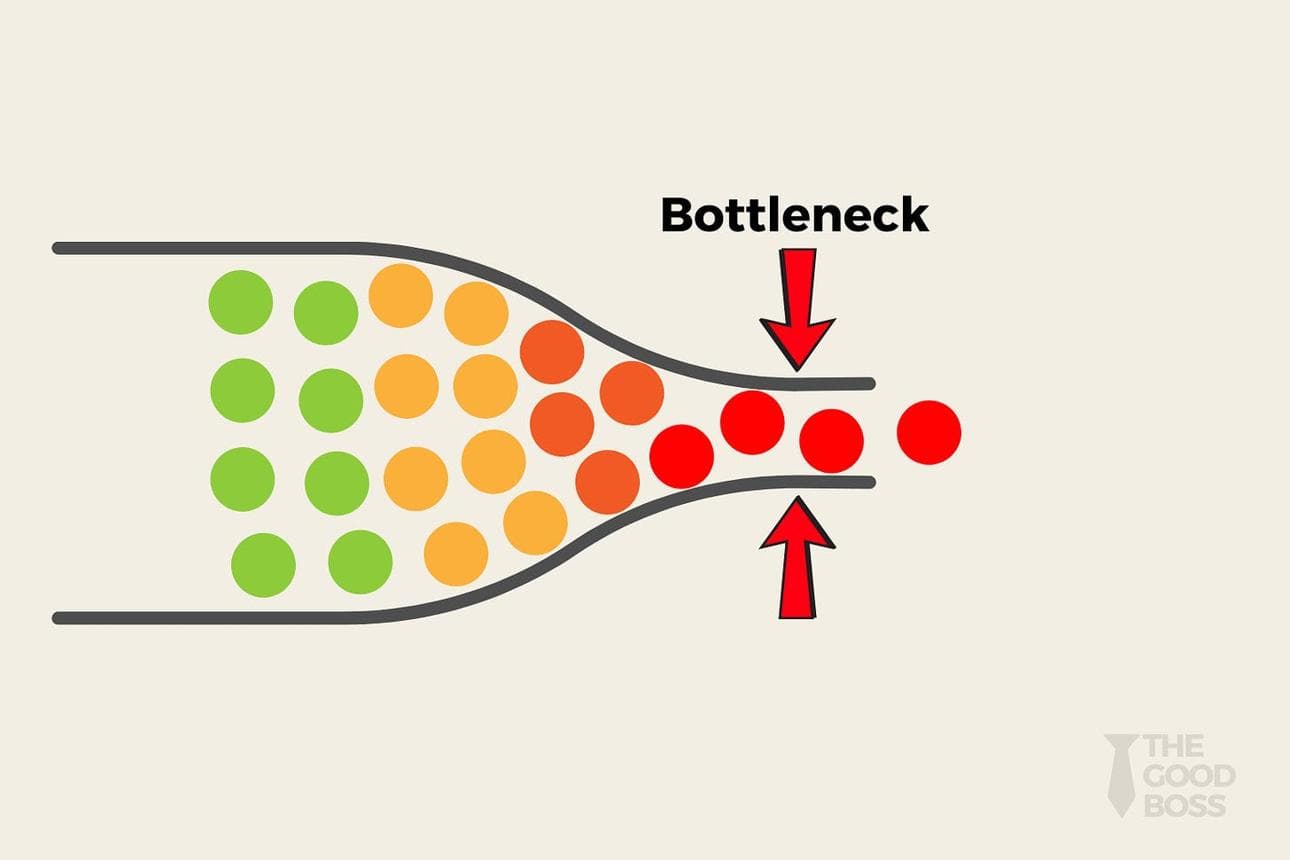
A D2C brand was adding warehouse staff every quarter because the fulfilment team was consistently overwhelmed. Response times were slow, error rates were rising, and the operations head was convinced that the business needed more people and more warehouse space to keep up with growth. The founder approved three consecutive rounds of warehouse expansion and headcount addition. The fulfilment performance improved marginally with each addition and then plateaued again within six weeks. What the business actually had was not a fulfilment capacity problem. It had a demand forecasting problem because the inventory replenishment was reactive rather than predictive, the warehouse was regularly receiving large unexpected inflows of inventory that created fulfilment bottlenecks regardless of how much capacity had been added. The capacity additions were not addressing the constraint. They were absorbing the symptom of the constraint while the constraint itself demand forecasting remained unaddressed. This is what constraint blindness looks like in practice and it is why most scaling efforts produce disappointing results relative to their cost.
The Theory of Constraints: What It Actually Means
Eliyahu Goldratt's Theory of Constraints, originally formulated for manufacturing systems, contains a single insight of radical practical importance: in any system pursuing a goal, exactly one constraint limits the system's output at any given time. All other factors in the system have slack they are operating below their maximum capacity. Improving the throughput of a non-constraint factor does not improve the system's output. It improves that factor's performance metrics while the system's output remains limited by the unchanged constraint.Applied to a business system, this means that the right question at any point in time is not 'what should we improve?' but 'what is preventing us from producing more of what we want to produce?' and the answer to that question is singular and specific. It might be CAC that limits the rate at which the business can profitably acquire customers. It might be gross margin that limits the marketing investment the business can sustain. It might be fulfilment capacity, working capital, product development speed, or the founder's own decision-making bandwidth. But it is one thing and every improvement effort that is not directed at that one thing is, by definition, suboptimal.
How to Identify Your Business's Binding Constraint
The diagnostic process for identifying a binding constraint starts with the question: what is the output the business most wants to increase? For most D2C businesses at early growth stage, the answer is profitable revenue not revenue at any cost, but revenue that generates positive contribution margin and builds the business's financial resilience. Once the desired output is defined, the constraint identification process follows the flow of the business backward from the desired output looking for the step at which the flow is most restricted.If the business can produce and deliver more product than it is currently selling, the constraint is in demand generation or conversion. If the business has demand it cannot fulfil, the constraint is in production or fulfilment. If the business has demand it can fulfil but cannot fund the inventory to fulfil at scale, the constraint is in working capital. If the business has working capital but cannot deploy it because supplier lead times limit how quickly inventory can be built, the constraint is in the supply chain. Each of these is a different constraint requiring a different intervention and the intervention that works for one constraint will be irrelevant or counterproductive when applied to a different one.
The Five Focusing Steps: A Practical Scaling Framework
Goldratt's five focusing steps provide the operational framework for constraint-based scaling. Step one: identify the system's current binding constraint. Step two: decide how to exploit the constraint extract maximum output from the constraint without additional investment, by eliminating waste and inefficiency within the constrained step. Step three: subordinate everything else to the constraint ensure that every other part of the system is aligned to support and feed the constraint at its maximum capacity, rather than optimised independently. Step four: elevate the constraint once the constraint has been fully exploited, invest in increasing its capacity. Step five: once the constraint is broken, return to step one, because breaking one constraint exposes the next one.The discipline of returning to step one after each constraint is broken is the component that most businesses miss. The natural tendency is to declare victory after a constraint is resolved and return to the previous improvement agenda which is, by definition, an agenda aimed at non-constraints. The businesses that scale consistently are the ones that institutionalise the constraint identification and exploitation cycle as their primary operational rhythm, treating the question 'what is our current binding constraint?' as the most important question in the business at every stage of growth.
Business Architecture: The Missing Layer in Most Startups
Related articles
View all → Autonomous Coordination
The Rise of Autonomous Enterprise Coordination Platforms
Enterprise coordination the alignment of people, processes, information, and resources across organisational boundaries has always been expensive, slow, and error-prone when managed through human intermediaries alone. Autonomous coordination platforms powered by AI are replacing the coordination overhead of large organisations with intelligent systems that synchronise the enterprise continuously and without manual intervention.
 AI Agents
How AI Agents Are Transforming Enterprise Workflow Intelligence
AI agents autonomous systems that perceive their environment, reason about objectives, and take action across enterprise workflows are moving from research concept to operational reality. The enterprises deploying AI agents at scale are discovering that workflow intelligence is not just about automation it is about creating organisational capability that compounds with every cycle.
 AI-Native Infrastructure
Why Global Enterprises Need AI-Native Operational Infrastructure
The operational infrastructure that global enterprises built in the pre-AI era was designed for a different competitive environment. Enterprises that try to layer AI on top of legacy operational infrastructure will capture a fraction of AI's potential. The ones that rebuild their operational foundations as AI-native will gain structural advantages their competitors cannot close.