Why AI Agents Will Become the New Enterprise Operations Layer
Enterprise operations has historically been a human layer the people, processes, and management systems that convert strategic intent into operational outcomes. AI agents are becoming capable of performing the majority of the functions that human operations performs for routine cases, creating a new enterprise architecture where AI is the primary operations layer and humans concentrate on the genuinely strategic.
Manthan Sharma
Author

The operations function of a large enterprise is, in its essence, a coordination and execution engine. It receives strategic directives grow revenue in this market, reduce costs in this category, improve customer retention in this segment and converts them into the coordinated operational actions that produce the intended outcomes: purchase orders submitted, inventory repositioned, customer interventions executed, projects launched, resources allocated. The people who staff the operations function operations managers, procurement specialists, supply chain coordinators, project managers, customer success managers are, in their daily work, primarily coordination and execution workers: receiving information, making routine decisions, executing actions across systems, and managing the exceptions that arise when operations deviate from plan. AI agents are becoming capable of performing all of these functions for the routine cases the well-defined, rule-governed, pattern-matching coordination and execution work that constitutes the majority of operational staff activity. As this capability matures, AI agents are not adding a new layer to the enterprise architecture; they are replacing a substantial portion of the existing operations layer with a technology layer that is faster, more consistent, and available at all hours without the coordination overhead that human operations requires.
The Enterprise Operations Functions AI Agents Can Perform
The enterprise operations functions that AI agents can perform in 2026 span the full breadth of routine operational coordination and execution. In supply chain operations, AI agents can monitor supplier performance, detect delivery exceptions, initiate corrective actions with suppliers, adjust purchase order quantities in response to demand signals, manage customs and compliance documentation for cross-border shipments, and coordinate with logistics providers to optimise routing and delivery schedules. The proportion of supply chain operational decisions that meet the criteria for autonomous AI execution well-defined decision criteria, bounded authority, reversible actions, low-consequence individual decisions is typically 70 to 80% of total decision volume.In financial operations, AI agents can process invoices, match payments to purchase orders, route approval requests, execute approved payments within policy parameters, reconcile bank statements, generate journal entries for routine transactions, and produce standard financial reports. The proportion of financial operations decisions suitable for autonomous AI execution is similarly high the exception cases that require human judgment are a small but important minority of total financial operations activity. In customer operations, AI agents can handle tier-one customer service interactions, route escalations to the appropriate human expert, execute routine account management actions (subscription renewals, account updates, usage reporting), monitor customer health signals, and trigger intervention workflows when customer health metrics cross defined thresholds. In project operations, AI agents can track task completion, identify blockers and exceptions, reassign blocked tasks within defined parameters, update project schedules to reflect actual progress, and escalate at-risk milestones to the appropriate human decision-maker.
The Human Operations Role in an AI Agent World
The emergence of AI agents as the primary enterprise operations layer does not eliminate the human operations role it transforms it from a coordination and execution role to a governance, exception management, and strategic operations role. The human operations professional in an AI agent world is responsible for four categories of work that AI agents cannot yet perform well. The first is governance: defining the authority boundaries and performance standards for AI agent operations, monitoring agent performance against those standards, and adjusting agent configurations when performance deviates from expectations. This is the 'managing AI agents' role equivalent in many ways to the management function for human teams, but with different tools and different oversight requirements.The second category is exception management: the 10 to 20% of operational decisions that fall outside the AI agent's autonomous authority, either because they involve amounts above the autonomous threshold, situations that deviate significantly from the patterns the agent was designed for, or decisions that require stakeholder relationships, ethical judgments, or contextual understanding that AI agents do not possess. The third category is strategic operations improvement: using the operational performance data that AI agent operations generate to identify the systemic process improvements, supplier relationship investments, and operational capability developments that will improve the enterprise's operational performance over the medium and long term. The fourth category is human relationship management: the supplier negotiations, customer executive relationships, and internal stakeholder management that depend on trust, empathy, and personal accountability the distinctively human elements of operations that AI agents will not meaningfully replicate in the foreseeable future.
Building the AI Agent Operations Infrastructure
Building the AI agent operations infrastructure requires a sequenced investment in technology, process, and organisational capability that is more complex than deploying individual AI tools but more straightforward than the full enterprise transformation that the AI-first operating model requires. The technology investment sequence starts with the integration layer: ensuring that the enterprise's operational systems ERP, CRM, procurement, supply chain, project management are accessible to AI agents through APIs and that the access controls, audit logging, and rate limiting required for autonomous agent interactions are in place.The process investment sequence starts with authority boundary definition: for each operational workflow domain where AI agent deployment is planned, explicitly defining the decision parameters within which agents can operate autonomously, the thresholds above which human confirmation is required, and the escalation paths for decisions that the agent cannot classify within its authority framework. This authority boundary definition is not a one-time exercise it is an ongoing governance process that evolves as agent performance data accumulates and organisational confidence in agent judgment expands. The organisational investment sequence starts with role redesign: defining the human roles that will oversee, govern, and collaborate with AI agent operations, and developing the skills and knowledge those roles require. The operations professional who transitions from manual coordination to AI governance needs different skills analytical thinking about agent performance, judgment about when to override agent decisions, and the ability to identify the systemic issues that agent performance data reveals and the skill development investment is a critical success factor for the transition.

Enterprise Execution Intelligence: The Next Competitive Advantage for Global Companies
Related articles
View all →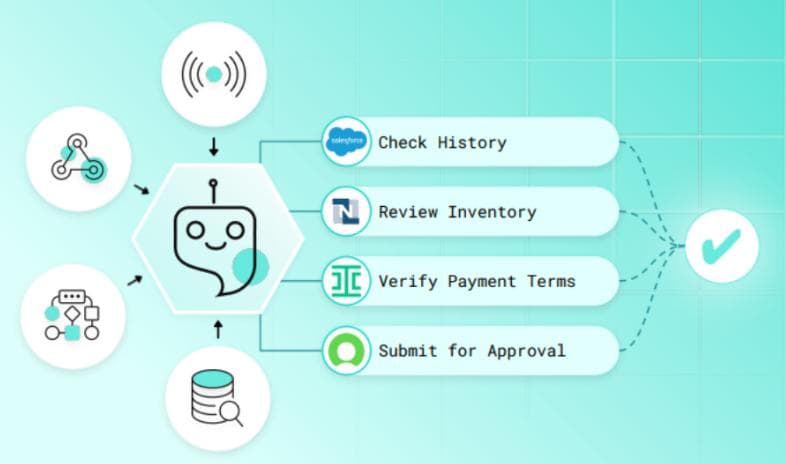 AI Execution
Why AI Execution Systems Will Define the Future of Enterprise Operations
The next frontier of enterprise competitive advantage is not strategy it is execution. AI execution systems that translate strategic intent into coordinated operational action, faster and more reliably than any human-managed process, are becoming the defining infrastructure of enterprise performance in every sector.
 AI Agents
How AI Agents Are Transforming Enterprise Workflow Intelligence
AI agents autonomous systems that perceive their environment, reason about objectives, and take action across enterprise workflows are moving from research concept to operational reality. The enterprises deploying AI agents at scale are discovering that workflow intelligence is not just about automation it is about creating organisational capability that compounds with every cycle.
 AI-Native Infrastructure
Why Global Enterprises Need AI-Native Operational Infrastructure
The operational infrastructure that global enterprises built in the pre-AI era was designed for a different competitive environment. Enterprises that try to layer AI on top of legacy operational infrastructure will capture a fraction of AI's potential. The ones that rebuild their operational foundations as AI-native will gain structural advantages their competitors cannot close.