Agentic AI in Action: 3 Real-World Use Cases (Finance, Ops, Engineering)
Abstract promises about agentic AI are easy to make. The real test is whether autonomous execution systems deliver measurable operational outcomes faster cycle times, fewer escalations, lower coordination overhead in the finance, operations, and engineering workflows where enterprise value is created and lost.
Manthan Sharma
Author

The most important question in enterprise AI in 2026 is not whether autonomous execution systems are theoretically possible. It is whether they are actually working delivering measurable time savings, cost reductions, and operational improvements in the workflows where enterprise value is most concentrated. The answer, for organisations that have deployed genuine execution layers rather than enhanced dashboards, is clearly affirmative. The following three use cases from finance, operations, and engineering illustrate what autonomous execution looks like in practice, what the before-and-after operational metrics are, and why the difference matters at scale.
Finance: Auto-Reconciliation and Approval Routing
Before autonomous execution, a finance team processing 10,000+ transactions per month spent an average of 340 person-hours per month on reconciliation work matching transactions against POs, flagging discrepancies, routing anomalies for review, and following up with vendors and internal teams on unresolved items. The process ran on a monthly cycle, meaning discrepancies detected early in the month were often not resolved until the month-end close, creating cash flow uncertainty and audit risk.With SuperManager's autonomous execution layer deployed, the reconciliation cycle runs continuously. Transactions are matched against POs in real time. Discrepancies below the defined threshold are automatically queried with vendors through structured communication workflows and logged for audit. Discrepancies above the threshold are routed to the appropriate finance reviewer with full context and a defined resolution timeline. The 340 monthly person-hours reduced to 40 with the remaining 40 hours focused entirely on the genuine exceptions that require human judgment. Month-end close time reduced from twelve days to three.
Operations: Vendor Coordination and Logistics Management
Before autonomous execution, an operations team managing relationships with forty-plus vendors across a manufacturing supply chain spent significant management bandwidth on delivery status tracking, ETA updates, logistics rescheduling, and ERP record maintenance work that was almost entirely reactive, triggered by delays that had already occurred rather than prevented by early intervention.With an autonomous execution layer monitoring delivery ETAs against production schedules in real time, the system identifies potential delays forty-eight to seventy-two hours before they would impact production, automatically contacts the vendor's logistics team, requests updated ETAs, evaluates alternative sourcing or scheduling options, executes the optimal response within defined parameters, updates the ERP and production schedule, and notifies the operations manager only when a delay cannot be resolved within the defined parameters. Vendor-caused production delays reduced by 60%. Operations manager time spent on logistics coordination reduced by 70%.
Engineering: Sprint Execution and Blocker Resolution
Before autonomous execution, engineering teams in a 200-person product organisation spent an estimated 15% of engineering management time on Jira ticket hygiene updating statuses, reassigning blocked tickets, pinging reviewers on overdue PRs, and escalating dependencies between teams. Daily standups consumed thirty minutes per team per day primarily to surface information that should have been visible in the project management system.With an autonomous AI project manager deployed on top of the existing Jira and GitHub environment, ticket statuses update automatically based on PR and deployment events. Blocked tickets trigger automatic reassignment or escalation workflows based on the type of block. Overdue PR reviews trigger reviewer reminders and escalate to engineering leads after defined periods. Cross-team dependencies are monitored and flagged proactively. Standup time reduced from thirty minutes to ten. Engineering management time on ticket hygiene reduced by 80%. Sprint cycle time from story assignment to production deployment reduced by 2.3x.

Related articles
View all →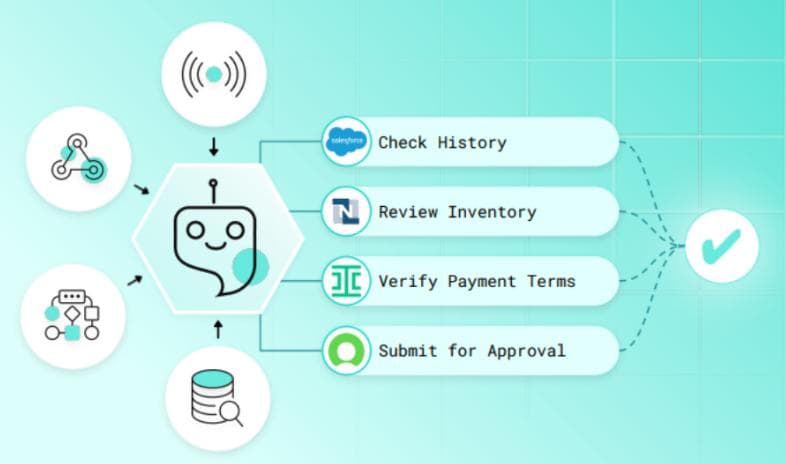 AI Execution
Why AI Execution Systems Will Define the Future of Enterprise Operations
The next frontier of enterprise competitive advantage is not strategy it is execution. AI execution systems that translate strategic intent into coordinated operational action, faster and more reliably than any human-managed process, are becoming the defining infrastructure of enterprise performance in every sector.
 Autonomous Coordination
The Rise of Autonomous Enterprise Coordination Platforms
Enterprise coordination the alignment of people, processes, information, and resources across organisational boundaries has always been expensive, slow, and error-prone when managed through human intermediaries alone. Autonomous coordination platforms powered by AI are replacing the coordination overhead of large organisations with intelligent systems that synchronise the enterprise continuously and without manual intervention.
 AI Agents
How AI Agents Are Transforming Enterprise Workflow Intelligence
AI agents autonomous systems that perceive their environment, reason about objectives, and take action across enterprise workflows are moving from research concept to operational reality. The enterprises deploying AI agents at scale are discovering that workflow intelligence is not just about automation it is about creating organisational capability that compounds with every cycle.