Coding Interviews Are Broken AI Changed the Game
The whiteboard interview was already a poor predictor of job performance. AI has made it completely disconnected from reality. Here's what's replacing it.
Prince Kumar
Author
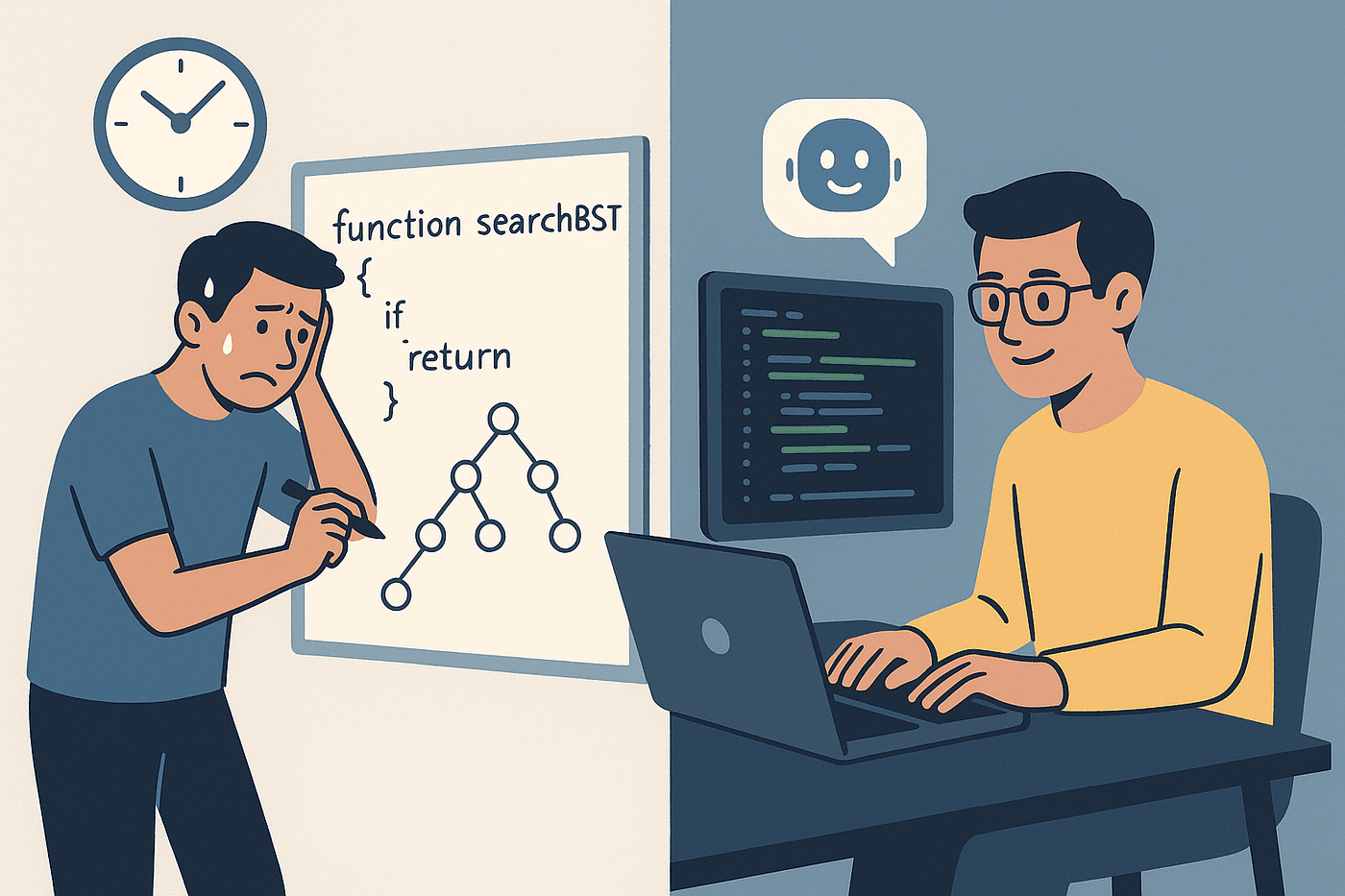
The technical interview as it exists today was designed for a world that no longer exists. It tests whether a candidate can solve a dynamic programming problem in 45 minutes without Google. In 2026, every working developer has access to tools that solve those problems in seconds. The interview tests a skill that is no longer the job. And companies that haven't updated their process are filtering for the wrong people.
What the Traditional Interview Was Actually Testing
The LeetCode-style technical interview emerged from a specific era: large tech companies needed to filter hundreds of applicants quickly, and algorithm performance was a reasonable proxy for general engineering ability when software was more constrained. The test was never perfect. Research consistently showed weak correlation between whiteboard performance and actual job effectiveness. But it was defensible as a filter when the job itself required strong recall and fast implementation.That justification has collapsed. When AI can solve most LeetCode problems instantly, a candidate who solves them in 45 minutes is not demonstrating a meaningful advantage over AI. They're demonstrating a skill that costs more to maintain in a human than to offload to a tool.
How AI Has Broken the Current Format
- Candidates use AI during take-home assignments and companies largely cannot detect it. The output looks clean, the explanations are coherent, but the candidate may not understand what was generated.
- Remote interviews can be gamed with screen-sharing tools and AI assistants running in parallel windows. Studies from 2025 found that over 60% of candidates in remote technical interviews used some form of AI assistance.
- The skills tested rapid algorithm recall, syntax precision under pressure are exactly the skills AI has made least valuable on the job.
- Top candidates who are genuinely strong engineers are opting out of companies with heavy LeetCode processes, knowing their time is better spent elsewhere.
What Forward-Looking Companies Are Doing Instead
The companies updating their hiring process in 2025 and 2026 are moving in one direction: evaluating judgment, not recall. The formats that are gaining traction include system design interviews where candidates walk through architectural trade-offs with no single correct answer, pair programming with AI tools enabled where the interviewer evaluates how the candidate directs and reviews AI output, and project-based evaluations where candidates are given a real problem, access to their full toolset including AI, and evaluated on the decisions they make rather than the code they produce.Stripe, Linear, and several AI-native startups have moved entirely to work-sample evaluations with AI enabled. The argument is direct: if the job involves working with AI tools, the interview should too. Evaluating a candidate without those tools is like testing a surgeon's ability to operate without using standard medical equipment.
The New Signals That Actually Predict Job Performance
- Problem decomposition: can the candidate break an ambiguous requirement into well-specified sub-problems?
- AI output evaluation: when shown AI-generated code, can the candidate identify the edge cases, security gaps, and incorrect assumptions?
- Architectural reasoning: can the candidate explain why one approach is better than another under a specific set of constraints?
- Communication under uncertainty: can the candidate clearly state what they don't know and how they would resolve it?
- Domain curiosity: does the candidate understand the business context well enough to know when a technically correct solution is the wrong product decision?
What This Means for Candidates
If you are preparing for technical interviews in 2026 by grinding LeetCode without also learning how to work with AI tools effectively, you are optimizing for a narrowing slice of the hiring market. The companies still running pure LeetCode processes are often the companies slowest to adapt to AI which is itself a signal about where you'd be working.The candidates who will do best in the next hiring cycle are those who can demonstrate judgment about AI output, articulate architectural trade-offs clearly, and show deep understanding of a specific problem domain. Those skills are harder to fake with AI assistance than algorithm recall, and they're what the best companies are starting to test for.
The Honest Conclusion
Coding interviews are not just broken. They are broken in a way that actively selects against the skills that matter most in an AI-native engineering environment. Companies that haven't updated their process are not just measuring the wrong things they're driving away the candidates who have already adapted to the new reality and have no patience for a process that hasn't.The fix is not subtle. Test for judgment. Enable the tools. Evaluate the decisions, not the syntax. The companies that make this shift first will have a meaningful hiring advantage over those still sorting by LeetCode percentile.

Related articles
View all → Autonomous Coordination
The Rise of Autonomous Enterprise Coordination Platforms
Enterprise coordination the alignment of people, processes, information, and resources across organisational boundaries has always been expensive, slow, and error-prone when managed through human intermediaries alone. Autonomous coordination platforms powered by AI are replacing the coordination overhead of large organisations with intelligent systems that synchronise the enterprise continuously and without manual intervention.
 AI Agents
How AI Agents Are Transforming Enterprise Workflow Intelligence
AI agents autonomous systems that perceive their environment, reason about objectives, and take action across enterprise workflows are moving from research concept to operational reality. The enterprises deploying AI agents at scale are discovering that workflow intelligence is not just about automation it is about creating organisational capability that compounds with every cycle.
 AI-Native Infrastructure
Why Global Enterprises Need AI-Native Operational Infrastructure
The operational infrastructure that global enterprises built in the pre-AI era was designed for a different competitive environment. Enterprises that try to layer AI on top of legacy operational infrastructure will capture a fraction of AI's potential. The ones that rebuild their operational foundations as AI-native will gain structural advantages their competitors cannot close.