The Enterprise Operating Model After the Rise of Autonomous AI
The enterprise operating model that was built for human coordination hierarchies, approval chains, monthly reviews, and manual handoffs is being structurally disrupted by autonomous AI systems that act, coordinate, and close loops without waiting for the next scheduled meeting. The organisations that redesign their operating model around AI execution will define the next decade of enterprise performance.
Nirmal Nambiar
Author
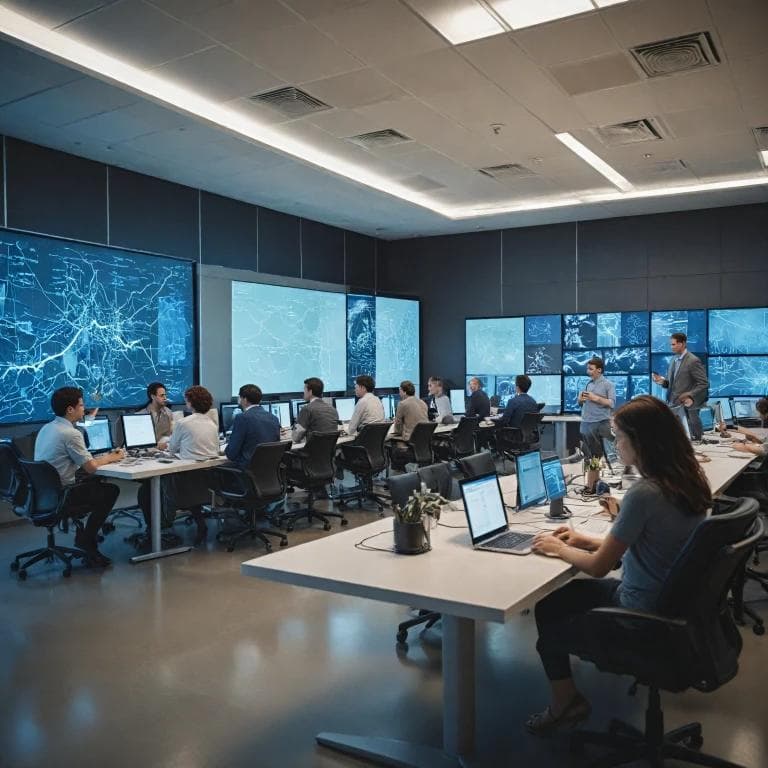
The enterprise operating model has not changed fundamentally in fifty years. Organisations are still structured around hierarchies that aggregate decisions upward, coordination processes that move information horizontally through human intermediaries, and review cadences weekly, monthly, quarterly that batch the business's operational intelligence into windows where leaders can assess and act. This model was designed for a world where the only execution agents were humans, where information moved at human speed, and where the cost of coordination was primarily the time of the people doing the coordinating. Autonomous AI has changed every assumption in this model simultaneously. Information now moves at system speed. Actions can be executed and verified without a human touching the keyboard. Coordination between functions can happen through machine-to-machine signal routing rather than through the meeting, the email, and the escalation chain. The enterprise that has not rethought its operating model in light of these changes is running a 1975 organisational architecture on a 2026 technology substrate and the mismatch is not academic. It shows up in the speed gap between what the organisation knows and what it acts on, in the coordination overhead that consumes management capacity that should be going to strategy, and in the competitive disadvantage that accrues to organisations whose slower-moving operating model is being outpaced by competitors who have built around autonomous execution.
The Four Structural Flaws in the Legacy Enterprise Operating Model
Flaw one: decision latency concentrated at the top. The traditional enterprise operating model routes decisions upward operational exceptions escalate to managers, strategic implications escalate to directors, resource allocation decisions escalate to executives. At each level, the decision waits for availability, for the relevant meeting, for the approval cycle. The total elapsed time between when an operational signal becomes visible in the data and when a decision is made and executed can be measured in weeks for decisions that should take hours. In a market environment where competitive advantage is determined partly by the speed of operational response, this latency is a structural competitive disadvantage.Flaw two: coordination overhead consuming strategic capacity. Research on enterprise management time consistently finds that 40 to 60% of management time is consumed by coordination the status updates, the alignment meetings, the information-gathering conversations that exist to compensate for the absence of shared real-time operational visibility. This coordination overhead is not zero-value: coordination produces alignment and alignment produces execution quality. But it is radically over-sized relative to what technology-enabled operational visibility could replace. An enterprise where every manager has real-time access to the operational state of their domain and every adjacent domain does not need a weekly alignment meeting to discover what is happening. The meeting is a symptom of information scarcity. Real-time operational intelligence makes it obsolete.Flaw three: functional silos that prevent cross-domain signal routing. The enterprise operating model organises work into functional units finance, operations, marketing, supply chain, HR each with its own data systems, its own performance metrics, its own reporting cadence, and its own leadership. The signals that cross functional boundaries the supply chain disruption that should immediately inform the marketing team's demand generation plans, the customer acquisition cost spike that should immediately inform the finance team's working capital forecast, the production quality issue that should immediately inform the customer service team's escalation protocols travel slowly and incompletely across these silos. Human intermediaries translate, filter, and schedule the cross-functional signal. In the time it takes the signal to cross the organisational boundary, the situation it describes has evolved, the response window has narrowed, and the cost of delayed action has accumulated.Flaw four: performance management cycles that are too slow for the pace of operational change. The monthly P&L review, the quarterly business review, the annual strategy cycle each of these review cadences was designed for a business environment where operational reality changed slowly enough that monthly or quarterly data was sufficiently current to inform decisions. In a global enterprise managing supply chains across multiple continents, marketing campaigns across dozens of channels, and customer relationships across hundreds of product categories, the operational reality can change materially in hours. The performance management system that surfaces these changes in the next monthly review is not managing performance. It is narrating history.
The New Enterprise Operating Model: Five Structural Shifts
Shift 1: From hierarchical decision routing to distributed decision authority with AI execution
In the new operating model, routine decisions those that are rule-applicable, data-driven, and below a defined impact threshold are made and executed by AI systems without human involvement. The campaign that crossed the unprofitable CAC threshold is paused automatically. The supplier payment that is due and within approved parameters is released automatically. The production reorder that the inventory system has triggered is generated automatically for one-click approval rather than assembled manually. Human decision-making is concentrated on the decisions that genuinely require human judgment strategic choices, relationship decisions, novel situations, and high-stakes calls where the human's contextual knowledge and accountability are essential. The hierarchy is not eliminated. It is reoriented: from routing all decisions upward to routing only the genuinely judgment-requiring decisions to the appropriate human level.
Shift 2: From scheduled coordination to continuous signal routing
The weekly alignment meeting, the monthly business review, and the quarterly planning cycle are replaced not eliminated, but substantially reduced by continuous signal routing between functions. When the logistics function's AI detects an NDR spike in a specific geography, the signal routes automatically to the marketing function's AI, which adjusts campaign geo-targeting, and to the customer service function's AI, which adjusts escalation protocols for that geography. The coordination happens in minutes, not at the next scheduled meeting. The human leadership team convenes for the decisions that the automatic signal routing cannot resolve the strategic choices, the stakeholder management, the decisions that require the specific judgment and accountability of human leaders.
Shift 3: From functional silos to integrated intelligence networks
The new operating model integrates functional data streams into a single operational intelligence layer that monitors every domain simultaneously and surfaces cross-functional patterns that no individual function's data would reveal. The enterprise intelligence network is not a single data warehouse or a single AI model. It is a coordinated network of domain-specific AI agents each expert in its function's data and decision logic that share signals across function boundaries through defined interfaces and routing protocols. The human organisation is structured around this network rather than the network being structured around the human organisation.
Shift 4: From monthly performance management to continuous performance intelligence
Performance management in the new operating model is not a periodic review of what happened in the prior period. It is a continuous intelligence function that monitors performance against targets in real time, surfaces variances when they occur rather than when the review cycle arrives, and routes the variance to the person or system that can respond to it within the response window where action changes the outcome. The monthly P&L review becomes the strategic confirmation of a month's worth of operational intelligence that the continuous system has already surfaced and acted on. The review cycle is not eliminated it gains strategic significance precisely because the operational detail has been handled continuously.
Shift 5: From human-executed workflows to AI-executed workflows with human oversight
The workflows that currently require human execution the invoice processing, the contract renewal tracking, the compliance documentation, the customer onboarding, the supplier performance assessment are executed by AI systems in the new operating model. The human role is oversight: defining the standards, reviewing the exceptions that fall outside the AI's defined authority, and continuously improving the system's performance as the business context evolves. This shift does not eliminate management roles. It redefines them: from execution to architecture, from doing to directing, from managing the workflow to managing the system that manages the workflow.
What SuperManager AGI Enables in This Transition
SuperManager AGI is designed as the execution infrastructure for this operating model transition the layer that sits between the enterprise's existing data systems and the humans who need to act on what those systems contain. It does not replace the enterprise's ERP, CRM, or project management tools. It connects them, monitors them continuously, and executes the cross-functional coordination logic that no individual tool was designed to handle.The specific capabilities that SuperManager AGI brings to the new operating model: continuous cross-domain signal monitoring that surfaces cross-functional patterns within hours of their emergence, automated workflow execution for the routine coordination that currently consumes management capacity, human-in-the-loop governance architecture that routes genuine judgment decisions to the appropriate human level, and an audit trail that makes every automated action transparent, traceable, and reversible. For the enterprise that is ready to redesign its operating model around autonomous AI execution, SuperManager AGI provides the infrastructure that makes the transition achievable rather than theoretical.
The Transition Timeline: What Enterprises Can Realistically Achieve
- Year one: data foundation and first-domain automation connect the primary operational data streams, implement continuous monitoring for the highest-value cross-domain signal (supply chain to marketing is typically the highest-ROI first loop), and automate the highest-frequency routine decisions in one operational domain
- Year two: cross-functional signal routing and performance management evolution extend the continuous signal routing to cover three to five cross-functional loops, begin transitioning monthly reviews from operational status reporting to strategic exception management
- Year three: enterprise-wide operating model redesign redesign the management architecture around the new operating model, with human decision authority concentrated on the genuinely judgment-requiring decisions and AI execution handling the routine operational and coordination layer
- The organisations that begin this transition in 2026 will have a three-year head start on their competitors who wait for the operating model to become industry standard before investing the same head start that the first enterprise adopters of ERP, CRM, and cloud had over their slower-moving peers

Why AI Agents Will Become Strategic Partners for Enterprise Leaders
Related articles
View all → Super Manager AGI
How Super Manager AGI Enables Autonomous Business Execution at Scale
The concept of a Super Manager AGI an artificial general intelligence system capable of managing complex business operations autonomously, across functions and geographies, at a scale and quality that human management cannot approach is moving from theoretical possibility to operational reality. Understanding what it enables and what it requires is the most important strategic question facing enterprise leaders today.
 AI Coordination
Why AI Coordination Engines Will Replace Traditional Workflow Tools
Traditional workflow tools automate processes that have been explicitly defined. AI coordination engines understand objectives, orchestrate the work required to achieve them, and adapt as conditions change. The difference is not incremental it is the difference between a tool that does what it is told and a system that understands what needs to be done.
AI AgentsWhy AI Agents Will Become Strategic Partners for Enterprise Leaders
The AI agent that flags an anomaly is a tool. The AI agent that investigates the anomaly, assesses its strategic implications, identifies the available responses, and presents a structured recommendation with evidence that is a strategic partner. The transition from AI-as-tool to AI-as-strategic-partner is already beginning in the most advanced enterprise deployments.