Everything You Learned About Coding Is Becoming Useless
The syntax you memorized, the algorithms you drilled, the frameworks you mastered AI is making all of it less relevant. Here's what actually matters now.
Manroze
Author

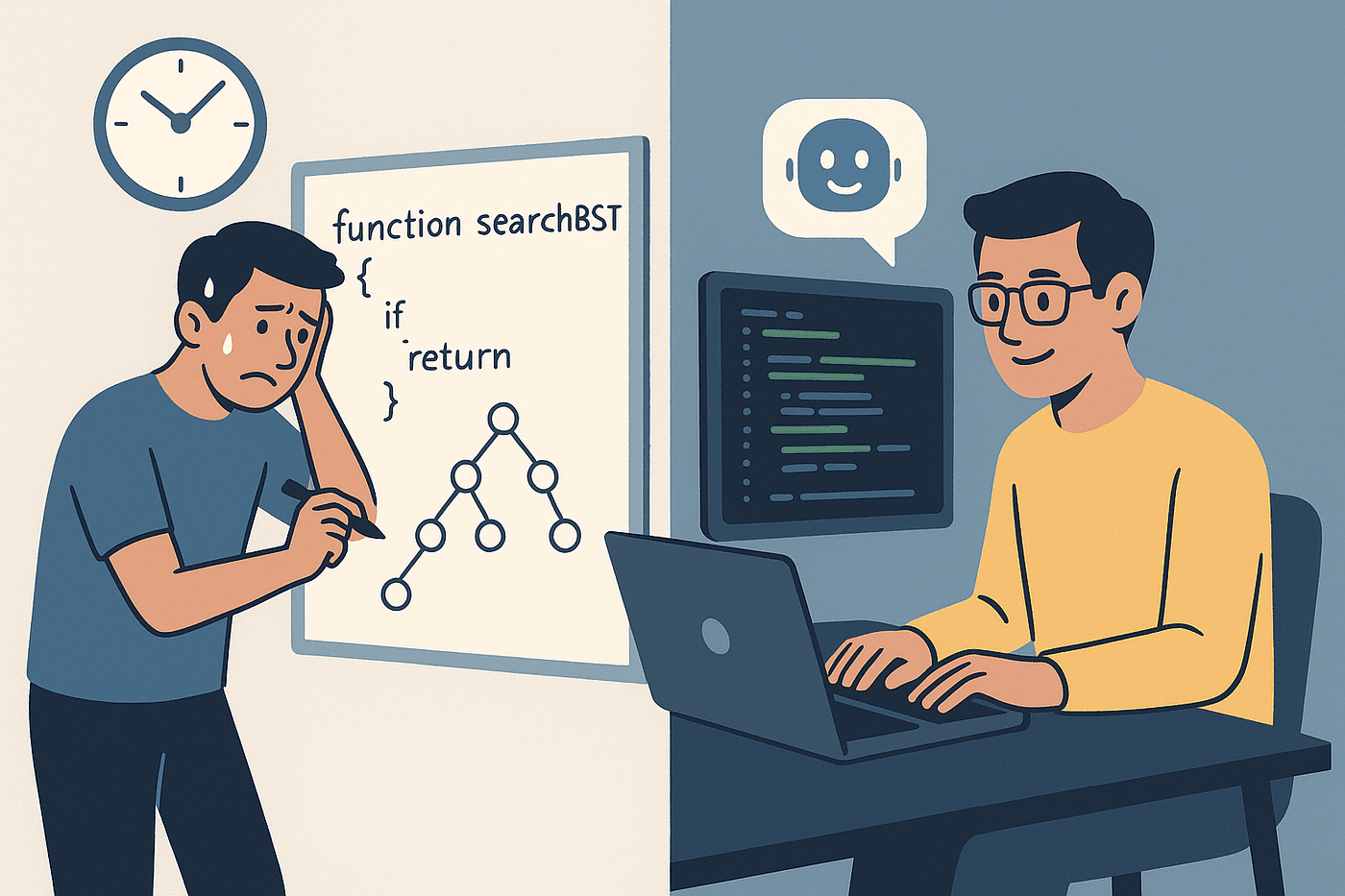
For twenty years, the path into software engineering was clear: learn data structures, master algorithms, pick a language, grind LeetCode, pass the interview. That path still exists. But it leads somewhere smaller than it used to. The floor of what AI can do has risen so fast that the foundational skills most developers were hired for in 2021 are no longer differentiated. This isn't a prediction about the future it's a description of what's already happened.
What AI Can Already Do Better Than You
GitHub Copilot has a 46% code completion rate. Claude Code can scaffold a full-stack application from a single prompt. GPT-4o can debug a 500-line function faster than most mid-level developers. The tasks that filled most junior and mid-level engineering hours writing boilerplate, translating logic into syntax, implementing standard patterns are now handled faster and cheaper by AI than by a human.This is not a marginal improvement. In a 2025 McKinsey study, AI tools reduced time spent on routine coding tasks by 3045% across sampled development teams. The tasks being displaced aren't edge cases. They are the core of what most developers were hired to do.
The Skills That Are Losing Value
- Syntax memorization: knowing how to write a for loop in five languages is irrelevant when AI autocompletes it in any language instantly.
- Boilerplate generation: CRUD endpoints, standard authentication flows, basic API wrappers AI writes these faster than you can type the function signature.
- Framework familiarity without depth: knowing how to use React hooks without understanding the rendering model underneath is no longer enough. AI can use hooks too.
- LeetCode-style algorithm recall: if you can only solve dynamic programming problems after three months of drilling, and an AI can solve them in ten seconds, the drilling was the wrong investment.
- Stack Overflow dependency: copying solutions from forums without understanding the underlying system is a junior skill that AI has made nearly obsolete.
What Is Actually Replacing These Skills
The shift isn't from coding to not-coding. It's from writing code to directing code. The most productive engineers in 2026 are not those who type the fastest they are those who can break down a complex problem clearly enough for AI to execute it, review AI output for correctness and security, and understand the second and third-order consequences of architectural decisions that no AI can fully evaluate.This is a different cognitive skill set. It requires systems thinking, not syntax recall. It requires the ability to hold product intent and technical constraints simultaneously and to judge whether the AI's output actually satisfies both. Engineers who spent their careers going deep on one framework are discovering that depth in abstraction is now more valuable than depth in syntax.
The Hard Truth About Self-Taught and Bootcamp Developers
The bootcamp model was built for a specific market: companies that needed volume developers who could implement well-specified features quickly. That market is contracting. Not because bootcamp graduates are less capable, but because the work they were trained to do is now cheaper to do with AI. A 20242025 analysis showed junior software engineering job postings in the U.S. declined significantly. Big-tech new-graduate hiring is down 55% from its 2019 peak.The developers most at risk are those whose skill set was entirely surface-level: frameworks without fundamentals, tools without understanding of the trade-offs those tools were designed to address. The developers least at risk are those who understand why software systems are built the way they are, not just how to build them.
What You Should Be Learning Instead
- Systems design: how large-scale software systems handle scale, failure, and complexity. AI can write the code; it cannot make the architectural trade-offs.
- AI orchestration: how to direct, evaluate, and chain AI outputs effectively. This is the new core engineering skill.
- Security and compliance: AI-generated code introduces new attack surfaces. Engineers who can audit for vulnerability have rising value.
- Domain expertise: deep knowledge of a specific industry healthcare, fintech, logistics combined with technical ability makes an engineer nearly impossible to replace.
- Communication and problem decomposition: the ability to translate a vague business requirement into a precise technical specification is now the most valuable skill in the pipeline.
The Honest Conclusion
Everything you learned about coding is not useless. But a significant portion of what most developers spent their time learning the syntax, the patterns, the framework-specific knowledge is declining in value faster than anyone officially acknowledges. The developers who treat this as a threat will struggle. The developers who treat it as a shift in what they need to be good at will find the ceiling for what one person can build has never been higher.The code is not the job anymore. Judgment about the code is the job. That distinction is what separates the developers who thrive from 2026 onward from those who spend the next five years wondering why they're competing with AI for roles they used to own.
Related articles
View all → Autonomous Coordination
The Rise of Autonomous Enterprise Coordination Platforms
Enterprise coordination the alignment of people, processes, information, and resources across organisational boundaries has always been expensive, slow, and error-prone when managed through human intermediaries alone. Autonomous coordination platforms powered by AI are replacing the coordination overhead of large organisations with intelligent systems that synchronise the enterprise continuously and without manual intervention.
 AI Agents
How AI Agents Are Transforming Enterprise Workflow Intelligence
AI agents autonomous systems that perceive their environment, reason about objectives, and take action across enterprise workflows are moving from research concept to operational reality. The enterprises deploying AI agents at scale are discovering that workflow intelligence is not just about automation it is about creating organisational capability that compounds with every cycle.
 AI-Native Infrastructure
Why Global Enterprises Need AI-Native Operational Infrastructure
The operational infrastructure that global enterprises built in the pre-AI era was designed for a different competitive environment. Enterprises that try to layer AI on top of legacy operational infrastructure will capture a fraction of AI's potential. The ones that rebuild their operational foundations as AI-native will gain structural advantages their competitors cannot close.