From Insights to Execution: Why SuperManager Is the Autonomous Layer Your Enterprise Needs
AI without execution is expensive noise. SuperManager AGI is not another LLM wrapper or analytics dashboard it is an autonomous execution system with native enterprise integrations, agentic memory, and a human-in-the-loop architecture designed for the workflows where enterprises lose the most time and money.
Manroze
Author

A manufacturing enterprise was closing its books on the 12th of every month. The month-end close process involved fourteen manual reconciliation workflows across finance, operations, and procurement each requiring cross-team coordination, sequential approvals, and manual ERP updates. The finance team of eleven people spent approximately 60% of their working time in the first twelve days of each month on close-related coordination. The remaining eighteen days of the month were the window in which they did everything else. After deploying SuperManager as the autonomous execution layer across their month-end close workflows, the close completed on the 3rd. The finance team's coordination overhead during close reduced by 75%. The twelve days became three not because the work was eliminated, but because the work that did not require human judgment was executed autonomously, without waiting for attention, bandwidth, or availability. This is what SuperManager is built to do.
What SuperManager Is And Is Not
SuperManager AGI is an autonomous execution platform. It is not an LLM wrapper that provides a conversational interface to your enterprise data. It is not an analytics tool that generates better dashboards. It is not a workflow automation tool that executes pre-scripted process flows without intelligence. It is a system that combines AI-driven decision-making with autonomous action execution across the enterprise's integrated tool ecosystem owning workflows from signal to resolution, coordinating across teams, and surfacing only genuine exceptions for human review.The distinction matters because the market is crowded with tools that claim to automate enterprise workflows but deliver enhanced notification systems. SuperManager is designed for a specific and different outcome: not to help humans manage workflows more efficiently, but to autonomously manage the workflows that do not require human judgment, so that human attention is concentrated entirely on the workflows that do.
Three Capabilities That Define the Platform
The first is native enterprise integration. SuperManager connects directly to the ERP, CRM, project management, treasury, and communication tools that enterprises already use not through fragile API wrappers, but through deep integrations that allow the system to read state, take actions, and verify outcomes in the systems where work actually lives. The execution layer acts where the work is, not in a separate interface.The second is agentic memory and accountability. SuperManager maintains persistent workflow state across time it knows what it triggered, what the response was, what the current state of every managed workflow is, and what the escalation path is if resolution has not been reached. Every action is logged with a complete audit trail. Every managed workflow has a defined human owner who receives escalations. The accountability structure that LLMs lack by design is built into the platform architecture.The third is human-in-the-loop for exceptions only. SuperManager's deployment model is not binary it does not require a choice between full automation and full human control. For each workflow category, the system operates autonomously within defined confidence and value thresholds, and escalates to the designated human owner for cases that fall outside those thresholds. The human's role is exception management and policy setting, not routine operation.
The Starting Point: Your Most Broken Workflow
The practical entry point for SuperManager is not an enterprise-wide transformation project. It is the single workflow that your operations, finance, or engineering team identifies as the highest-friction, highest-cost coordination problem in the business right now. The procurement approval bottleneck. The month-end reconciliation process. The vendor escalation workflow that currently runs through a spreadsheet and a Slack channel. The sprint blocker management process that consumes forty minutes of every daily standup.SuperManager's deployment process for a single workflow runs in two weeks integration setup, workflow mapping, threshold definition, and parallel-run validation before the system takes autonomous ownership. The ROI from that single workflow deployment is the foundation of the internal case for broader deployment. AI without execution is expensive noise. The autonomous execution layer that converts enterprise AI investment into operational outcomes is available now and the starting point is the workflow your team is most tired of managing manually.

Related articles
View all →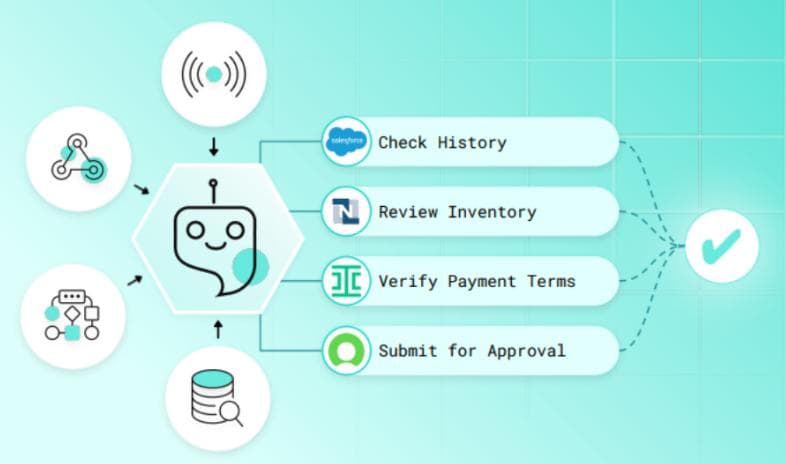 AI Execution
Why AI Execution Systems Will Define the Future of Enterprise Operations
The next frontier of enterprise competitive advantage is not strategy it is execution. AI execution systems that translate strategic intent into coordinated operational action, faster and more reliably than any human-managed process, are becoming the defining infrastructure of enterprise performance in every sector.
 Autonomous Coordination
The Rise of Autonomous Enterprise Coordination Platforms
Enterprise coordination the alignment of people, processes, information, and resources across organisational boundaries has always been expensive, slow, and error-prone when managed through human intermediaries alone. Autonomous coordination platforms powered by AI are replacing the coordination overhead of large organisations with intelligent systems that synchronise the enterprise continuously and without manual intervention.
 AI Agents
How AI Agents Are Transforming Enterprise Workflow Intelligence
AI agents autonomous systems that perceive their environment, reason about objectives, and take action across enterprise workflows are moving from research concept to operational reality. The enterprises deploying AI agents at scale are discovering that workflow intelligence is not just about automation it is about creating organisational capability that compounds with every cycle.