The Hidden Supply Chain Mistakes Killing FMCG Margins
Most FMCG founders focus on acquiring customers. The margin erosion that kills their business is happening in the supply chain in dead stock, delayed distribution, inaccurate demand forecasting, and the inventory carrying costs that never appear as a line item but accumulate to crores at scale.
Nirmal Nambiar
Author
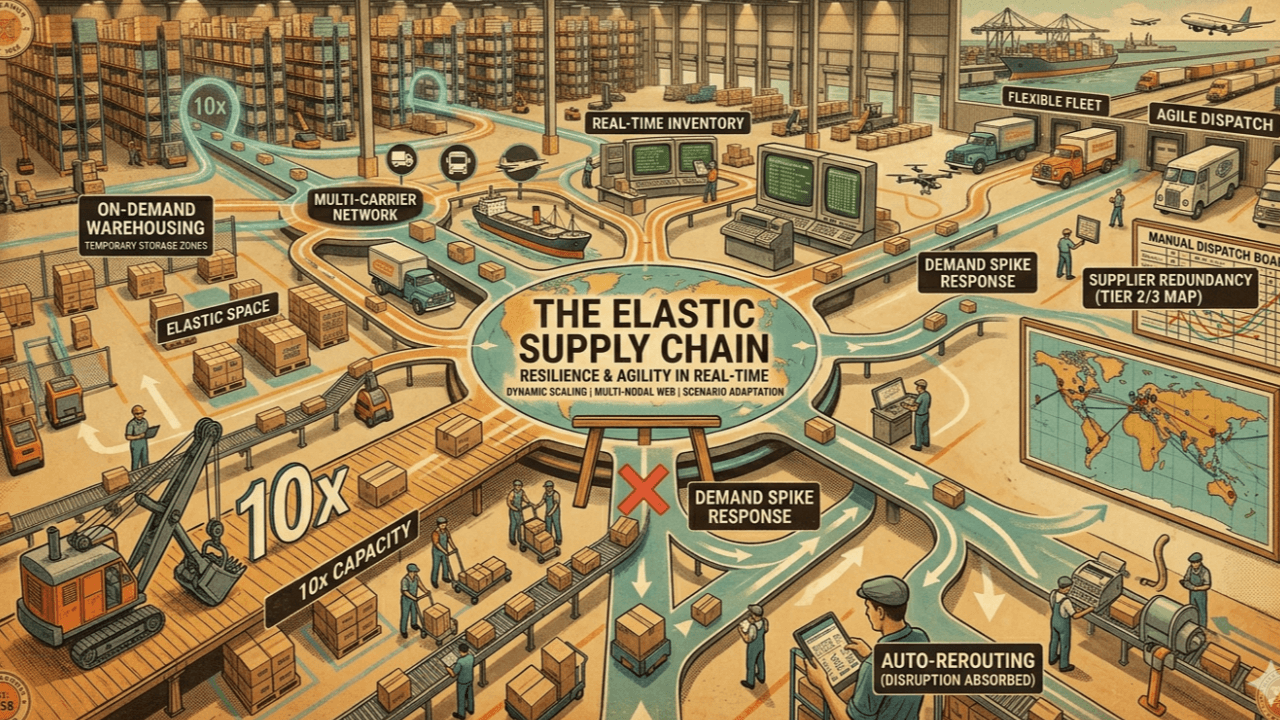
The FMCG P&L that looks healthy on a revenue basis often conceals a supply chain that is quietly destroying margin. Dead stock sitting in warehouses. Distribution delays that push products past their promotional window. Inventory purchased at forecast that was built on last season's sales rather than current sell-through velocity. And the carrying cost of all of it the working capital tied up in goods that are not moving which most founders never see as a single line item because it is distributed across the balance sheet rather than the income statement. The supply chain mistakes that kill FMCG margins are not dramatic failures. They are structural inefficiencies that are tolerable at small scale and fatal at large scale, and they are almost always invisible until a funding crisis or a cash crunch forces the founder to look at inventory age, turnover rates, and distribution efficiency with the scrutiny those numbers deserve.
Mistake 1: Inventory Purchased on Optimistic Forecasts
The most common and most expensive supply chain mistake in FMCG is buying inventory based on optimistic demand forecasts rather than actual sell-through velocity. The logic that produces this mistake is understandable: minimum order quantities from manufacturers require purchasing in bulk, suppliers offer price breaks at higher volumes, and the founder's optimism about the upcoming season or campaign makes larger inventory commitments feel justified. The consequence is dead stock inventory that moves slowly or not at all, occupying warehouse space, consuming working capital, and eventually either being sold at a discount that destroys the original margin calculation or written off entirely.The specific mechanic that makes this mistake expensive at scale: a brand with ₹20 lakh of dead stock at ₹1 crore monthly revenue has 0.6 months of revenue tied up in non-moving inventory. A brand with the same proportional dead stock problem at ₹5 crore monthly revenue has ₹1 crore of dead stock a figure that can represent a significant fraction of available working capital and can determine whether the brand can fund its next production run. The dead stock problem that was a nuisance at small scale becomes a liquidity crisis at large scale.The fix is shifting forecast methodology from top-down optimism (we expect to sell X units based on growth targets) to bottom-up sell-through analysis (our current weekly velocity by SKU by channel projects to X units over the manufacturing and distribution lead time, adjusted for seasonal factors). This requires clean, current sell-through data at the SKU level the exact data that most FMCG brands are not tracking systematically.
Mistake 2: Distribution Delays That Miss Promotional Windows
FMCG sales in India are heavily driven by promotional events festival seasons, platform sale events, seasonal demand peaks. The margin on promotional sales is already compressed relative to regular price sales. When distribution delays push goods to retail or marketplace channels after the promotional window has closed, the brand is left with inventory purchased at full production cost and now moving at post-promotional velocity typically significantly lower than the volume the purchase decision assumed.Distribution delays in India originate from several systemic sources: unreliable trucking availability during peak periods when every brand is trying to move goods simultaneously, customs and logistics delays on imported packaging or components, and the coordination failures that occur when production, logistics, and distribution planning are managed through separate spreadsheets or through informal communication rather than integrated visibility systems. The brands that consistently hit their distribution windows have visibility into production completion, logistics booking, and distribution ETAs in a single system not assembled from three separate spreadsheets by a logistics coordinator the day before the goods need to move.
Mistake 3: The Invisible Cost of Inventory Carrying
Inventory carrying cost the total cost of holding inventory including capital cost, warehouse cost, obsolescence risk, and insurance is typically estimated at 20 to 30% of inventory value annually in Indian FMCG contexts. This means a brand carrying ₹50 lakh of average inventory is spending ₹10 to ₹15 lakh annually just to hold that inventory, before any of it is sold. This cost rarely appears as a single line item in a founder's P&L review. It is distributed across rent, interest, and write-offs in ways that make it invisible as a single figure.Making this cost visible calculating it explicitly as a percentage of average inventory value and tracking it as a KPI changes the incentive structure around inventory decisions. A purchasing decision that looks margin-accretive based on volume discount pricing may look margin-destructive when the carrying cost of the incremental inventory is included. Founders who see this number explicitly make different inventory decisions than those who do not.
Mistake 4: SKU Proliferation Without SKU Performance Discipline
FMCG brands grow their SKU count faster than they grow their supply chain capability to manage complexity. Each additional SKU adds a new set of demand forecasting, inventory management, supplier management, and distribution coordination requirements. Below a certain scale, the marginal complexity of each new SKU is manageable. Above that scale, the cumulative complexity of managing twenty-five SKUs with varying velocity, seasonality, MOQ constraints, and shelf life requirements overwhelms a supply chain team that was sized for ten SKUs.The discipline that high-performing FMCG brands apply is contribution-adjusted velocity analysis by SKU measuring not just which SKUs sell the most units but which SKUs deliver the highest contribution margin per unit of working capital deployed, and actively rationalising the portfolio to concentrate supply chain resources on the SKUs that deliver the most value per unit of complexity. This analysis consistently reveals that 20 to 30% of SKUs in a typical FMCG portfolio are consuming 40 to 50% of supply chain complexity while contributing 10 to 15% of total contribution margin.
The Supply Chain Metrics Every FMCG Founder Should Know Weekly
| Metric | What It Measures | Healthy Range (Indian FMCG) | Warning Signal |
|---|---|---|---|
| Inventory turnover ratio | How many times inventory is sold and replaced per year | 812x for fast-moving categories | Below 6x indicates accumulating dead or slow stock |
| Days of inventory on hand (DOH) | How many days of sales current inventory covers | 3045 days for most categories | Above 60 days signals overstock; below 20 signals stockout risk |
| Dead stock as % of total inventory | Inventory with no sales movement in 90+ days | Under 5% of total inventory value | Above 10% requires immediate SKU rationalisation action |
| Fill rate | % of orders shipped complete and on time | Above 95% for retail; above 98% for modern trade | Below 90% signals distribution or inventory planning failure |
| Carrying cost as % of average inventory | Total annual cost to hold inventory | 2025% of average inventory value | Above 30% signals storage inefficiency or slow-moving inventory problem |

Related articles
View all → Autonomous Coordination
The Rise of Autonomous Enterprise Coordination Platforms
Enterprise coordination the alignment of people, processes, information, and resources across organisational boundaries has always been expensive, slow, and error-prone when managed through human intermediaries alone. Autonomous coordination platforms powered by AI are replacing the coordination overhead of large organisations with intelligent systems that synchronise the enterprise continuously and without manual intervention.
 AI Agents
How AI Agents Are Transforming Enterprise Workflow Intelligence
AI agents autonomous systems that perceive their environment, reason about objectives, and take action across enterprise workflows are moving from research concept to operational reality. The enterprises deploying AI agents at scale are discovering that workflow intelligence is not just about automation it is about creating organisational capability that compounds with every cycle.
 Enterprise Management
The Future of Enterprise Management Through AI Execution Layers
Enterprise management is being restructured by AI execution layers intelligent systems that sit between strategic direction and operational action, translating intent into coordinated execution at a speed and consistency that human management hierarchies cannot match. The enterprises that deploy these layers effectively are redefining what management means and what managers do.