The Future of Enterprise Management Through AI Execution Layers
Enterprise management is being restructured by AI execution layers intelligent systems that sit between strategic direction and operational action, translating intent into coordinated execution at a speed and consistency that human management hierarchies cannot match. The enterprises that deploy these layers effectively are redefining what management means and what managers do.
Manroze
Author

The management hierarchy of the modern large enterprise was designed to solve a specific problem: how do you coordinate the actions of thousands of people toward a common set of objectives when the information required to make coordination decisions is distributed across the organisation and no single person can process all of it? The solution layers of managers who each synthesise information from their level and translate direction from above into action at their level was the best available answer for most of the twentieth century. It is no longer the best available answer. AI execution layers intelligent systems that receive strategic direction, decompose it into operational tasks, coordinate resources across organisational boundaries, monitor execution progress in real time, and adjust dynamically as conditions change perform the core coordination function of management hierarchies faster, more consistently, and with lower overhead than human management layers at comparable scale. This does not eliminate the need for human management it changes what human management is for, and demands that enterprises redesign their management structures around the capabilities that AI execution layers provide and the judgment that human managers uniquely contribute.
What AI Execution Layers Change About Enterprise Management
The management functions that AI execution layers can perform information synthesis, task decomposition, progress monitoring, resource coordination, and exception routing represent a significant proportion of what middle management does in most large enterprises. When these functions are performed by AI systems that are faster, more consistent, and more scalable than human managers, the economics and structure of enterprise management change fundamentally. Management layers that exist primarily to perform coordination and information routing functions become redundant. Management roles that combine coordination with genuine judgment the ability to interpret ambiguous situations, make contextually appropriate decisions, and lead people through change become more valuable.The transition to AI-execution-layer management models requires deliberate design of what human managers do when AI systems are handling the coordination functions. The answer is not simply fewer managers doing the same work it is a fundamentally different set of management responsibilities: setting and communicating strategic direction that AI systems can translate into operational plans, designing the governance frameworks that ensure AI execution systems operate within appropriate boundaries, handling the exceptions and edge cases that fall outside the AI system's defined authority, developing the human capabilities of teams that are working alongside AI systems, and maintaining the organisational culture and values that AI systems cannot embody.
Four Ways AI Execution Layers Are Reshaping Enterprise Management
Reshaping 1: From information aggregation to strategic synthesis
A significant proportion of senior management time in traditional enterprises is consumed by aggregating information from multiple sources and levels reading reports, attending status meetings, requesting updates to form a picture of operational reality that AI execution layers can provide automatically and continuously. When this aggregation function is performed by AI, senior management time shifts from information assembly to strategic synthesis interpreting the complete, current operational picture that the AI layer provides and making the forward-looking strategic decisions that the operational data informs. This shift is a genuine upgrade in management value creation: the time previously consumed by information assembly is redirected to the judgment work that creates strategic advantage.
Reshaping 2: From sequential approval chains to exception-based governance
Traditional management hierarchies govern operational decisions through sequential approval chains that route decisions up through management layers for review and authorisation. AI execution layers replace this model with exception-based governance: the AI system executes decisions autonomously within defined parameters, and routes only the decisions that fall outside those parameters to human managers for judgment. The result is dramatically faster decision execution for the majority of operational decisions, and higher quality human judgment applied to the minority of decisions that genuinely require it because managers are no longer spending their decision capacity on approvals that the AI system could have made reliably.
Reshaping 3: From periodic performance review to continuous performance intelligence
The traditional management performance review cycle monthly business reviews, quarterly performance assessments, annual planning cycles is a response to the latency of management information systems that AI execution layers eliminate. When AI systems provide continuous, real-time performance intelligence at the individual, team, function, and enterprise level, the periodic review cycle is replaced by a continuous management dialogue informed by current data. Managers shift from preparing for and presenting at periodic reviews to interpreting continuous performance signals and making real-time adjustments to direction, resources, and priorities.
Reshaping 4: From functional silos to cross-functional orchestration
The functional silo structure of most large enterprises reflects the coordination cost of cross-functional work in human-managed organisations: when coordination requires human intermediaries at every functional boundary, minimising the number of boundaries minimises the coordination overhead. AI execution layers that handle cross-functional coordination automatically maintaining workflow visibility across functional boundaries, managing handoffs, and routing exceptions to the appropriate human decision-makers reduce the coordination cost of cross-functional work to the point where the silo structure is no longer the organisationally efficient default. Management structures can be redesigned around value creation objectives rather than coordination cost minimisation.
AI Execution Layer Management Diagnostic
- What proportion of your middle management's time is currently spent on coordination and information routing functions versus genuine judgment and leadership work? The coordination proportion is the primary AI execution layer opportunity in your management structure.
- How many management layers does a typical operational decision pass through between the level where relevant information exists and the level where authority to decide resides? Each layer is a latency introduction point that AI execution layer governance models eliminate.
- What would your management structure look like if all routine coordination, information routing, and progress monitoring functions were performed by AI systems? The answer to this question is the target management architecture, and the distance from your current structure to that target is the transformation agenda.
- Do your senior managers currently spend more time assembling information to form an operational picture or interpreting a complete operational picture to make strategic decisions? The former indicates an AI execution layer deployment opportunity that would redirect management capacity to higher-value work.
- What governance framework does your organisation have for defining which operational decisions AI execution systems can make autonomously and which require human approval? Without clear governance boundaries, AI execution layers either create operational risk through excessive autonomy or lose their speed advantage through excessive escalation.
- How does your current management model compare in speed, consistency, and overhead cost to the AI-execution-layer management models being deployed by the most operationally advanced enterprises in your competitive landscape? This comparison is the most useful framing of the urgency and scope of your management transformation agenda.

How Super Manager AGI Enables Autonomous Business Execution at Scale
Related articles
View all →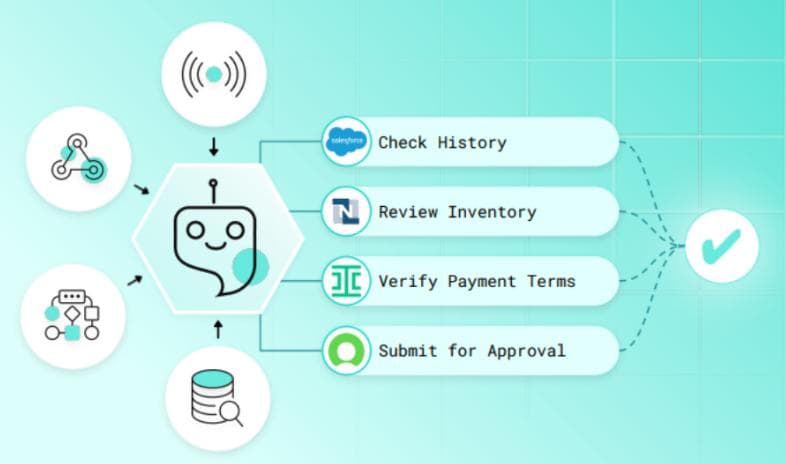 AI Execution
Why AI Execution Systems Will Define the Future of Enterprise Operations
The next frontier of enterprise competitive advantage is not strategy it is execution. AI execution systems that translate strategic intent into coordinated operational action, faster and more reliably than any human-managed process, are becoming the defining infrastructure of enterprise performance in every sector.
 Autonomous Coordination
The Rise of Autonomous Enterprise Coordination Platforms
Enterprise coordination the alignment of people, processes, information, and resources across organisational boundaries has always been expensive, slow, and error-prone when managed through human intermediaries alone. Autonomous coordination platforms powered by AI are replacing the coordination overhead of large organisations with intelligent systems that synchronise the enterprise continuously and without manual intervention.
 AI Agents
How AI Agents Are Transforming Enterprise Workflow Intelligence
AI agents autonomous systems that perceive their environment, reason about objectives, and take action across enterprise workflows are moving from research concept to operational reality. The enterprises deploying AI agents at scale are discovering that workflow intelligence is not just about automation it is about creating organisational capability that compounds with every cycle.