How Automation Will Reshape Global Workforce Dynamics
Automation is not eliminating work it is fundamentally changing which work humans do, how organisations are structured, and what skills determine professional value. The enterprises and individuals that understand and prepare for this shift will lead the next era of global economic activity.
Prince Kumar
Author

Every major wave of technological change has reshaped the workforce not by eliminating work, but by shifting which tasks require human effort and which can be performed by machines. The current wave of automation, driven by AI and robotics, is broader and faster than previous waves affecting cognitive work and physical work simultaneously, at a pace that gives individuals and organisations less time to adapt than historical transitions allowed. The enterprises that understand what automation does and does not change about the nature of work, and that build the workforce strategies to navigate the transition, will emerge with stronger organisations, higher productivity, and more engaged employees. The ones that treat automation as a cost-cutting tool without a workforce strategy will lose the institutional knowledge, employee trust, and organisational capability that make automation valuable in the first place.
What Automation Actually Changes and What It Does Not
Automation changes which tasks humans perform not whether humans are needed. The tasks most susceptible to automation are those that are repetitive, rule-based, high-volume, and well-defined: data entry, invoice processing, scheduled reporting, standard customer service responses, quality inspection of uniform products, and logistics routing. These tasks will be performed by automated systems faster, more accurately, and at lower cost than humans can perform them. This is not a future projection it is happening now across every industry and function.What automation does not change is the need for human judgment in ambiguous situations, the ability to build trust in complex relationships, the capacity to navigate novel problems without a defined rule set, and the creative and strategic thinking that generates new value rather than optimising existing processes. The workforce of the automation era is not smaller it is different. It is composed of people who work alongside automated systems, focus their effort on the tasks that require human capability, and continuously update their skills as the boundary between human and automated work evolves.
Four Workforce Dynamics That Automation Is Reshaping
Dynamic 1: The shift from task execution to task orchestration
As automation handles routine task execution, the human role in many functions shifts from doing the work to managing the systems that do the work setting parameters, handling exceptions, validating outputs, and improving processes. This shift requires a different skill set: comfort with technology, analytical capability to identify when automated outputs are incorrect, and the judgment to handle the edge cases that automation cannot resolve. Organisations that redesign roles around this shift, rather than simply layering automation on top of existing job descriptions, will realise significantly more value from their automation investments.
Dynamic 2: The acceleration of skill obsolescence and the reskilling imperative
The half-life of specific technical skills is shortening as automation capabilities expand. Skills that were valuable five years ago manual data processing, basic coding without AI assistance, standard financial modelling are being automated or augmented at a pace that makes them less differentiating every year. The workforce dynamic this creates is a continuous reskilling requirement: organisations that build the internal learning infrastructure to upskill employees faster than their skills become obsolete will retain talent, maintain productivity, and avoid the costly cycle of layoffs and rehiring that slow adaptation creates.
Dynamic 3: The geographic redistribution of work
Automation is not eliminating jobs uniformly across geographies it is eliminating specific types of jobs in specific locations while creating new types of jobs in different locations. Manufacturing automation is reducing low-skill assembly work in low-cost countries while increasing demand for automation engineers and technicians. AI is reducing certain types of knowledge work in high-cost markets while increasing demand for AI specialists, data scientists, and AI-augmented professionals. The global workforce dynamics this creates will be significant: some regions will face structural unemployment in sectors that automation has transformed, while others will face acute talent shortages in the roles that support and extend automation capabilities.
Dynamic 4: The premium on uniquely human capabilities
As automation handles more of the routine cognitive and physical work, the economic premium on capabilities that automation cannot replicate will increase. Creativity, empathy, complex negotiation, ethical judgment, and the ability to lead through ambiguity are becoming more valuable relative to technical execution skills not because technical skills are unimportant, but because they are increasingly table stakes rather than differentiators. The individuals and organisations that invest in developing these capabilities alongside technical proficiency will be best positioned in the automation era.
Workforce Automation Readiness Diagnostic
- What percentage of the tasks performed by your workforce today are repetitive, rule-based, and high-volume? This percentage represents the near-term automation opportunity and the workforce impact that requires proactive planning.
- Do you have a structured reskilling programme that prepares employees for roles that automation creates rather than just the roles it eliminates? Without it, automation investment will generate short-term cost reduction and long-term talent gaps.
- How does your organisation currently measure the productivity impact of automation investments by cost reduction only, or by the value of the human work that automation enables? Organisations that measure only cost reduction systematically underinvest in the human capability that makes automation valuable.
- What is your current ratio of roles focused on managing and improving automated systems versus roles performing the tasks those systems will automate? This ratio should be shifting continuously toward the former as automation matures.
- Do you have visibility into which roles in your organisation are most exposed to automation disruption in the next three years? Without this visibility, workforce planning is reactive rather than proactive.
- How quickly can your organisation redeploy employees whose roles are being automated into new roles that create value? Above six months indicates a redeployment process that is too slow for the pace of automation change.

Why Enterprise Agility Matters More Than Enterprise Size
Related articles
View all →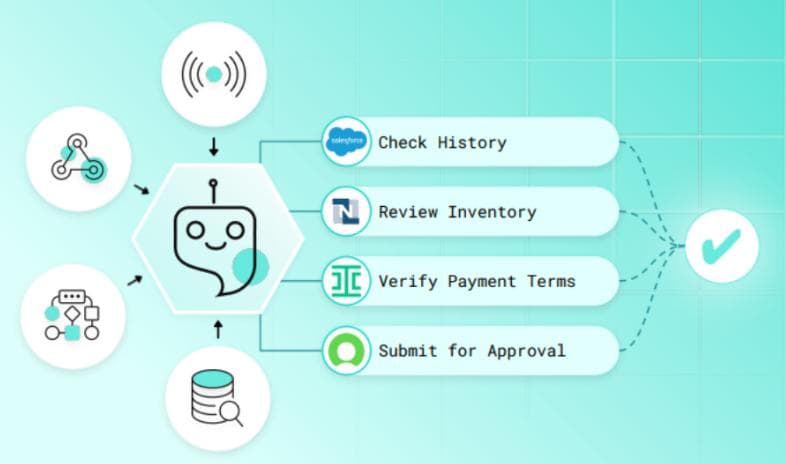 AI Execution
Why AI Execution Systems Will Define the Future of Enterprise Operations
The next frontier of enterprise competitive advantage is not strategy it is execution. AI execution systems that translate strategic intent into coordinated operational action, faster and more reliably than any human-managed process, are becoming the defining infrastructure of enterprise performance in every sector.
 Autonomous Coordination
The Rise of Autonomous Enterprise Coordination Platforms
Enterprise coordination the alignment of people, processes, information, and resources across organisational boundaries has always been expensive, slow, and error-prone when managed through human intermediaries alone. Autonomous coordination platforms powered by AI are replacing the coordination overhead of large organisations with intelligent systems that synchronise the enterprise continuously and without manual intervention.
 AI Agents
How AI Agents Are Transforming Enterprise Workflow Intelligence
AI agents autonomous systems that perceive their environment, reason about objectives, and take action across enterprise workflows are moving from research concept to operational reality. The enterprises deploying AI agents at scale are discovering that workflow intelligence is not just about automation it is about creating organisational capability that compounds with every cycle.