Intelligent Automation Strategies for Modern Enterprises
Intelligent automation the combination of AI, robotic process automation, and workflow orchestration is moving from isolated deployments to enterprise-wide strategies. The organisations that build automation as a coherent capability rather than a collection of tools are achieving results that point deployments cannot.
Nirmal Nambiar
Author

Robotic process automation delivered its promise and its limitations clearly. The promise: significant cost reduction and quality improvement for rule-based, high-volume processes that could be automated with deterministic logic. The limitation: brittleness in the face of process variation, high maintenance costs when underlying systems changed, and an inability to handle the judgment-light but not judgment-free tasks that make up a significant portion of enterprise operational work. Intelligent automation addresses these limitations by combining the process execution capability of RPA with the adaptive intelligence of AI. Natural language understanding that handles the variability in unstructured inputs. Computer vision that interprets documents and interfaces that change. Machine learning that improves automation performance over time rather than requiring manual reprogramming. The result is an automation capability that is more resilient, more broadly applicable, and more valuable over time than first-generation RPA and the enterprises building intelligent automation as a strategic capability, not a point solution portfolio, are the ones realising its full potential.
From Point Solutions to Automation Strategy
The difference between enterprises with a collection of automation point solutions and enterprises with a coherent automation strategy is visible in three dimensions. The first is coverage: point solution enterprises have automated the obvious high-volume processes but have not built the infrastructure to systematically identify and automate the long tail of processes that, in aggregate, represent more total effort than the obvious targets. Strategic automation enterprises have built process discovery capabilities both technology-enabled process mining and systematic human-led process audits that continuously surface automation opportunities across the organisation.The second dimension is integration: point solution automation tools often operate in isolation, handling specific process steps without connecting to the broader workflow. Strategic automation orchestrates multiple automation components into end-to-end automated workflows eliminating the manual handoffs between automated steps that represent a significant portion of residual effort in point solution deployments. The third dimension is governance: strategic automation enterprises have centralised automation ownership, standardised development practices, and systematic performance monitoring that allows the automation portfolio to be managed, maintained, and improved as a coherent asset rather than a fragmented collection of scripts.
Building an Intelligent Automation Capability
The Process Discovery Foundation
Intelligent automation strategy starts with a comprehensive understanding of the process landscape which processes exist, how they are currently executed, what their volume and cost profile looks like, and which of them represent viable automation candidates. Process mining technology that analyses system logs to map actual process execution patterns revealing the variations, exceptions, and inefficiencies invisible in documented process maps is the most efficient tool for this discovery at scale. Combined with targeted process interviews that capture the judgment-light decision steps that mining tools may not surface, process discovery provides the foundation for an automation roadmap prioritised by value, feasibility, and strategic relevance.
The Centre of Excellence Model
Enterprises that have successfully scaled intelligent automation to enterprise-wide impact have almost universally adopted a centre of excellence model a centralised team that owns automation strategy, governance, and capability development while supporting distributed deployment across business functions. The centre of excellence maintains the technology platform, sets development standards, manages vendor relationships, monitors automation performance, and develops the internal capability that business functions need to identify and implement automation opportunities in their domains. Without a centre of excellence, automation deployment fragments into inconsistent point solutions that are expensive to maintain and difficult to scale.
Intelligent Automation Strategy Questions
- Do you have a systematic process for identifying automation opportunities across your organisation or does automation deployment depend on individual champions identifying and advocating for specific opportunities?
- What is your current maintenance cost for deployed automation solutions and does this cost profile suggest that your automation architecture is sustainable as the portfolio grows?
- Have you built the end-to-end workflow orchestration required to automate processes across system boundaries or are your automation deployments limited to single-system process steps?
- What is your organisation's current automation development capacity and does it match the backlog of identified opportunities, or is implementation bandwidth the primary constraint on automation progress?
- How do you currently measure the performance and business impact of deployed automation and does your measurement framework capture the full value delivered, including quality improvement and capacity reallocation?

Related articles
View all →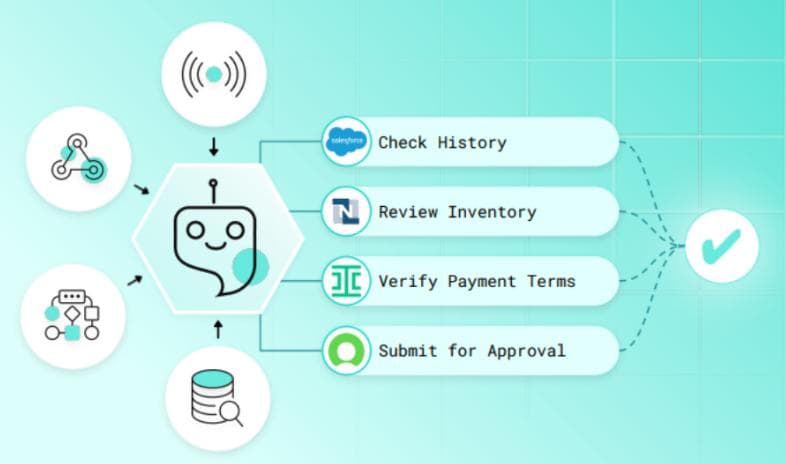 AI Execution
Why AI Execution Systems Will Define the Future of Enterprise Operations
The next frontier of enterprise competitive advantage is not strategy it is execution. AI execution systems that translate strategic intent into coordinated operational action, faster and more reliably than any human-managed process, are becoming the defining infrastructure of enterprise performance in every sector.
 Autonomous Coordination
The Rise of Autonomous Enterprise Coordination Platforms
Enterprise coordination the alignment of people, processes, information, and resources across organisational boundaries has always been expensive, slow, and error-prone when managed through human intermediaries alone. Autonomous coordination platforms powered by AI are replacing the coordination overhead of large organisations with intelligent systems that synchronise the enterprise continuously and without manual intervention.
 AI Agents
How AI Agents Are Transforming Enterprise Workflow Intelligence
AI agents autonomous systems that perceive their environment, reason about objectives, and take action across enterprise workflows are moving from research concept to operational reality. The enterprises deploying AI agents at scale are discovering that workflow intelligence is not just about automation it is about creating organisational capability that compounds with every cycle.