The Open Source vs. Closed Source AI War
Meta has released Llama models that rival GPT-4 performance at zero licence cost. DeepSeek produced a model competitive with OpenAI's frontier at a fraction of the training cost. The closed-source AI model that was untouchable 18 months ago is being matched or beaten by open alternatives. The war is not over, but the balance has shifted.
Aditya Sharma
Author
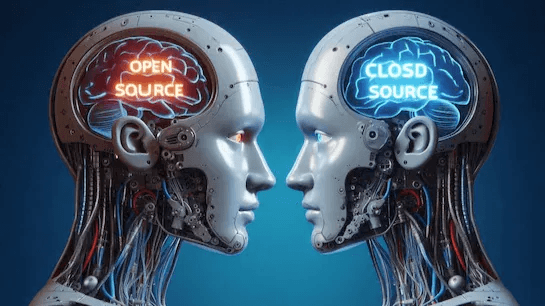
In 2022, the AI capability landscape was simple: a handful of closed-source API providers OpenAI, Anthropic, Google had frontier models that were substantially more capable than anything available through open channels. Organisations that wanted state-of-the-art AI capability had to pay API fees to these providers, accept their usage policies, and accept that their inference requests were processed on infrastructure they did not control. In 2026, this landscape has changed substantially. Meta has released successive generations of Llama models that, on many standard benchmarks, rival or match GPT-4 class performance. DeepSeek, a Chinese AI lab, produced a model in early 2025 that was competitive with OpenAI's frontier at a reported training cost of approximately $6 million a fraction of the hundreds of millions estimated for comparable closed-source models. Mistral, Qwen, and dozens of other open-weight models are available for download, fine-tuning, and on-premises deployment at zero licence cost. The open-source vs. closed-source AI war is not a future contest. It is a current reality with real consequences for every organisation making AI investment decisions.
The Current State of Play
As of early 2026, the capability gap between frontier closed-source models (GPT-4o, Claude 3.5, Gemini Ultra) and frontier open-weight models (Llama 3.1, DeepSeek V3, Qwen 2.5) has narrowed dramatically. On standard benchmarks MMLU, HumanEval, GSM8K, MATH the best open-weight models now score within a few percentage points of the best closed-source models. On specific tasks, open models have overtaken closed ones. DeepSeek's mathematical reasoning performance exceeded GPT-4 on several benchmarks when it was released in late 2024.The performance convergence has happened faster than most AI industry observers predicted. The conventional wisdom in 2022 was that frontier AI capability required the computational resources and proprietary training data accessible only to the largest technology companies. DeepSeek's demonstration that a highly capable model could be trained for $6 million challenged this assumption. If the training cost gap is not as large as assumed, the capability moat that justified closed-source AI's premium pricing becomes harder to sustain.
Why Closed Source Still Has Advantages
Frontier capability on standard benchmarks is not the only dimension that matters for enterprise AI deployment. Closed-source providers retain significant advantages in several categories that are important for serious production deployments. Safety and alignment investment: OpenAI, Anthropic, and Google have dedicated research teams working on model safety, bias reduction, and harmful output prevention that open-source projects cannot match in investment scale. For organisations deploying AI in sensitive contexts healthcare, legal, financial advice the safety investment of closed-source providers is not a trivial consideration.Infrastructure reliability: using a closed-source API means the provider handles all infrastructure management, uptime guarantees, and scaling. Deploying an open-weight model on-premises or in a private cloud requires the organisation to manage inference infrastructure, handle hardware failures, scale capacity, and maintain the model as new versions are released. For most organisations without AI infrastructure expertise, this total cost of ownership difference makes closed-source APIs more practical than their licence savings suggest.Multimodal capability and tool integration: as of 2026, closed-source frontier models still lead in multimodal capability (vision, audio, video), in tool use reliability, and in the quality of surrounding infrastructure (function calling, structured output, batch processing). These capabilities matter for production agentic systems and are still not fully matched by open-source alternatives.
Why Open Source Is Winning in Specific Contexts
For organisations in regulated industries BFSI, healthcare, legal the ability to run AI inference entirely within their own infrastructure perimeter, without any data crossing an external API boundary, is not a feature preference. It is a compliance requirement (as documented in the data sovereignty article). Open-weight models deployed on-premises are the only architecture that satisfies this requirement without custom enterprise agreements. The data sovereignty compliance case alone makes open-source models the correct choice for a significant portion of the enterprise market, regardless of the benchmark performance comparison.For cost-sensitive deployments at scale, the economics of open-source models are compelling. A closed-source API charges per token fractions of a rupee per query that become significant costs at the millions-of-queries-per-day scale that large enterprise deployments reach. An open-weight model deployed on owned or rented GPU infrastructure has a fixed infrastructure cost that becomes proportionally cheaper as query volume increases. For organisations that can predict and sustain their AI query volume, the break-even point where open-source total cost of ownership becomes lower than closed-source API fees is typically reached within six to twelve months at moderate deployment scale.
The Deepseek Moment and What It Means
DeepSeek's January 2025 release sent a shockwave through the AI industry that caused a significant single-day decline in Nvidia's stock price and prompted widespread discussion about the sustainability of the AI infrastructure investment thesis. The model's reported training cost of approximately $6 million compared to the estimated hundreds of millions for comparable models from US labs suggested that the efficiency improvements in training methodology had advanced faster than the market had priced in.The DeepSeek moment matters for the open-source vs. closed-source war for a specific reason: it demonstrated that frontier-competitive AI capability was not exclusively a function of the largest possible training runs with the largest possible compute budgets. If capable models can be trained efficiently, the cost barrier to producing competitive open-source models decreases, which increases the rate of open-source capability improvement, which accelerates the erosion of the closed-source capability moat. The direction of travel is toward capability parity at lower cost. The timeline on which parity is fully achieved is uncertain, but the direction is not.
What Organisations Should Actually Do
- Do not make a binary commitment to either open or closed source the right architecture depends on your specific use case, data sovereignty requirements, deployment scale, and in-house infrastructure capability
- For regulated industries where data cannot cross an external API boundary, open-weight models deployed in a sovereign infrastructure configuration are likely the only compliant option
- For use cases where frontier multimodal capability or the highest safety alignment is required, closed-source frontier models retain real advantages that benchmark comparisons on text tasks do not fully capture
- For high-volume deployments where cost at scale matters, model the total cost of ownership of open-source infrastructure deployment versus closed-source API fees at your anticipated query volume the break-even point varies significantly by usage pattern
- Monitor the capability frontier across both open and closed models continuously the landscape is changing fast enough that a decision made six months ago may no longer reflect the current capability and cost reality

How Small Businesses Can Beat Big Companies with AI
Related articles
View all → Autonomous Coordination
The Rise of Autonomous Enterprise Coordination Platforms
Enterprise coordination the alignment of people, processes, information, and resources across organisational boundaries has always been expensive, slow, and error-prone when managed through human intermediaries alone. Autonomous coordination platforms powered by AI are replacing the coordination overhead of large organisations with intelligent systems that synchronise the enterprise continuously and without manual intervention.
 AI Agents
How AI Agents Are Transforming Enterprise Workflow Intelligence
AI agents autonomous systems that perceive their environment, reason about objectives, and take action across enterprise workflows are moving from research concept to operational reality. The enterprises deploying AI agents at scale are discovering that workflow intelligence is not just about automation it is about creating organisational capability that compounds with every cycle.
 AI-Native Infrastructure
Why Global Enterprises Need AI-Native Operational Infrastructure
The operational infrastructure that global enterprises built in the pre-AI era was designed for a different competitive environment. Enterprises that try to layer AI on top of legacy operational infrastructure will capture a fraction of AI's potential. The ones that rebuild their operational foundations as AI-native will gain structural advantages their competitors cannot close.