The Shift from Enterprise Automation to Enterprise Autonomy
Automation executes predefined logic. Autonomy pursues objectives. The shift from enterprise automation to enterprise autonomy is not incremental it is a fundamental change in what technology can do for organisations, and the enterprises that understand this distinction are building for a different future.
Aditya Sharma
Author

The history of enterprise technology is largely a history of automation: encoding human decisions into systems that execute those decisions consistently at scale. Each generation of enterprise software extended the reach of automation more processes encoded, more decisions systematised, more operational tasks handled by machines rather than people. Enterprise autonomy is what comes after automation. Systems that are not executing pre-specified logic but pursuing objectives systems that understand what they are trying to achieve, perceive the current state of the environment, identify the actions most likely to achieve the objective given that environment, and adapt their approach when circumstances change. The shift from automation to autonomy is not incremental improvement. It is a qualitative change in what technology can do and it changes the frontier of what enterprises can achieve without human intervention.
The Automation-Autonomy Distinction
The distinction between automation and autonomy is most clearly illustrated through examples at the operational level. An automated invoice processing system executes a defined workflow: extract data fields, match to purchase order, flag discrepancies above a threshold, route matched invoices to payment queue. It handles the cases its logic was designed for and fails on cases it was not requiring manual intervention for the variations its programming did not anticipate. An autonomous invoice processing system pursues the objective of accurate, efficient invoice processing understanding what that means, perceiving the characteristics of each invoice, determining the appropriate processing approach for each case including variations not seen before.The difference in operational impact is significant. The automated system handles a defined set of cases consistently. The autonomous system handles the full range of cases adaptively and improves its handling over time. For enterprises whose operational environments are variable, complex, and continuously changing, the autonomous system delivers value that the automated system cannot, because the automated system's fixed logic becomes increasingly misaligned with the changing environment while the autonomous system continuously adapts.
Building for Enterprise Autonomy
The Technology Requirements for Autonomy
Building enterprise autonomy requires technology infrastructure that goes beyond conventional automation platforms. Large language models or domain-specific AI models that can understand objectives and generate appropriate action plans. Reinforcement learning systems that can improve autonomous decision-making through experience. Agent orchestration infrastructure that coordinates multiple autonomous systems pursuing related objectives. Robust safety and governance systems that constrain autonomous operation within acceptable boundaries and detect when autonomous systems are operating outside their intended parameters.
The Governance Imperative for Autonomous Systems
The shift from automation to autonomy requires a corresponding shift in governance approach. Automated systems fail in predictable ways they encounter cases their logic cannot handle and either fail explicitly or produce incorrect outputs. Autonomous systems can fail in less predictable ways pursuing objectives through approaches that are technically coherent but operationally undesirable. Governing autonomous enterprise systems requires continuous monitoring of both outputs and behaviours, well-designed objective specifications that capture the full intent of what the system should achieve, and robust escalation mechanisms for situations where autonomous behaviour diverges from organisational expectations.
Automation to Autonomy Transition Questions
- Which of your current enterprise automation deployments are constrained by the rigidity of their programmed logic requiring significant manual intervention for cases their automation cannot handle?
- What would moving from automation to autonomy enable in your highest-priority operational domain in terms of case handling coverage, exception rate reduction, and operational adaptability?
- What governance framework would you need to deploy autonomous systems with confidence specifically, how would you define and monitor the boundaries of acceptable autonomous behaviour?
- What is your organisation's current AI maturity level and does your technology and talent infrastructure support the shift from automation to autonomy, or does it need significant development?
- How would you sequence the transition from automation to autonomy in your enterprise starting with the domains where autonomy is most viable and the value case is clearest?

Why Global Enterprises Need AI-Native Operational Infrastructure
Related articles
View all →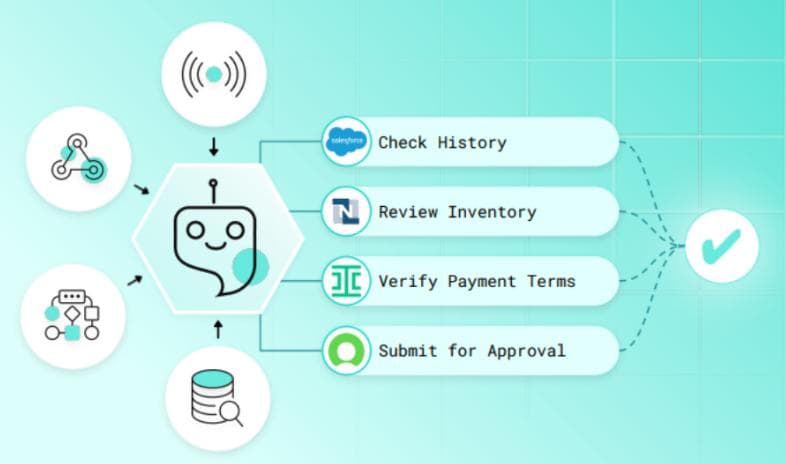 AI Execution
Why AI Execution Systems Will Define the Future of Enterprise Operations
The next frontier of enterprise competitive advantage is not strategy it is execution. AI execution systems that translate strategic intent into coordinated operational action, faster and more reliably than any human-managed process, are becoming the defining infrastructure of enterprise performance in every sector.
 Autonomous Coordination
The Rise of Autonomous Enterprise Coordination Platforms
Enterprise coordination the alignment of people, processes, information, and resources across organisational boundaries has always been expensive, slow, and error-prone when managed through human intermediaries alone. Autonomous coordination platforms powered by AI are replacing the coordination overhead of large organisations with intelligent systems that synchronise the enterprise continuously and without manual intervention.
 AI Agents
How AI Agents Are Transforming Enterprise Workflow Intelligence
AI agents autonomous systems that perceive their environment, reason about objectives, and take action across enterprise workflows are moving from research concept to operational reality. The enterprises deploying AI agents at scale are discovering that workflow intelligence is not just about automation it is about creating organisational capability that compounds with every cycle.