Why AI Execution Agents Will Become the Core Operating Layer for Global Enterprises
AI execution agents autonomous systems that plan, decide, and act across enterprise workflows without constant human instruction are transitioning from experimental technology to operational infrastructure. The global enterprises that deploy them earliest are building an execution advantage that compounds with every passing quarter.
Prince Kumar
Author

The history of enterprise software is a history of encoding human decisions into systems that execute those decisions consistently at scale. ERP systems encoded procurement and financial workflows. CRM systems encoded sales and customer management processes. Logistics platforms encoded fulfilment and inventory decisions. Each generation of enterprise software increased the consistency and scale of execution but the decisions themselves still required human input. The logic had to be specified in advance. Edge cases had to be handled manually. Changes to the operating environment required system reconfiguration. AI execution agents represent a qualitative break from this pattern. Systems that do not just execute pre-specified logic but that understand objectives, perceive the current state of the environment, plan sequences of actions to achieve those objectives, and adapt their approach when circumstances change. The implications for enterprise operations are significant: a core operating layer that can handle not just routine execution but adaptive, judgment-light coordination across the full complexity of a global enterprise.
What AI Execution Agents Actually Do
An AI execution agent is defined by four capabilities that distinguish it from conventional automation. Perception: the ability to gather and interpret information from multiple sources structured data, unstructured documents, real-time signals, and system states to form an accurate picture of the current operational environment. Planning: the ability to generate a sequence of actions that will achieve a specified objective given the current environment, including identifying dependencies, sequencing steps, and anticipating likely obstacles. Execution: the ability to carry out planned actions across enterprise systems triggering workflows, generating documents, routing approvals, updating records, and communicating with stakeholders without manual intervention at each step. Adaptation: the ability to recognise when the environment has changed or when an action has produced an unexpected result, and to revise the plan accordingly.The combination of these four capabilities produces a system that can handle the kind of complex, multi-step operational tasks that previously required significant human coordination effort. A procurement process that involves supplier selection, negotiation, contract generation, approval routing, and system updating a process that might consume days of human effort across multiple roles can be handled by an AI execution agent that manages each step autonomously, escalates only the decisions that require human judgment, and completes the process in a fraction of the time.
The Enterprise Impact of AI Execution Agents
Operational Speed as Competitive Advantage
The most immediate competitive impact of AI execution agents is speed. The enterprise whose procurement cycles run in hours instead of days, whose contract review and approval processes complete in hours instead of weeks, whose customer onboarding workflows execute in minutes instead of days, has a structural speed advantage that manifests as lower operational cost, faster revenue recognition, and higher customer satisfaction. In global enterprises where process complexity and geographic distribution routinely extend execution timelines, AI execution agents that operate continuously across time zones and systems without the coordination overhead of human handoffs represent a transformational speed improvement.
The Scalability Dimension
Beyond speed, AI execution agents address the scalability constraint that limits human-operated enterprise processes. Human execution capacity scales linearly with headcount more volume requires more people. AI execution agents scale near-instantaneously: an agent handling 1,000 procurement transactions per month can handle 10,000 with the same infrastructure investment, simply processing more in parallel. For global enterprises managing operational volume across hundreds of markets and thousands of product lines, the scalability of AI execution agents is not a marginal efficiency improvement it is the difference between operational models that are viable at global scale and those that collapse under their own coordination complexity.
AI Execution Agent Deployment Questions
- Which enterprise processes in your organisation involve the most multi-step coordination across systems and stakeholders and what would it mean for operational performance if those processes ran autonomously?
- What percentage of your current operational bottlenecks are caused by human handoff delays between process steps rather than the complexity of any individual step?
- Have you evaluated AI execution agent platforms available for your highest-priority process categories and do you have a defined pilot framework for testing their performance?
- What governance framework would you need to deploy AI execution agents with confidence defining which decisions agents handle autonomously and which require human approval?
- What would a 70 percent reduction in the cycle time of your three most complex operational processes enable for your business in cost, revenue speed, and customer experience?
Super Manager AGI and the Rise of AI-Native Enterprise Management Systems
Related articles
View all →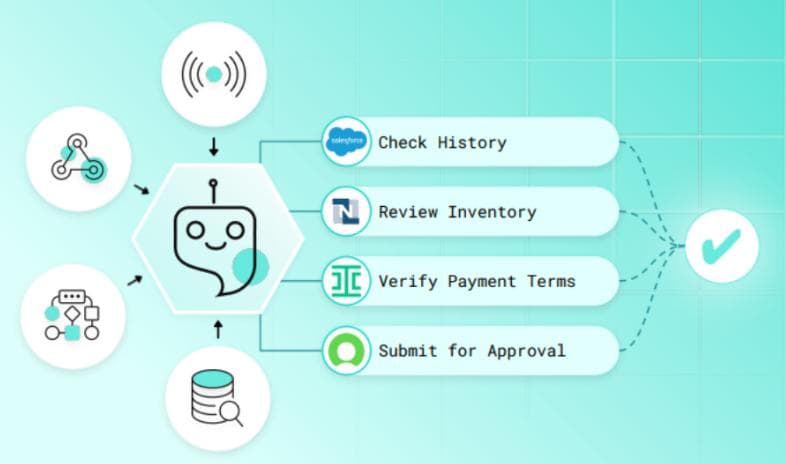 AI Execution
Why AI Execution Systems Will Define the Future of Enterprise Operations
The next frontier of enterprise competitive advantage is not strategy it is execution. AI execution systems that translate strategic intent into coordinated operational action, faster and more reliably than any human-managed process, are becoming the defining infrastructure of enterprise performance in every sector.
 AI Agents
How AI Agents Are Transforming Enterprise Workflow Intelligence
AI agents autonomous systems that perceive their environment, reason about objectives, and take action across enterprise workflows are moving from research concept to operational reality. The enterprises deploying AI agents at scale are discovering that workflow intelligence is not just about automation it is about creating organisational capability that compounds with every cycle.
 Agentic AI
The Evolution of Enterprise Operations in the Age of Agentic AI
Agentic AI AI systems that pursue goals, take actions, and adapt to feedback without requiring step-by-step human instruction is not an incremental evolution of enterprise automation. It is a structural shift in what operational systems can do and what human operators are for.