Why Discounts Are Killing Your D2C Brand (And What to Do Instead)
Every discount trains your customer to wait for the next one. Revenue goes up on sale day. Brand value, repeat purchase rate, and margin go down permanently. Here is why discounting is the most expensive growth strategy availableand what the brands building durable businesses do instead.
Prince Kumar
Author
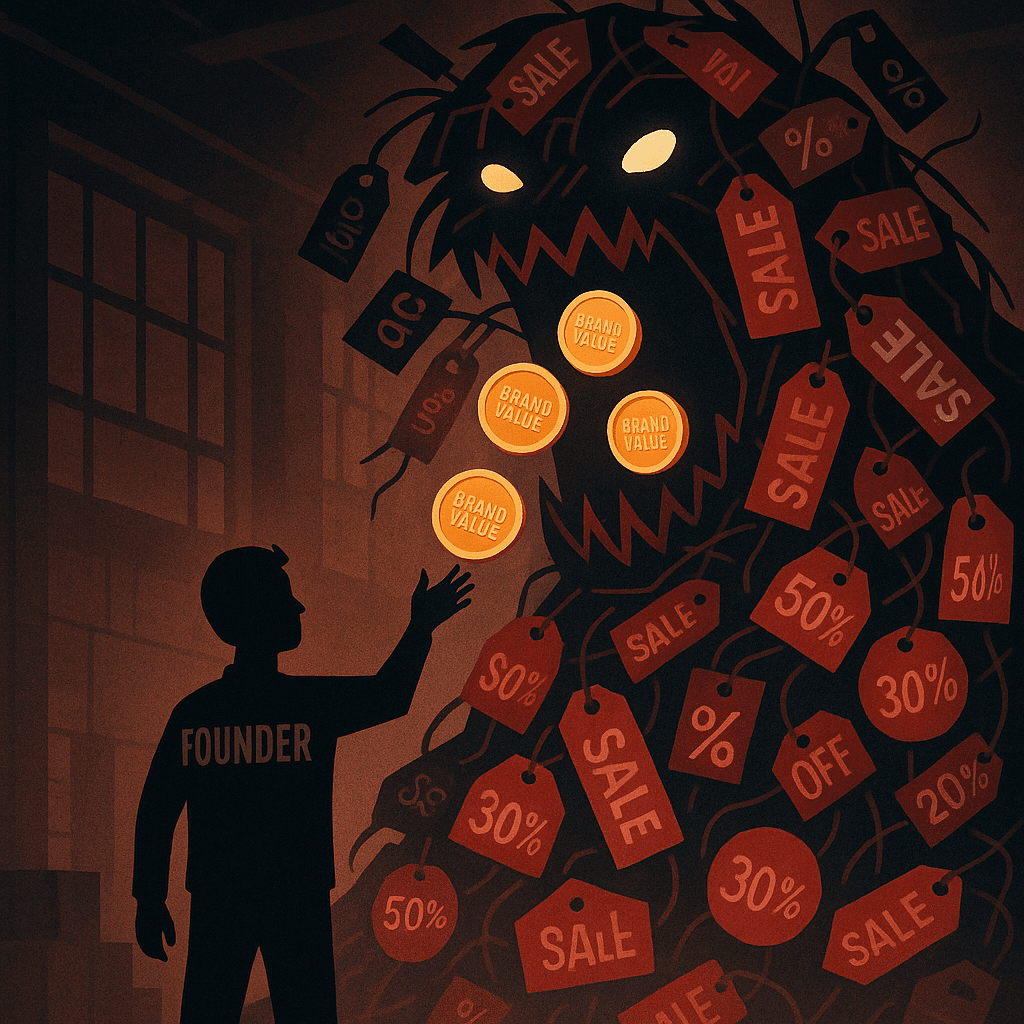
The festive sale worked. Revenue doubled in five days. The team celebrated. Three weeks later, the founder looked at the numbers more carefully. The 40% discount on the hero SKU produced revenue that was 40% lower margin per order than the brand's normal price. The customer acquisition cost on sale-driven orders was 30% higher because competition for attention during platform sales inflates ad CPMs. The return rate on sale orders was 8 percentage points higher than on full-price ordersbecause customers buying on impulse at a discount are less committed to the purchase than customers who chose to buy at full price. And the week after the sale, full-price conversion dropped 23% because a segment of the brand's audience was waiting to see if another sale was coming. The sale generated the revenue number the founder was looking for. It cost the brand significantly more than the discount line in the P&L suggests.
The True Cost of Discounting: Beyond the Margin Math
The margin cost of discounting is the visible cost30% discount means 30% less revenue per order, which means the contribution margin on that order is significantly compressed. For a product with 45% gross margin selling at ₹799, a 30% discount to ₹559 reduces gross margin from ₹360 to ₹200 per unita 44% reduction in per-unit contribution before fulfilment costs. This visible cost is real and large. It is also the smallest component of discounting's true cost.The invisible costs are larger and more durable. Brand price anchor erosion: every time a customer buys at ₹559, that price becomes their mental reference for what the product is worth. When the brand returns to ₹799, the customer experiences the full price not as the product's actual value but as a premium above the 'real' price they know the brand will eventually offer. The conversion rate at full price after a major discount event is reliably lowertypically 15 to 25% lower in the two to four weeks following the salebecause a segment of the audience now waits for the discount to repeat.Discount customer cohort quality: customers acquired during discount periods have measurably lower lifetime value than customers acquired at full price. Research across Indian D2C categories consistently shows that the 90-day repeat purchase rate for sale-acquired customers is 20 to 35% lower than for full-price-acquired customers. The explanation is straightforwarda customer who chose to buy at full price made a quality-driven purchase decision. A customer who bought because the price dropped made a price-driven purchase decision. Price-driven customers continue to shop price-driventhey come back at the next sale, or they find a cheaper alternative.
Why Founders Keep Discounting Anyway
The discount trap is self-reinforcing for a structural reason: discounts produce immediate, visible results that justify themselves in the short-term reporting cycle. The sale event shows revenue up 2x. The week after the sale, revenue returns to normal. The CAC for the sale period looks low because the denominator (new customers acquired) is large. The margin compression, the cohort quality degradation, and the full-price conversion suppression do not appear in the same reporting period as the revenue spikethey appear in the following weeks and months, often without being connected causally to the discount event that caused them.This time lag between discounting action and discounting consequence is the mechanism that keeps brands in the discount cycle. The sale worked (in the short term). So it gets repeated. And repeated. Until the brand's audience has been trained to wait for sales, the full-price conversion rate has structurally declined, and the brand's perceived value has anchored at the discount price rather than the full price.
What to Do Instead: Value Creation Without Price Reduction
Bundle offers that increase AOV without reducing per-unit price
A bundle offerbuy two, get a complimentary productincreases the average order value, provides perceived value to the customer, and does not reduce the price point of any individual product in the catalogue. The customer experiences a value event without the brand establishing a discount precedent. The economics are typically better than a direct discount: a ₹150 complimentary product on a ₹1,600 bundle order is a 9.4% cost-of-offer, compared to a 20% discount on the same order value that costs ₹320.
Loyalty programme rewards that create repeat purchase incentives
A points-based loyalty programme that rewards repeat purchasegiving credits redeemable on future orderscreates the customer incentive of a discount without reducing the acquisition price. New customers pay full price. Returning customers accumulate value over time that is redeemable on future orders. The programme rewards the customer behaviour the brand wants (repeat purchase) rather than the behaviour it does not want (single discount-driven purchase). The effective discount rate of a loyalty programme is distributed across the customer lifetime rather than concentrated at the acquisition moment.
Value-added experiences instead of price reduction
Free samples of new products added to orders during specific periods, personalised thank-you notes, early access to new product launches for existing customersthese create differentiated value for existing customers without reducing price. For acquisition, exclusive content, community access, or first-mover product access creates perceived value that converts customers who align with the brand's mission rather than customers who respond to price signals.
The Discount Audit Every D2C Founder Should Run
- Compare the 90-day repeat purchase rate of customers acquired during your last three discount events against customers acquired in the three weeks before and after each eventthe cohort quality gap will typically be 20 to 35 percentage points
- Calculate the full-price conversion rate in the two weeks following each major discount event and compare it to the two weeks preceding the eventa structural drop of 15 to 25% is the normal consequence of an anchoring event
- Model the 12-month LTV of a discount-acquired customer at their actual retention rate against the CAC spent to acquire themin most D2C categories in India, discount-acquired customers at 30% discount are loss-making at 12-month LTV even at full full-price unit economics
- Calculate what the same discount budget invested in post-purchase experience improvementspackaging, personalised communication, loyalty rewardswould have delivered in repeat purchase rate improvement and LTV uplift versus the discount-driven acquisition
Related articles
View all → Growth
The Future of Enterprise Growth Through AI Innovation
AI is not just improving the efficiency of existing growth strategies it is enabling entirely new growth models. The enterprises that understand how to use AI as a growth driver, not just a cost reducer, are accessing markets, customer segments, and revenue streams that were previously out of reach.
 Scalability
AI-Powered Systems for Enterprise Scalability and Resilience
The ability to scale without proportional cost increases and to absorb shocks without operational failure is what separates enterprises that grow sustainably from those that grow into crisis. AI-powered systems are the infrastructure through which scalability and resilience are built.
 AI
AIThe Future of AI-Powered Digital Marketplaces
Digital marketplaces are evolving from transactional platforms into intelligent commerce ecosystems. AI is reshaping how buyers discover products, how sellers manage operations, and how platforms create value for everyone in the ecosystem and the pace of this transformation is accelerating.