Why Every Enterprise Will Have an AI Operating Layer
The enterprise technology stack is adding a new fundamental layer that will become as ubiquitous as operating systems became for computing and databases became for data management. The AI operating layer sits between enterprise applications and handles the orchestration, governance, and coordination that allows AI agents to operate across systems autonomously while maintaining enterprise control, audit, and compliance requirements. Without this layer, enterprises deploy isolated AI point solutions that cannot coordinate with each other, lack unified governance, and create fragmented intelligence that cannot scale beyond individual use cases. With an AI operating layer, enterprises gain a unified execution environment where agents can coordinate workflows across applications, share context, maintain audit trails, and operate under consistent governance policies.
Aditya Sharma
Author
A financial services firm operates 140 enterprise applications across trading, risk management, compliance, customer service, and operations. Without an AI operating layer, each application team deploys isolated AI solutions: the trading desk implements an AI system for market analysis, risk management deploys a separate AI for exposure monitoring, compliance builds another AI for regulatory reporting, and customer service implements yet another for inquiry handling. These isolated AI systems cannot share context or coordinate actions across workflows. When a significant market event occurs, the trading AI generates alerts that the risk AI must separately detect, the compliance AI must independently verify, and the customer service AI has no visibility intocreating coordination overhead, duplicate processing, and delayed responses. The same firm deployed an AI operating layer that provides unified orchestration: when the market event occurs, the trading AI detects it and triggers coordinated response through the operating layerthe risk AI receives immediate context about positions affected, the compliance AI automatically initiates required filings, and the customer service AI receives talking points for client inquiries. The coordination that previously required emergency meetings, manual status updates, and hours of human coordination now happens autonomously through the AI operating layer in minutes. This unified orchestration capability is why every enterprise will need an AI operating layer: without it, AI remains fragmented point solutions; with it, AI becomes an integrated execution environment that coordinates autonomous operations across the enterprise.
The Fragmentation Problem That Point Solutions Cannot Solve
The current enterprise AI deployment model creates structural fragmentation: each business function or application team deploys AI solutions independently, optimizing for their specific use cases without coordination across the enterprise. A procurement AI optimizes supplier selection, an inventory AI optimizes stock levels, a production AI optimizes scheduling, and a logistics AI optimizes shipmentsbut these systems operate independently without shared context or coordinated decision-making. When a supplier delay occurs, the procurement AI detects it in isolation, the inventory AI separately identifies stock risk, the production AI independently adjusts schedules, and the logistics AI reoptimizes routeseach system making locally optimal decisions without global coordination, often creating conflicting actions that require human intervention to resolve. The coordination overhead that AI was meant to eliminate remains unchanged because isolated point solutions cannot coordinate with each other.The economic impact of this fragmentation is substantial and grows with each additional AI deployment. Organizations report that enterprises deploy an average of 660 applications, and as AI capabilities embed in more applications, the coordination complexity multiplies: each AI system generates alerts, recommendations, and actions that must be reconciled with outputs from other AI systems. Research shows knowledge workers spend 40% of productive time on coordination activities and toggle between applications 1,200+ times daily, costing enterprises approximately $450 billion annually in context switching overhead. Deploying isolated AI solutions that improve individual application performance without addressing cross-system coordination actually increases the coordination burden because humans must now coordinate between AI outputs across systems rather than between human decisions. The AI operating layer solves this by providing a unified execution environment where AI agents coordinate through explicit protocols, share context across workflows, and resolve conflicts through governance-defined priorities rather than requiring human intermediation.
Core Capabilities: What an AI Operating Layer Provides
An AI operating layer delivers five essential capabilities that isolated AI deployments cannot provide. First, unified orchestration: a coordination framework where AI agents across different applications can trigger workflows, hand off tasks, and share context without human intermediation. Second, centralized governance: a policy engine that enforces consistent authority boundaries, approval thresholds, and compliance requirements across all AI agents regardless of which application deployed them. Third, cross-system context: a shared knowledge layer that allows AI agents to access relevant information from any enterprise system rather than being limited to data within their originating application. Fourth, audit and observability: comprehensive logging of all AI decisions and actions across the enterprise with unified monitoring that identifies performance issues, governance violations, or coordination failures. Fifth, security and identity: unified authentication and authorization that ensures AI agents operate with appropriate permissions and cannot access data or execute actions outside their authority scope.The technical architecture of an AI operating layer mirrors traditional operating systems but operates at the enterprise workflow level rather than the compute resource level. Just as operating systems abstract hardware complexity and provide common services (memory management, process scheduling, file systems) that applications use without reimplementation, an AI operating layer abstracts enterprise system complexity and provides common services (orchestration, governance, context management) that AI agents use without requiring each agent to implement these capabilities independently. Organizations deploying AI operating layers report dramatic reductions in deployment complexity: instead of each AI project requiring custom integrations with multiple systems, governance frameworks, and audit infrastructure, agents connect to the operating layer which handles cross-system coordination. Early adopters report 60-70% reduction in time-to-deploy for new AI capabilities and 40-50% reduction in ongoing governance and compliance overhead because centralized operating layer capabilities eliminate duplicate implementation across individual AI projects.
Market Evolution: From Point Solutions to Platform Infrastructure
The enterprise AI market is undergoing the same platform consolidation that enterprise software experienced in the 2000s when SaaS platforms replaced point solutions through unified platforms that provided common infrastructure. Gartner predicts that 40% of enterprise applications will feature task-specific AI agents by 2026, and as AI capabilities proliferate across applications, the coordination and governance complexity will drive enterprises toward AI operating layer adoption. The pattern is consistent with historical technology adoption: early-stage markets favor point solutions that solve specific problems; as deployments proliferate, integration and governance complexity drives demand for platform infrastructure that provides unified capabilities. Organizations are already experiencing this transition pressure: enterprises with 20+ AI deployments report that governance, audit, and cross-system coordination consume more effort than deploying additional AI capabilities, creating economic pressure to consolidate on unified platform infrastructure.The strategic implications for enterprises are significant. Organizations that deploy AI operating layers early will gain structural advantages in AI deployment velocity and operational coordination that competitors operating with fragmented point solutions cannot match. The operating layer becomes the foundation for enterprise AI strategy: instead of evaluating AI capabilities application-by-application, enterprises architect agent capabilities that leverage unified orchestration, governance, and context management. The market indicators suggest this transition is accelerating: 80% of enterprise applications shipped in Q1 2026 embed AI capabilities, creating unprecedented coordination complexity; 31% of enterprises already have AI agents in production, with concentrated adoption in banking (47%) and insurance (45%) sectors that face the highest governance requirements. The enterprises winning the AI transformation will not be those with the most AI point solutions deployedthey will be enterprises that built unified AI operating layer infrastructure enabling coordinated autonomous execution at scale while maintaining governance and control that fragmented deployments cannot deliver.

Related articles
View all →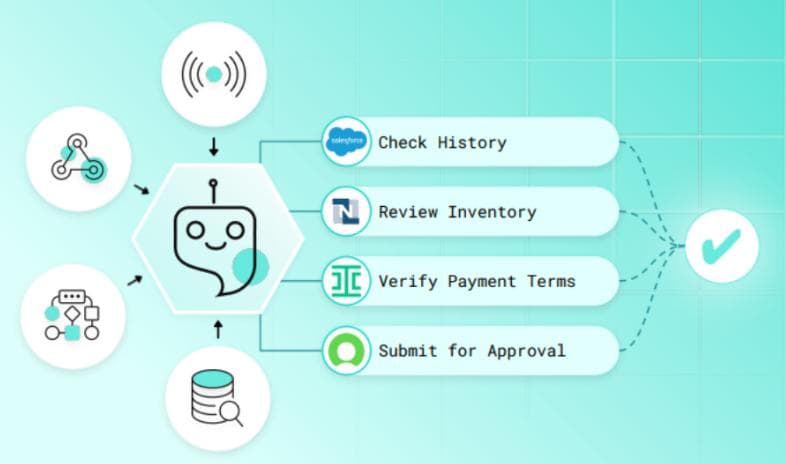 AI Execution
Why AI Execution Systems Will Define the Future of Enterprise Operations
The next frontier of enterprise competitive advantage is not strategy it is execution. AI execution systems that translate strategic intent into coordinated operational action, faster and more reliably than any human-managed process, are becoming the defining infrastructure of enterprise performance in every sector.
 Autonomous Coordination
The Rise of Autonomous Enterprise Coordination Platforms
Enterprise coordination the alignment of people, processes, information, and resources across organisational boundaries has always been expensive, slow, and error-prone when managed through human intermediaries alone. Autonomous coordination platforms powered by AI are replacing the coordination overhead of large organisations with intelligent systems that synchronise the enterprise continuously and without manual intervention.
 AI Agents
How AI Agents Are Transforming Enterprise Workflow Intelligence
AI agents autonomous systems that perceive their environment, reason about objectives, and take action across enterprise workflows are moving from research concept to operational reality. The enterprises deploying AI agents at scale are discovering that workflow intelligence is not just about automation it is about creating organisational capability that compounds with every cycle.