How AI Agents Are Becoming the New Digital Workforce
The enterprise workforce model is undergoing its most significant restructuring since the industrial revolution. The traditional assumptionthat every operational task requires a human employee with a job title, salary, and benefits packageis collapsing under economic pressure that makes human-only workforces uncompetitive at scale. A Fortune 500 company that requires 2,000 customer service representatives to handle inquiry volume that could be processed by 400 human agents coordinating 60 AI workers is not operating efficientlythey are operating with a workforce model designed for 1990 when software could store and retrieve information but could not reason, decide, or act autonomously. The enterprises that are winning in 2026 are those that have rebuilt their workforce architecture around a hybrid model where AI agents handle high-volume execution and human employees focus on judgment, strategy, and relationship management that creates differentiated value.
Manthan Sharma
Author
A global telecommunications provider handles 340,000 customer service interactions monthly across billing inquiries, service changes, technical support, and retention scenarios. The traditional workforce model required 850 customer service representatives working in three shifts to maintain response time and quality targets. Average cost per interaction: $12.40. Quality score (measured by customer satisfaction and first-contact resolution): 78%. Training time for new representatives: 6 weeks before full productivity. Employee turnover: 34% annually. The same provider deployed a hybrid workforce model built around specialized AI agents: a billing agent that handles payment processing, invoice questions, and account updates; a technical support agent that diagnoses common connectivity issues and guides resolution steps; a service change agent that processes plan modifications and feature activations; and a retention agent that detects cancellation risk and offers targeted retention incentives within approved parameters. These AI agents handle 73% of interactions end-to-end without human involvement. The 27% that require human attentioncomplex technical issues, high-value retention scenarios, regulatory escalationsroute to 320 human representatives who now serve as specialists rather than generalists. Average cost per interaction handled by AI workers: $1.80. Average cost per interaction handled by human specialists: $18.20. Blended cost per interaction: $5.76a 54% reduction. Quality score: 82%4 points higher because human specialists handle only cases that require judgment. Training time for new representatives: 2 weeks focused on complex scenarios rather than routine processes. Employee turnover: 19% because representatives find the work more engaging. This is not workforce reductionthis is workforce restructuring around a digital-human hybrid model where AI agents execute routine workflows and humans provide the judgment and relationship management that differentiated service requires.
The Economic Case for the Digital Workforce Model
The shift to AI agents as digital workers is driven by economic reality that makes human-only workforces increasingly unviable for high-volume operational functions. The cost structure is irrefutable: a customer service AI agent that resolves a contained inquiry costs $0.46 versus $4.18 for human handlinga 9x cost advantage. A code review AI agent completes routine PR review for $0.72 versus $48 in senior engineer timea 66x advantage. Organizations deploying AI agents report median time savings of 6.4 hours per knowledge worker per week, with customer service representatives saving 8-9 hours and senior practitioners saving 10-12 hours weekly. The productivity gains are not marginal improvementsthey represent fundamental reallocation of human time from execution to oversight and judgment. Customer service operations report 4.2x productivity gains, code review operations report 3.6x gains, and marketing operations report 3.1x productivity improvements when AI agents handle routine execution while humans focus on complex scenarios.The adoption data demonstrates enterprises recognizing this economic imperative: 97% of executives report deploying AI agents in the past year, 52% of employees are already using AI agents in daily workflows, and 80% of enterprise applications shipped or updated in Q1 2026 embed at least one AI agentup from 33% in 2024. The decision is no longer whether to deploy AI agents as digital workers; the decision is which workflows justify the implementation and governance overhead. Early adopters are seeing clear financial returns: median payback periods are 4.1 months for customer service AI agents, 6.7 months for marketing operations, and 9.3 months for engineering applications. Organizations that achieve positive ROI within 12 monthscurrently 41% of deploymentsshare consistent characteristics: they tie AI agent performance directly to business outcomes rather than activity metrics, they architect platforms that give business teams autonomy while IT retains governance oversight, and they treat AI agent deployment as operational infrastructure rather than experimental technology projects.
Workforce Roles Emerging in the Human-Agent Hybrid Model
The digital workforce model is not eliminating jobsit is restructuring roles around a division of labor where AI agents handle repeatable execution and humans provide oversight, exception handling, strategy, and relationship management. New workforce categories are emerging across enterprises deploying hybrid models. Agent orchestrators design multi-agent workflows, define authority boundaries and escalation rules, and monitor agent performance against operational metricsthese roles combine technical understanding of agent capabilities with deep knowledge of business processes. Exception specialists handle the 15-30% of workflows that exceed agent authority or encounter scenarios outside agent trainingthese roles require judgment, subject matter expertise, and ability to resolve novel situations that agents correctly identify as requiring human intervention. Quality assurance analysts continuously evaluate agent decision patterns, identify drift in output quality, and refine agent training based on exception patterns and customer feedbackthese roles ensure that autonomous execution maintains quality standards as operational conditions evolve.The most significant workforce transformation is the elevation of frontline workers from execution to judgment roles. Customer service representatives in hybrid workforce models no longer handle routine inquiriesthey serve as specialists who resolve complex scenarios that agents escalate, manage high-value customer relationships, and provide the human judgment that differentiated service requires. Operations coordinators no longer spend time manually routing tasks and updating systemsthey monitor exception queues, resolve scenarios where agents encounter conflicting business rules, and optimize workflow orchestration based on performance patterns. According to LinkedIn's 2026 Labor Market Report, employers have created 1.3 million AI-related job opportunities in the past two years including data annotators, AI engineers, and forward-deployed engineersroles that did not exist five years ago but have become essential to digital workforce operations. The workforce model is not humans versus AI agentsit is humans working with AI agents in a restructured operational model where execution scales through automation and human attention focuses on scenarios that genuinely require judgment.
Implementation Patterns for Building Digital Workforce Capability
Enterprises succeeding with digital workforce models follow consistent implementation patterns that differ fundamentally from traditional automation projects. The successful sequence is: identify high-volume workflows where execution currently consumes human capacity but requires limited judgment once process rules are clear, deploy task-specific AI agents with explicitly bounded authority and defined escalation criteria rather than attempting to automate entire job functions, measure the shift in human workload from execution to exception handling and strategic work rather than measuring headcount reduction, and expand digital workforce capability systematically as agent performance and governance frameworks demonstrate stability. The organizations that fail attempt to replace entire job functions with AI agents without first establishing the monitoring, exception handling, and quality assurance infrastructure that makes autonomous execution operationally viable.The governance requirements for digital workforce models are explicit and non-negotiable. Only 21% of enterprises have mature governance frameworks for autonomous AI agents according to Deloitte's 2026 research, and this governance gap is the primary barrier preventing faster adoption. Successful digital workforce implementations establish clear authority boundaries for each agent typea procurement agent can place orders below $10,000 but escalates higher amounts for human approval; a customer service agent can process standard refunds but escalates policy exceptions to human specialists. They implement comprehensive audit trails that make every agent decision transparent for compliance review and performance analysis. They maintain human-on-the-loop monitoring where specialists oversee agent decision patterns and intervene when agents operate near authority boundaries or encounter scenarios requiring judgment. The result is a workforce model where 70-85% of operational execution happens autonomously through AI agents, 15-30% of scenarios escalate to human specialists for judgment and exception handling, and the combined human-agent workforce delivers higher throughput at lower cost than human-only operations while providing better outcomes because humans focus exclusively on work that requires genuine expertise rather than processing routine volume.
Related articles
View all →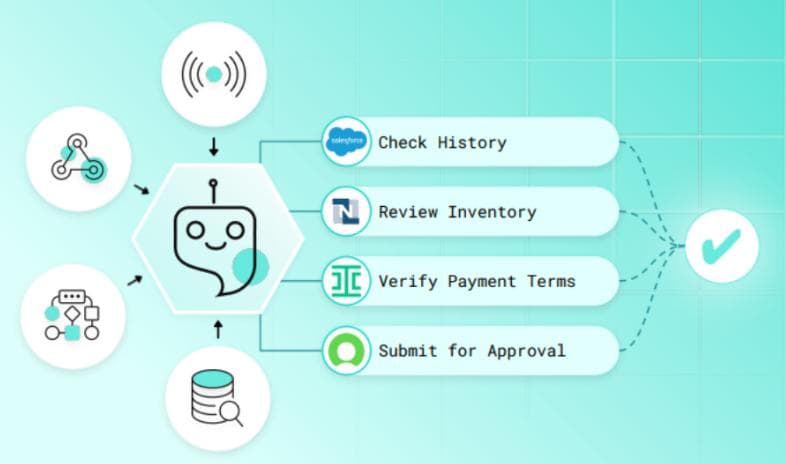 AI Execution
Why AI Execution Systems Will Define the Future of Enterprise Operations
The next frontier of enterprise competitive advantage is not strategy it is execution. AI execution systems that translate strategic intent into coordinated operational action, faster and more reliably than any human-managed process, are becoming the defining infrastructure of enterprise performance in every sector.
 Autonomous Coordination
The Rise of Autonomous Enterprise Coordination Platforms
Enterprise coordination the alignment of people, processes, information, and resources across organisational boundaries has always been expensive, slow, and error-prone when managed through human intermediaries alone. Autonomous coordination platforms powered by AI are replacing the coordination overhead of large organisations with intelligent systems that synchronise the enterprise continuously and without manual intervention.
 AI Agents
How AI Agents Are Transforming Enterprise Workflow Intelligence
AI agents autonomous systems that perceive their environment, reason about objectives, and take action across enterprise workflows are moving from research concept to operational reality. The enterprises deploying AI agents at scale are discovering that workflow intelligence is not just about automation it is about creating organisational capability that compounds with every cycle.