Why Enterprises Need AI Managers, Not Just AI Assistants
The gap between AI assistants and AI managers represents the fundamental constraint preventing most enterprises from scaling AI beyond individual productivity improvements. An AI assistant helps a marketing manager draft campaign copy faster. An AI manager coordinates the entire campaign workflowassigning tasks to execution agents, monitoring progress across creative development and media placement, detecting blockers and automatically reassigning work, validating deliverable quality against brand guidelines, and reporting campaign status to stakeholderswithout requiring the marketing manager to manually coordinate each step. The difference is not capabilityit is scope of authority. Assistants augment individual tasks. Managers orchestrate multi-step workflows across teams and systems. The enterprises achieving operational transformation through AI are those that have shifted from deploying task assistants to deploying workflow managers with the authority to coordinate execution rather than merely suggest next steps.
Manroze
Author
A pharmaceutical R&D organization manages clinical trial coordination across 14 active studies involving 47 research sites, 230 principal investigators, and continuous regulatory compliance requirements. The traditional model required 8 clinical operations managers to coordinate sample collection schedules, monitor enrollment targets, track adverse event reporting, ensure protocol adherence, coordinate site visits, and manage documentation workflows. Each manager spent 60% of their time on coordination overheadsending status requests, chasing missing documentation, updating project trackers, and running weekly alignment meetings. Actual strategic workanalyzing enrollment patterns to optimize site selection, identifying protocol bottlenecks, improving site performance through targeted supportconsumed the remaining 40% when coordination allowed. The organization deployed an AI manager system built around workflow orchestration: the system monitors enrollment data across all sites in real-time, detects sites falling behind target and automatically triggers intervention protocols, coordinates sample logistics by integrating lab capacity with collection schedules, validates documentation completeness and flags missing items before regulatory deadlines, generates status reports for stakeholders and escalates only genuine blockers that require human judgment. The 8 clinical operations managers now spend 20% of their time on coordination overheadhandling the complex scenarios that the AI manager escalatesand 80% on strategic work improving trial design and site performance. Trial enrollment improved by 17% because coordination no longer depended on weekly status meetings to detect problems. Protocol deviation rates dropped by 24% because the AI manager validates adherence continuously rather than through periodic audits. This is why enterprises need AI managers that orchestrate workflows, not just AI assistants that help individuals work faster.
The Coordination Tax That AI Assistants Cannot Solve
The fundamental limitation of AI assistants is that they operate at the individual task level while enterprise value creation happens at the workflow leveland coordination overhead at the workflow level is where most operational inefficiency lives. An AI assistant can help a sales representative draft a follow-up email 5x faster. But the sales workflow requires coordinating outreach sequences, scheduling discovery calls, preparing proposals, routing approvals, updating forecasts, and looping in technical specialistsnone of which the email drafting assistant orchestrates. The sales representative still spends hours per week manually coordinating these handoffs across systems and stakeholders. Research shows that knowledge workers are interrupted every 6-12 minutes on average, requiring 23 minutes to regain focus after each interruption, and context switching between coordination activities consumes 40% of productive time. AI assistants that help individuals complete tasks faster do not reduce coordination overheadthey simply allow individuals to complete their individual task components faster while the workflow-level coordination bottleneck remains unchanged.The economic impact of coordination overhead is massive and largely invisible because enterprises measure individual productivity rather than workflow throughput. A product development team using AI assistants to write code faster, draft documentation faster, and design interfaces faster can ship individual components at higher velocitybut if coordination overhead between engineers, designers, and product managers consumes 6 hours per person per week, the total cycle time improvement is minimal. The workflow bottleneck is not how fast individuals execute their tasksit is how much time they spend coordinating who does what, when, and with what information. Organizations deploying AI managers that orchestrate multi-step workflows report 20-30% faster workflow cycles not because individual tasks execute faster but because coordination overhead between tasks drops dramatically when an AI manager handles task assignment, progress monitoring, blocker detection, and status communication rather than requiring humans to manually coordinate these handoffs through meetings, email threads, and status update requests.
What AI Managers Do That Assistants Cannot
An AI manager operates at a fundamentally different scope than an AI assistant. An assistant responds to prompts from an individual user to complete specific tasks. A manager maintains context across an entire workflow, assigns tasks to appropriate executorswhether human or AI agentsmonitors progress against objectives, detects blockers and initiates corrective action, and escalates only scenarios that require human judgment beyond the manager's authority boundaries. This is not a technical capability differencemodern AI frameworks can support both architectures. This is an authority allocation difference: assistants have no authority to act without human prompting; managers have bounded authority to orchestrate workflows autonomously within defined governance constraints. A procurement AI manager can detect when inventory falls below reorder threshold, evaluate supplier lead times and pricing, generate purchase orders within approved spending limits, route higher-value orders for human approval, track delivery status, and update inventory systemsall without a human initiating each step.The operational implications are profound for enterprises attempting to scale AI beyond individual productivity. Gartner predicts that by 2028, at least 15% of work decisions will be made autonomously by AI agentsbut this prediction assumes enterprises shift from deploying task assistants to deploying workflow managers with decision-making authority. The current reality is that most enterprises have deployed assistants that improve individual task speed but maintain human-coordinated workflows where managers still spend the majority of their time coordinating rather than providing strategic direction. Organizations successfully deploying AI managers report three consistent outcomes: 40-60% reduction in coordination overhead as managers automate task assignment, progress monitoring, and status communication; significant improvement in workflow cycle times because managers detect and resolve blockers faster than periodic human status reviews can identify them; and dramatic shifts in how human managers allocate their timefrom 60-70% coordination to 20-30% coordination with the remaining time available for strategic planning, performance improvement, and relationship management that create differentiated value.
Building the Management Layer: From Task Assistance to Workflow Orchestration
The transition from AI assistants to AI managers requires architectural decisions that most enterprises are unprepared to make because their AI deployment strategy focused on augmenting individual productivity rather than orchestrating workflows. The AI manager architecture requires fundamentally different components: a workflow context layer that maintains state across multi-step processes rather than treating each interaction as independent, an authority framework that defines what decisions the manager can make autonomously versus what requires human escalation, a multi-agent coordination protocol that allows the manager to delegate subtasks to specialized execution agents and integrate their outputs, and comprehensive audit and monitoring infrastructure that makes manager decision-making transparent for governance review. Enterprises attempting to build manager capability on top of assistant architectures encounter fundamental limitations because assistants were not designed to maintain workflow state or coordinate across multiple actors.The implementation pattern for AI managers follows a clear but demanding sequence: identify multi-step workflows where coordination overhead currently consumes significant human management time, map the workflow into discrete decision points and identify which decisions can be made autonomously versus which require human judgment, deploy an AI manager with explicitly bounded authority to orchestrate the workflow within defined governance constraints, measure the reduction in human coordination time and the improvement in workflow cycle time, and expand manager scope systematically as performance demonstrates reliable orchestration. The enterprises that fail attempt to deploy AI managers across multiple workflows simultaneously without first establishing the governance frameworks, exception handling protocols, and monitoring systems that make autonomous workflow orchestration acceptable to risk and compliance teams. The enterprises that succeed start with one high-coordination workflow, prove that manager orchestration reduces cycle time while maintaining quality, and expand to adjacent workflows only when the first deployment demonstrates stable autonomous operation. The strategic advantage of AI managers over AI assistants is not incrementalit is structural: managers that orchestrate workflows eliminate the coordination bottleneck that assistants cannot address, and in doing so they enable enterprises to scale operational throughput beyond what human coordination capacity can support.
Related articles
View all →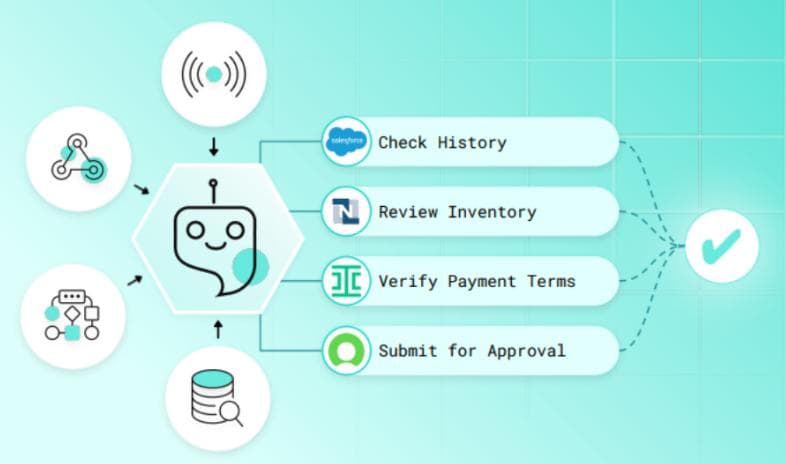 AI Execution
Why AI Execution Systems Will Define the Future of Enterprise Operations
The next frontier of enterprise competitive advantage is not strategy it is execution. AI execution systems that translate strategic intent into coordinated operational action, faster and more reliably than any human-managed process, are becoming the defining infrastructure of enterprise performance in every sector.
 Autonomous Coordination
The Rise of Autonomous Enterprise Coordination Platforms
Enterprise coordination the alignment of people, processes, information, and resources across organisational boundaries has always been expensive, slow, and error-prone when managed through human intermediaries alone. Autonomous coordination platforms powered by AI are replacing the coordination overhead of large organisations with intelligent systems that synchronise the enterprise continuously and without manual intervention.
 AI Agents
How AI Agents Are Transforming Enterprise Workflow Intelligence
AI agents autonomous systems that perceive their environment, reason about objectives, and take action across enterprise workflows are moving from research concept to operational reality. The enterprises deploying AI agents at scale are discovering that workflow intelligence is not just about automation it is about creating organisational capability that compounds with every cycle.