Enterprise AI Is Broken Without Execution Capability
The enterprise AI market has generated hundreds of billions in investment to build systems that can analyze data, generate insights, predict outcomes, and recommend actionsbut the majority of enterprise AI deployments stop at recommendation without closing the loop to execution. An AI system that predicts which customers are likely to churn but requires humans to manually review the predictions, decide on retention strategies, and execute outreach campaigns is not delivering operational value proportional to its capability. The prediction is only valuable if it triggers timely action, and requiring human intermediation between prediction and action introduces delays, inconsistencies, and coordination overhead that destroy much of the AI's potential value. The enterprises achieving transformative ROI from AI are those that have built execution capability into their AI systemsnot just intelligence that recommends but systems that act autonomously within governance boundaries.
Nirmal Nambiar
Author
A retail bank deployed an AI system that analyzes transaction patterns to detect fraud with 94% accuracy and generates risk scores for flagged transactions within seconds of occurrence. In the recommendation-only model, this system sent alerts to a fraud operations team who manually reviewed each case, made approval/decline decisions, contacted customers when needed, and updated case management systems. Average time from detection to resolution: 4.2 hours. False positive rate due to human review inconsistency: 12%. Customer satisfaction with fraud handling: 3.1 out of 5 because legitimate transactions were frequently delayed. The same bank deployed execution capability: the AI system now detects suspicious transactions, evaluates risk based on customer history and transaction context, automatically declines high-risk transactions while authorizing low-risk ones within risk tolerance parameters, sends targeted customer communications explaining the decision and offering immediate appeal options, and escalates only ambiguous cases that fall within the judgment zone to human fraud specialists. Average time from detection to resolution: 47 seconds for automated decisions, 2.1 hours for escalated cases. Overall resolution time dropped 89% because 82% of cases are now resolved autonomously. False positive rate dropped to 3.2% because the AI applies consistent decision criteria. Customer satisfaction improved to 4.6 out of 5 because most fraud blocks now resolve instantly with clear communication. The difference between AI that recommends and AI that executes is not incrementalit is the difference between a system that identifies problems and a system that solves them.
The Recommendation Ceiling: Where Most Enterprise AI Gets Stuck
The majority of enterprise AI deployments are trapped in recommendation mode: they analyze data, generate predictions, surface insights, and suggest actionsbut they require humans to review the outputs and manually execute the recommended steps. This design creates three compounding problems that limit AI value delivery. First, it introduces latency between insight and action: an AI system that detects a supply chain disruption at 3 AM generates recommendations that sit in a queue until humans review them during business hours, by which time the disruption has cascaded through dependent workflows. Second, it creates inconsistency in execution: different humans interpret the same AI recommendation differently based on their experience, risk tolerance, and available context, leading to variable outcomes that undermine the AI's predictive accuracy. Third, it fails to scale: recommendation-only AI creates more work for humansmore alerts to review, more insights to interpret, more recommendations to act uponrather than reducing the operational burden through autonomous execution.The economic data reveals this ceiling clearly: organizations report median AI deployment ROI of just 29% achieving significant returns, and only 23% seeing meaningful ROI from AI agents according to enterprise surveys. The problem is not AI capabilitymodern AI systems can predict, classify, and recommend with high accuracy across most enterprise use cases. The problem is the execution gap: the time, coordination overhead, and inconsistency introduced by requiring human intermediation between AI insight and operational action. Research shows that 88% of AI pilots never reach production, and of those that do, 22% report negative ROI at 12 months. Root cause analysis attributes 41% of these failures to unclear success criteria and 33% to insufficient tool or data accessboth of which are symptoms of AI systems that generate recommendations without the authority or integration to execute actions autonomously. The enterprises breaking through this ceiling are those deploying AI systems with explicit execution capability: bounded authority to take defined actions, direct integration with operational systems to execute without human intermediation, and comprehensive audit trails that make autonomous execution acceptable to governance and compliance teams.
Building Execution Capability: Technical and Organizational Requirements
Adding execution capability to AI systems requires both technical architecture and organizational authorization that most enterprises have not yet established. The technical requirements are explicit: direct API integration with operational systems so AI can execute actions (place orders, update records, send communications, trigger workflows) without requiring humans to manually translate recommendations into system operations; event-driven architecture that allows AI to detect conditions and execute responses in real-time rather than batch-processing recommendations for human review; and comprehensive monitoring and audit infrastructure that logs every autonomous decision for governance review and performance analysis. These technical capabilities existthe barrier is not technology maturity. The barrier is organizational readiness: enterprises must define authority boundaries (which actions can AI execute autonomously versus which require human approval), establish governance frameworks (how autonomous decisions are monitored, audited, and corrected), and allocate accountability (who owns outcomes when AI executes decisions).The implementation pattern for execution-capable AI follows a clear but demanding maturity path: deploy recommendation-only AI to establish baseline accuracy and build organizational trust in AI outputs, instrument the recommendation workflow to identify which AI recommendations humans accept without modificationthese are candidates for autonomous execution, convert high-acceptance recommendations into bounded autonomous workflows where AI can execute directly within defined parameters, maintain human approval gates for recommendations that require judgment or exceed authority thresholds, and expand autonomous execution scope systematically as performance demonstrates reliable operation. Only 21% of enterprises have mature governance frameworks for autonomous agents according to Deloitte research, and this governance gap is the primary organizational barrier preventing faster adoption of execution-capable AI. The enterprises succeeding are those that treat execution capability as a strategic priority requiring governance infrastructure rather than as a technical feature that can be added through configuration. The ROI difference is dramatic: median payback periods for execution-capable AI agents are 4-9 months versus 18-24 months for recommendation-only AI systems, and organizations deploying execution-capable systems report 3-5x higher productivity gains because they eliminate the coordination overhead between AI insight and operational action.
The Strategic Imperative: Execution Capability as Competitive Advantage
The competitive dynamics of enterprise AI are shifting from who has the most sophisticated models to who can deploy those models with execution capability at scale. Two enterprises with equivalent AI prediction accuracyone operating with recommendation-only deployment and one with execution-capable deploymentdeliver fundamentally different business value. The recommendation-only enterprise generates insights that require human review, coordination, and manual execution, maintaining the operational bottleneck that AI was meant to eliminate. The execution-capable enterprise operates with AI systems that detect conditions and execute responses autonomously, eliminating coordination overhead and scaling throughput beyond human capacity constraints. The throughput advantage is structural: execution-capable AI scales with system capacity while recommendation-only AI remains bounded by human review and coordination capacity.The market evidence is unambiguous: organizations achieving significant AI ROI share consistent characteristics including tying AI directly to revenue outcomes rather than activity metrics and architecting platforms that execute actions autonomously while maintaining governance oversight. Gartner predicts that by 2028, at least 15% of work decisions will be made autonomously by AI agents, up from virtually 0% in 2024, and that 40% of enterprise applications will feature task-specific AI agents by 2026. These predictions assume enterprises shift from recommendation-only deployments to execution-capable systemsa transition that requires governance frameworks, technical architecture, and organizational authorization that most enterprises have not yet established. The window of competitive advantage is now: enterprises that build execution capability into their AI systems in 2026-2027 will operate with autonomous execution models that create structural cost and speed advantages over competitors still operating with recommendation-only AI that requires human coordination. The strategic question is not whether to add execution capability to enterprise AIit is whether to do so fast enough to capture the competitive advantage before execution-capable AI becomes the baseline expectation for operational efficiency.
Related articles
View all →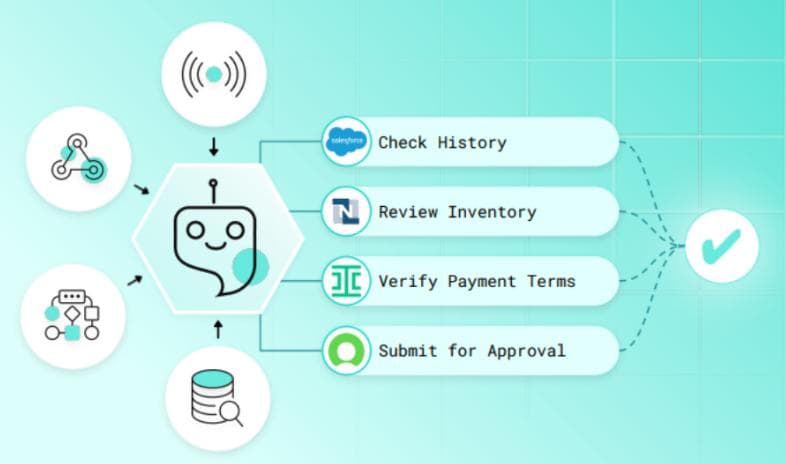 AI Execution
Why AI Execution Systems Will Define the Future of Enterprise Operations
The next frontier of enterprise competitive advantage is not strategy it is execution. AI execution systems that translate strategic intent into coordinated operational action, faster and more reliably than any human-managed process, are becoming the defining infrastructure of enterprise performance in every sector.
 Autonomous Coordination
The Rise of Autonomous Enterprise Coordination Platforms
Enterprise coordination the alignment of people, processes, information, and resources across organisational boundaries has always been expensive, slow, and error-prone when managed through human intermediaries alone. Autonomous coordination platforms powered by AI are replacing the coordination overhead of large organisations with intelligent systems that synchronise the enterprise continuously and without manual intervention.
 AI Agents
How AI Agents Are Transforming Enterprise Workflow Intelligence
AI agents autonomous systems that perceive their environment, reason about objectives, and take action across enterprise workflows are moving from research concept to operational reality. The enterprises deploying AI agents at scale are discovering that workflow intelligence is not just about automation it is about creating organisational capability that compounds with every cycle.