The Rise of Autonomous Enterprise Operations
The enterprise is experiencing a fundamental shift in how operational work gets executed. The model where humans make every operational decision, coordinate every cross-system workflow, and execute every process step is reaching its operational ceiling. A Fortune 500 manufacturing company that employs 800 operations managers to coordinate workflows across 47 enterprise systems is not running an efficient operationthey are running a coordination bottleneck where human decision-making capacity has become the constraint on operational throughput. The enterprises winning in 2026 are those that have shifted from human-coordinated operations to autonomous execution systems where AI agents handle routine operational decisions, coordinate cross-system workflows, and escalate only genuine exceptions that require human judgment.
Nirmal Nambiar
Author

A global logistics provider manages 2,400 daily shipments across 18 countries with real-time coordination requirements across customs systems, carrier APIs, warehouse management platforms, and customer communication channels. In the human-coordinated model, this required 140 operations coordinators working in shifts to monitor dashboards, interpret alerts, make routing decisions, coordinate exception handling, and communicate status updates. Average response time to operational disruptions: 47 minutes. Cost per shipment in coordination overhead: $8.20. Error rate from manual handoffs: 3.2%. The same logistics provider deployed an autonomous operations system built on specialized AI agents: a routing agent that optimizes shipment paths based on real-time carrier capacity and customs queue data, an exception handling agent that detects delays and automatically rebooks or reroutes affected shipments, a compliance agent that validates documentation and flags regulatory issues before they become clearance delays, and a communication agent that updates customers and internal teams with context-specific information. The autonomous system handles 89% of operational decisions without human input. Average response time to disruptions: 4 minutes. Cost per shipment in coordination overhead: $1.30. Error rate: 0.7%. The 140 operations coordinators were redeployed to strategic planning, carrier relationship management, and handling the 11% of scenarios that require genuine human judgment. This is not process improvement. This is the rise of autonomous enterprise operationsand it is fundamentally reshaping how enterprises execute at scale.
From Human Coordination to Autonomous Execution: What Changed
The shift to autonomous operations is enabled by three converging capabilities that reached production maturity in 2025-2026: AI agents that can maintain operational context across multiple systems and make decisions based on business rules and real-time data rather than static if-then logic, orchestration frameworks that allow multiple specialized agents to coordinate workflows and hand off tasks without human intermediation, and governance architectures that enforce decision boundaries and audit trails that make autonomous execution acceptable to enterprise risk and compliance teams. The technical maturity is now sufficient for production deployment at enterprise scale. According to Deloitte research, the autonomous AI market is growing at a 53% compound annual growth rate, expanding from $8.5 billion in 2026 to a projected $45 billion by 2030. IDC forecasts that the global population of actively deployed AI agents will surpass 1 billion by 2029a 40x increase over 2025 levelsunderscoring the rapid transition to autonomous enterprise operations. This is not speculative technology. This is operational infrastructure being deployed across manufacturing, logistics, and defense sectors where autonomous vehicles, robotics, and drones are already reshaping how work gets executed.The operational case for autonomous execution is compelling at enterprise scale. Organizations deploying autonomous operations report three consistent outcomes: 20-30% faster workflow cycles as agents eliminate the coordination overhead between human decision-makers, significant cost reductions in back-office operations where routine decision-making previously required human attention, and dramatic improvements in exception handling speed where autonomous agents detect and respond to operational disruptions faster than human monitoring teams can identify them in dashboard interfaces. The most sophisticated implementations employ multi-agent systems where specialized agents handle distinct operational domainsrouting, compliance, communication, exception handlingand coordinate through clearly defined handoff protocols. These systems have demonstrated 40-60% efficiency gains in enterprise applications by distributing responsibilities and enabling parallel processing of operational tasks that previously required sequential human coordination. The economic advantage is structural: enterprises operating with autonomous execution systems have operational throughput that scales with system capacity rather than with headcount, while human-coordinated enterprises remain constrained by the number of decisions their operations teams can make per hour.
Operational Domains Being Transformed by Autonomous Agents
The autonomous operations transformation is not uniform across enterprise functionsit is concentrated in operational domains where high decision volume, structured decision criteria, and real-time execution requirements create maximum value from autonomous execution. Supply chain and logistics operations are experiencing the most aggressive adoption: autonomous agents handle shipment routing, carrier selection, exception management, and real-time rescheduling based on disruptions or capacity changes. Manufacturing operations are deploying autonomous agents for production scheduling, quality monitoring, equipment maintenance triggering, and inventory optimization across multi-site operations. Customer service operations are moving beyond chatbots to autonomous agents that resolve entire support workflowsdetecting issues, pulling customer context from multiple systems, executing resolution steps, and updating relevant databases without human involvement except for complex escalations. Financial operations are using autonomous agents for invoice processing, payment approvals within threshold limits, compliance verification, and month-end close processes that previously required coordination across accounting teams.What makes these deployments successful is operational specificity: enterprises are not deploying general-purpose AI that attempts to handle all operational decisions. They are deploying task-specific agents with clearly defined authority boundaries, explicit escalation rules, and comprehensive audit trails. Gartner predicts that 40% of enterprise applications will feature task-specific AI agents by 2026, up from less than 5% in 2025. The emphasis is on task-specific rather than general-purpose autonomy. An autonomous procurement agent has authority to place purchase orders below $10,000 based on inventory triggers and approved vendor lists but escalates higher-value orders for human approval. An autonomous compliance agent can validate standard documentation and flag non-compliant submissions but escalates unusual regulatory scenarios for legal review. This bounded autonomy model allows enterprises to gain the throughput benefits of autonomous execution while maintaining governance controls that satisfy risk management and audit requirements. The result is operational systems where 85-95% of routine decisions execute autonomously and humans focus exclusively on the scenarios that require judgment, relationship management, or strategic consideration.
Building Enterprise Operations for the Autonomous Era
Transitioning to autonomous operations requires architectural decisions that most enterprises are unprepared to make because their operational infrastructure was designed for human-coordinated workflows. The autonomous operations architecture has fundamentally different requirements: event-driven systems that trigger agent action based on operational conditions rather than scheduled batch processing or human-initiated workflows, unified data infrastructure that provides real-time operational context across all systems rather than data warehouses that consolidate information hours or days after events occur, and orchestration platforms that coordinate multi-agent workflows and enforce governance rules directly in the execution layer rather than through manual approval processes. Legacy operational systems cannot support autonomous execution at scale because they were built on the assumption that humans would interpret data and initiate action. The technical debt accumulated in human-coordinated operational stacks is the primary barrier preventing most enterprises from deploying autonomous agents in production environments.The implementation pattern for successful autonomous operations transformations follows a consistent sequence: identify high-volume, rule-based operational workflows where human decision-making is currently the throughput constraint, deploy task-specific agents with clearly bounded authority and explicit escalation criteria, measure the reduction in cycle time, error rate, and coordination overhead against the human-coordinated baseline, and expand to adjacent workflows only when the first deployment demonstrates stable autonomous execution at scale. The enterprises that fail attempt to deploy autonomous agents across multiple operational domains simultaneously without first establishing governance frameworks, exception handling protocols, and measurement systems. The enterprises that succeed start with one operational workflow, prove the model, and expand systematically. By 2026, IDC expects AI copilots to be embedded in nearly 80% of enterprise workplace applications, reshaping how teams work, decide, and execute. The question is not whether autonomous operations will replace human-coordinated workflows. The question is which enterprises will transition quickly enough to maintain competitive operational costs in an environment where autonomous execution is becoming the baseline expectation for operational efficiency.

Related articles
View all →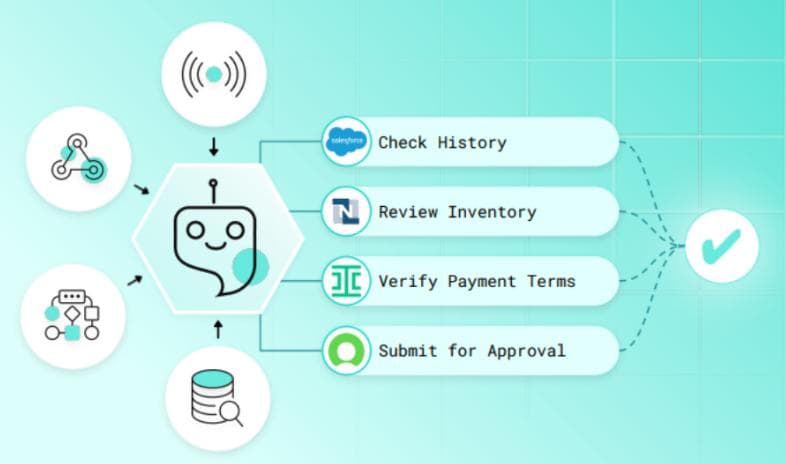 AI Execution
Why AI Execution Systems Will Define the Future of Enterprise Operations
The next frontier of enterprise competitive advantage is not strategy it is execution. AI execution systems that translate strategic intent into coordinated operational action, faster and more reliably than any human-managed process, are becoming the defining infrastructure of enterprise performance in every sector.
 Autonomous Coordination
The Rise of Autonomous Enterprise Coordination Platforms
Enterprise coordination the alignment of people, processes, information, and resources across organisational boundaries has always been expensive, slow, and error-prone when managed through human intermediaries alone. Autonomous coordination platforms powered by AI are replacing the coordination overhead of large organisations with intelligent systems that synchronise the enterprise continuously and without manual intervention.
 AI Agents
How AI Agents Are Transforming Enterprise Workflow Intelligence
AI agents autonomous systems that perceive their environment, reason about objectives, and take action across enterprise workflows are moving from research concept to operational reality. The enterprises deploying AI agents at scale are discovering that workflow intelligence is not just about automation it is about creating organisational capability that compounds with every cycle.