The Rise of Intelligent Business Operations at Scale
Scaling a business used to mean scaling headcount. Intelligent operations combining AI, automation, and real-time data are changing this equation, allowing enterprises to grow output without proportional growth in operational cost.
Nirmal Nambiar
Author

The unit economics of scaling a business have historically followed a predictable pattern. Revenue grows. Headcount grows to support the revenue. Operational complexity grows as the organisation gets larger. And at some point, the cost of managing the complexity of a larger organisation begins to erode the margin gains from scale. Intelligent operations change this pattern by replacing the linear relationship between revenue growth and headcount growth with a more favourable ratio. When AI systems handle routine operational tasks, automated workflows replace manual coordination, and real-time intelligence replaces periodic reporting-driven management, the operational capacity of a given team grows significantly before additional headcount is required. The enterprise that has built intelligent operations infrastructure is not just more efficient at its current scale it has a fundamentally different growth economics: the ability to scale revenue faster than operational cost, compressing the break-even point for growth investments and expanding the margin available for reinvestment.
The Components of Intelligent Operations at Scale
Intelligent operations at scale rest on three foundational components. The first is process automation that handles routine, rule-based operational tasks without human intervention. Order processing, invoice reconciliation, inventory replenishment triggers, customer communication workflows, compliance reporting processes that in a traditional operation consume significant manual effort at volume can be automated to handle unlimited volume with consistent quality and no incremental labour cost. The second component is AI-powered exception management: systems that identify when automated processes encounter situations outside their defined parameters and route those exceptions to human operators with the context required to resolve them efficiently.The third component is operational intelligence: real-time visibility into operational performance across all functions, with AI-powered analysis that surfaces the insights and recommendations most relevant to the decisions the operations team needs to make. The combination of these three components creates an operational model where routine operations run autonomously, exceptions are handled efficiently, and operational management focuses on improvement and strategy rather than execution and coordination.
Intelligent Operations Applications by Operational Domain
Customer Operations: Scaling Service Without Scaling Headcount
Customer operations is the domain where the intelligent operations model delivers the most visible impact on growth economics. A customer service function scaling linearly with customer volume requires proportional headcount growth each new cohort of customers requires additional agents to service them. An intelligent customer operations model combining AI-powered self-service for routine queries, intelligent routing of complex queries to the right human agents, and AI-assisted resolution for agents handling escalations can support significantly larger customer volumes with a sub-linear increase in headcount. The ratio of customers to service agents that an intelligent operations model can support versus a traditional model is typically two to four times higher representing a direct improvement in the unit economics of customer growth.
Supply Chain Operations: From Reactive to Autonomous
Supply chain operations in a traditional model are reactive: the operations team responds to stockouts, supplier delays, demand spikes, and logistics failures as they occur. In an intelligent operations model, AI systems monitor all relevant signals continuously, predict disruptions before they materialise, and trigger mitigation responses automatically within defined parameters. Purchase orders generated automatically when inventory reaches reorder points. Alternative supplier routes activated when primary supplier delivery risk exceeds thresholds. Demand forecast updates triggered in real time when sales velocity signals deviation from plan. The result is a supply chain that operates with significantly higher resilience and efficiency than a human-managed equivalent at a cost structure that does not scale linearly with volume.
Intelligent Operations Scale Readiness Questions
- What is the current ratio of operational headcount to revenue and how has this ratio changed as the business has grown over the last two years?
- Which operational processes in your business currently require the most manual effort at volume and are automation solutions available for those processes?
- What percentage of customer service interactions are currently resolved without human intervention and what would be required to increase this to 60 to 70 percent?
- Do your operational systems generate alerts when performance deviates from expected parameters or does deviation discovery depend on periodic manual review?
- What is your current cost per operational transaction in your highest-volume processes and what automation investment would be required to reduce this cost by 30 to 50 percent?

Related articles
View all →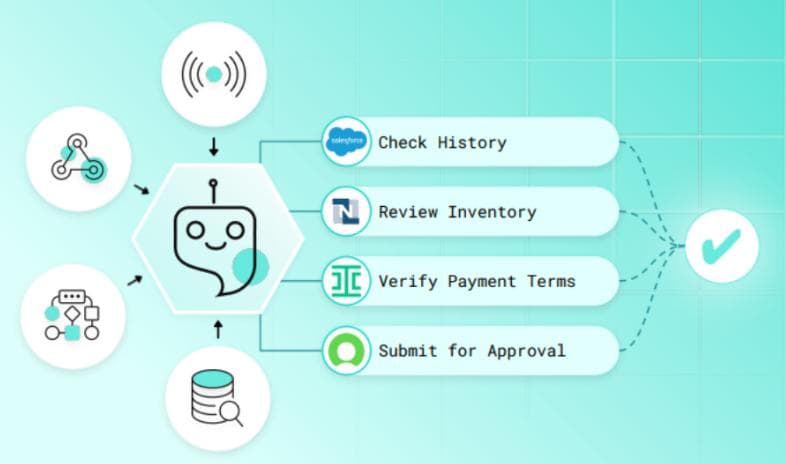 AI Execution
Why AI Execution Systems Will Define the Future of Enterprise Operations
The next frontier of enterprise competitive advantage is not strategy it is execution. AI execution systems that translate strategic intent into coordinated operational action, faster and more reliably than any human-managed process, are becoming the defining infrastructure of enterprise performance in every sector.
 Autonomous Coordination
The Rise of Autonomous Enterprise Coordination Platforms
Enterprise coordination the alignment of people, processes, information, and resources across organisational boundaries has always been expensive, slow, and error-prone when managed through human intermediaries alone. Autonomous coordination platforms powered by AI are replacing the coordination overhead of large organisations with intelligent systems that synchronise the enterprise continuously and without manual intervention.
 AI Agents
How AI Agents Are Transforming Enterprise Workflow Intelligence
AI agents autonomous systems that perceive their environment, reason about objectives, and take action across enterprise workflows are moving from research concept to operational reality. The enterprises deploying AI agents at scale are discovering that workflow intelligence is not just about automation it is about creating organisational capability that compounds with every cycle.