Why Enterprise Leaders Must Adopt AI-Driven Operational Intelligence
Operational intelligence the real-time, comprehensive understanding of what is happening across an enterprise and why has always been the foundation of effective leadership. AI is making a quality of operational intelligence available to enterprise leaders that was previously impossible to achieve, and the leaders who adopt it are making fundamentally better decisions than those who do not.
Manroze
Author
The quality of leadership decisions is directly bounded by the quality of the operational intelligence that informs them. A CEO making resource allocation decisions based on last month's management report is making decisions about a business that existed 30 days ago. A COO responding to operational problems identified in a weekly exception report is managing consequences that were set in motion a week before they became visible. The operational intelligence available to most enterprise leaders filtered through management layers, delayed by reporting cycles, and limited by the cognitive bandwidth of the human teams that assemble it is structurally insufficient for the speed and complexity of the environments they are leading. AI-driven operational intelligence changes this constraint fundamentally: providing enterprise leaders with a comprehensive, current, and continuously updated picture of their entire operational reality across all functions, geographies, and dimensions of performance simultaneously that was not achievable at any cost with human-managed intelligence systems. The leaders who adopt AI-driven operational intelligence are not just better informed they are leading differently, because the quality and currency of the information available to them enables decisions that their less-informed counterparts cannot make.
The Information Gap That AI Operational Intelligence Closes
The information gap in enterprise leadership is not primarily a technology problem it is an architectural problem. The information that enterprise leaders need to make good decisions exists somewhere in their organisation: in operational systems, in customer interactions, in financial transactions, in employee behaviour, and in external signals. The problem is not the absence of information but the absence of an intelligence layer that synthesises this information into the current-state picture that leadership decisions require, at the speed that operational conditions change, without the filtering and delay that human-mediated reporting introduces.Human-mediated reporting the process through which operational data is collected, aggregated, interpreted, and communicated by management layers before it reaches senior leaders introduces three systematic distortions. First, latency: information that is 30 days old is not current operational intelligence; it is history. Second, selectivity: the information that reaches senior leaders through human reporting is a curated selection of what intermediaries believed was important, filtered by the political and organisational dynamics that affect what people choose to report. Third, aggregation loss: summary reports that present aggregate performance metrics lose the granular detail that reveals the underlying causes of performance patterns and the specific interventions that would improve them. AI operational intelligence eliminates all three distortions simultaneously.
Four Dimensions of AI-Driven Operational Intelligence That Transform Leadership
Dimension 1: Comprehensive real-time operational awareness
AI operational intelligence systems provide enterprise leaders with a continuously updated picture of their entire operational reality financial performance, customer experience, supply chain status, workforce dynamics, and competitive position in real time rather than in periodic reports. This comprehensive awareness does not replace the judgment that leaders must apply to the information; it provides a foundation of current, complete information that makes that judgment more reliable. Leaders with comprehensive real-time operational awareness identify problems earlier, respond to opportunities faster, and make resource allocation decisions with a more accurate picture of operational reality than those relying on periodic reporting from human management layers.
Dimension 2: Causal intelligence that explains performance patterns
The difference between operational data and operational intelligence is causality: data tells you what happened; intelligence tells you why it happened and what it means for what will happen next. AI operational intelligence systems analyse performance patterns across the full breadth of available data to identify the causal relationships that explain current performance why revenue in a specific market is below plan, which operational variables are driving the cost increase in a specific function, what customer behaviour pattern is predicting the churn trend that is developing. This causal intelligence allows leaders to intervene at the root cause rather than the symptom a qualitatively more effective leadership approach that is made possible by the analytical depth that AI systems can apply to operational data.
Dimension 3: Predictive foresight about emerging conditions
AI operational intelligence systems do not just describe current operational reality they predict how current conditions are developing, what risks are emerging, and what opportunities are forming before they become visible in lagging performance metrics. A leader who knows that a customer segment is showing early churn signals three months before it appears in retention statistics can intervene while intervention is still effective. A leader who knows that a supply disruption is developing six weeks before it affects production can source alternatives without crisis-driven expediting costs. Predictive foresight is the leadership capability that AI operational intelligence most directly enables and it is the capability that most consistently produces the best return on intelligence investment.
Dimension 4: Decision support that accelerates and improves judgment
AI operational intelligence systems do not just provide leaders with better information they support the decision process by identifying the options available, quantifying the likely outcomes of each option based on operational data and historical patterns, and flagging the risks and uncertainties that the decision-maker should weight. This decision support capability does not replace leadership judgment the values, priorities, and contextual knowledge that define good leadership decisions remain human inputs that AI cannot replicate. But it significantly improves the quality and speed of that judgment by ensuring that it is applied to a comprehensive, accurate, and analytically processed picture of the decision context rather than an incomplete and potentially distorted one.
AI Operational Intelligence Adoption Diagnostic for Enterprise Leaders
- What is the current lag between a significant operational event occurring in your enterprise and your awareness of it as a senior leader? The lag is a direct measure of the operational intelligence gap that AI systems can close and a quantification of the decisions you are making based on information that does not reflect current operational reality.
- How comprehensive is the operational picture available to you at any given moment across all functions, geographies, and performance dimensions simultaneously? The dimensions of operational reality that are not continuously visible are the blind spots that create strategic risk.
- Do you currently have access to causal intelligence analytical explanations of why performance patterns are developing or primarily descriptive reporting that shows what is happening without explaining the underlying drivers? The absence of causal intelligence is the primary reason that management responses to performance problems are frequently ineffective.
- How much of your leadership time is currently consumed by seeking information attending status meetings, requesting reports, and asking management layers for updates versus applying judgment to a complete information picture that is already available? The time spent seeking information is the overhead cost of your current intelligence model.
- Do you have predictive operational intelligence early warning of emerging risks and opportunities based on leading indicators or are you primarily managing conditions that are already fully developed by the time they reach your awareness? The difference between leading and lagging intelligence is the difference between proactive and reactive leadership.
- How does the operational intelligence available to you compare to what the most analytically sophisticated leaders in your competitive landscape have access to? The intelligence gap is a decision quality gap that compounds over time into a strategic performance gap and the urgency of closing it is proportional to the pace of AI operational intelligence adoption among your most capable competitors.

The Enterprise Operating Model After the Rise of Autonomous AI
Related articles
View all →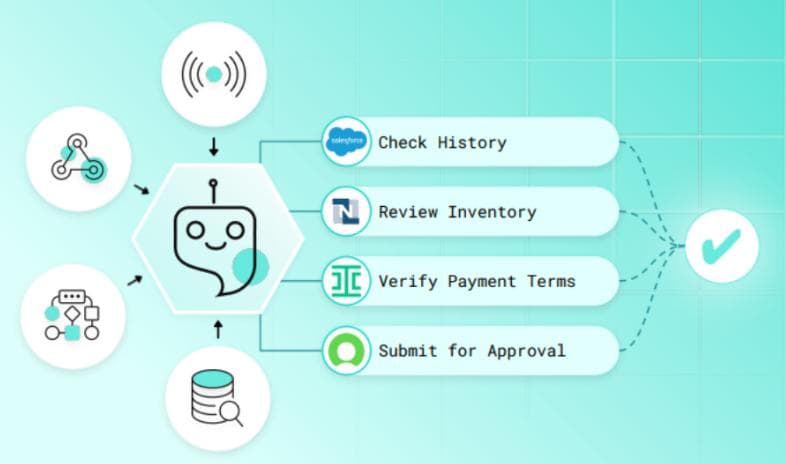 AI Execution
Why AI Execution Systems Will Define the Future of Enterprise Operations
The next frontier of enterprise competitive advantage is not strategy it is execution. AI execution systems that translate strategic intent into coordinated operational action, faster and more reliably than any human-managed process, are becoming the defining infrastructure of enterprise performance in every sector.
 Autonomous Coordination
The Rise of Autonomous Enterprise Coordination Platforms
Enterprise coordination the alignment of people, processes, information, and resources across organisational boundaries has always been expensive, slow, and error-prone when managed through human intermediaries alone. Autonomous coordination platforms powered by AI are replacing the coordination overhead of large organisations with intelligent systems that synchronise the enterprise continuously and without manual intervention.
 AI Agents
How AI Agents Are Transforming Enterprise Workflow Intelligence
AI agents autonomous systems that perceive their environment, reason about objectives, and take action across enterprise workflows are moving from research concept to operational reality. The enterprises deploying AI agents at scale are discovering that workflow intelligence is not just about automation it is about creating organisational capability that compounds with every cycle.