Why Fortune 500 Enterprises Are Moving Toward Autonomous Workflow Systems
The largest enterprises in the world are deploying autonomous workflow systems not as experiments but as core operational infrastructure. The early results are redefining what enterprise operational efficiency looks like and the gap between adopters and non-adopters is widening faster than most industry observers expected.
Manroze
Author

When JPMorgan Chase deployed its COIN contract intelligence platform to review commercial loan agreements, the system completed in seconds work that previously consumed 360,000 hours of lawyer and loan officer time annually. When Amazon deployed its autonomous replenishment systems to manage inventory across its fulfilment network, it reduced out-of-stock rates while simultaneously reducing excess inventory carrying costs an outcome that manual inventory management at Amazon's scale could not achieve. When Siemens deployed autonomous process control systems in its manufacturing facilities, it achieved energy efficiency improvements that no team of human operators, however skilled, could have sustained continuously across all variables simultaneously. These are not pilot programmes or innovation showcase projects. They are core operational infrastructure that these enterprises depend on daily and that have produced competitive advantages so significant that competitors are now investing urgently to close the gap. The Fortune 500 adoption of autonomous workflow systems is accelerating for a straightforward reason: the enterprises that have deployed them are demonstrating performance outcomes that enterprises without them cannot match. In industries where operational efficiency is a primary source of competitive advantage, this performance gap is existential.
The Performance Gap Between Autonomous and Manual Workflow Operations
The performance differential between autonomous workflow systems and human-managed equivalents is becoming quantifiable across enough deployments to identify consistent patterns. In financial operations, enterprises deploying autonomous invoice processing and payment reconciliation are reporting cost-per-transaction reductions of 60 to 80% compared to manual processing, with error rates approaching zero compared to 1 to 3% in manual operations. In supply chain operations, autonomous demand sensing and replenishment systems are delivering 20 to 30% reductions in inventory carrying costs alongside 15 to 25% improvements in service levels an outcome combination that manual supply chain management consistently fails to achieve because the two objectives are in tension and human managers cannot optimise both simultaneously across thousands of SKUs. In customer service operations, autonomous tier-1 resolution systems are handling 60 to 80% of enquiry volume without human involvement, with customer satisfaction scores for autonomous resolutions matching or exceeding those for human-handled resolutions for the enquiry types within the autonomous system's competence.The competitive implications of these performance differentials are significant and increasingly visible. An enterprise with autonomous financial operations processing invoices at $2 per transaction is competing against an enterprise processing at $14 per transaction a cost structure difference that, at scale, represents hundreds of millions of dollars of annual operating cost advantage. An enterprise with autonomous supply chain management carrying 25% less inventory for the same service level has a working capital advantage over its manual-management competitor that funds additional growth investment. These are not marginal efficiency gains they are structural competitive advantages that compound over time as autonomous systems improve through operational learning and as the enterprises that have not adopted them fall further behind in operational efficiency.
The Four Autonomous Workflow Investments Driving Fortune 500 Competitive Advantage
Investment 1: Autonomous financial operations platforms
Leading Fortune 500 enterprises are deploying autonomous financial operations platforms that handle the full procure-to-pay and order-to-cash cycles with minimal human involvement from purchase requisition to supplier payment, and from customer order to revenue recognition. These platforms combine intelligent document processing for invoice and contract handling, AI decision models for approval routing and exception resolution, and RPA execution for system updates and payment processing. The financial operations function in these enterprises is transitioning from a high-headcount transaction processing organisation to a small team of financial intelligence professionals who oversee the autonomous systems, manage the exceptions they escalate, and focus on the strategic financial analysis that creates business value.
Investment 2: Autonomous supply chain sensing and response
Fortune 500 supply chain leaders are deploying autonomous sensing and response systems that continuously monitor supplier performance, demand signals, inventory levels, and logistics status and automatically execute the replenishment, rerouting, and risk mitigation decisions that keep the supply chain operating optimally without waiting for human review cycles. These systems are producing the most significant competitive advantages in industries where supply chain performance is directly linked to customer satisfaction and revenue: retail, consumer goods, automotive, and electronics, where the ability to sense and respond to demand and supply signals faster than competitors directly determines market share.
Investment 3: Autonomous customer experience management
The most customer-centric Fortune 500 enterprises are deploying autonomous customer experience management systems that monitor every customer interaction across every channel, detect experience failures and satisfaction risks in real time, and automatically execute intervention and recovery actions that prevent or mitigate negative outcomes. These systems handle the tier-1 to tier-2 customer interaction volume autonomously, escalating to human agents only the interactions that require empathy, judgment, or authority levels beyond autonomous system capability. The result is a customer experience operation that is simultaneously less expensive and higher quality than the human-staffed equivalent because autonomous systems apply best-practice resolution approaches consistently and never have a bad day.
Investment 4: Autonomous compliance and risk monitoring
In regulated industries financial services, pharmaceuticals, healthcare, and energy compliance monitoring is a significant operational cost and a significant risk exposure. Fortune 500 enterprises in these industries are deploying autonomous compliance monitoring systems that continuously scan transactions, communications, and operational records for compliance violations and risk exposures replacing the sampling-based compliance monitoring that characterises manual compliance operations with continuous 100% coverage. The combination of higher coverage and faster detection that autonomous compliance monitoring provides is reducing regulatory risk exposure while simultaneously reducing the compliance operations cost a combination that manual compliance management cannot achieve.
The Autonomous Workflow Competitive Gap Diagnostic
- Have you benchmarked your operational performance in finance, supply chain, customer service, and compliance against the best-in-class performance that leading autonomous workflow adopters are achieving and quantified the competitive gap?
- Do you have a strategic roadmap for autonomous workflow adoption that addresses your highest-cost and highest-risk operational processes within a timeframe that prevents the competitive gap from becoming irreversible?
- Have you assessed the technology infrastructure readiness for autonomous workflow deployment system integration architecture, data quality, process documentation, and security governance and identified the gaps that must be closed before autonomous systems can operate effectively?
- Is your enterprise governance framework aligned with autonomous workflow operations with audit, accountability, and regulatory compliance mechanisms designed for autonomous system decisions rather than human decisions?
- Have you engaged your board and senior leadership on the strategic imperative of autonomous workflow adoption framing it not as an IT efficiency initiative but as a competitive strategy with time-sensitive implications for the enterprise's long-term position?

Super Manager AGI and the Evolution of Enterprise Execution Platforms
Related articles
View all →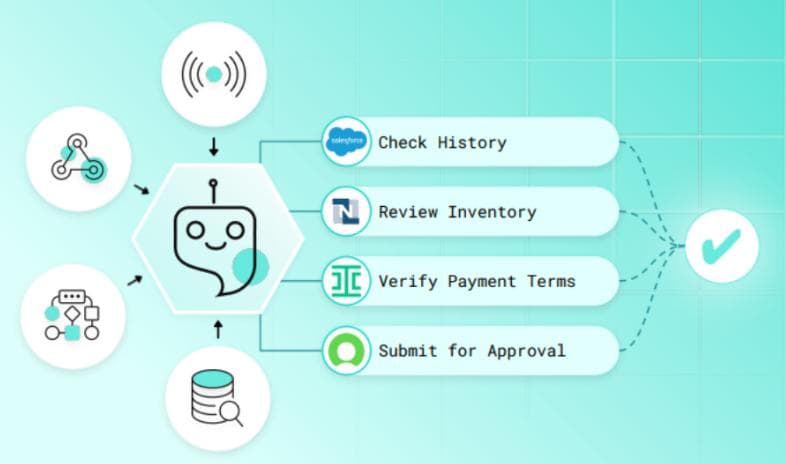 AI Execution
Why AI Execution Systems Will Define the Future of Enterprise Operations
The next frontier of enterprise competitive advantage is not strategy it is execution. AI execution systems that translate strategic intent into coordinated operational action, faster and more reliably than any human-managed process, are becoming the defining infrastructure of enterprise performance in every sector.
 Autonomous Coordination
The Rise of Autonomous Enterprise Coordination Platforms
Enterprise coordination the alignment of people, processes, information, and resources across organisational boundaries has always been expensive, slow, and error-prone when managed through human intermediaries alone. Autonomous coordination platforms powered by AI are replacing the coordination overhead of large organisations with intelligent systems that synchronise the enterprise continuously and without manual intervention.
 AI Agents
How AI Agents Are Transforming Enterprise Workflow Intelligence
AI agents autonomous systems that perceive their environment, reason about objectives, and take action across enterprise workflows are moving from research concept to operational reality. The enterprises deploying AI agents at scale are discovering that workflow intelligence is not just about automation it is about creating organisational capability that compounds with every cycle.